lunedì 20 giugno 2016

Lasagne per la Festa del Papà! / Father's Day Lasagne!


Lo strutto casereccio: prima ...
Homemade lard: before ...

... e dopo.
... and after.

’O rraù napulitano comincia a pipiare! Pipierà per tre ore in più
The Neapolitan ragù begins to "peep"! It will "peep" for three more hours.


Oltre ad essere uno dei più bravi produttori della pasta industriale del mondo, De Cecco fa sfoglie di lasagne che si adattano PERFETTAMENTE in una teglia standard da forno (33 x 40).
Besides being of the finest makers of machine-made pasta in the world, De Cecco makes lasagne sheets that fit PERFECTLY in a standard oven pan (13 x 16)

N.B.: Tutti gli ingredienti seguenti si aggiungono freddi, o almeno a temperatura ambiente. Niente deve essere caldo. Tutto si può fare un giorno o due in anticipo, tranne le sfoglie di lasagne che si devono fare al momento. Quattro minuti in abbondante acqua salata bollente (girandole sempre!), poi subito in una ciotola di acqua freddissima, cosicché le possiate toccare (e per fermare la cottura).  Note: All of the following ingredients are added cold, or at least at room temperature. Nothing must be hot. You can do everything a day or two ahead, except for the lasagne sheets, which you must make at the moment. Four minutes in abundant salted water (stirring constantly!), then immediately in a bowl of very cold water, so that you can handle them (and also to stop the cooking process).

Passo I°: Ungete la teglia con lo strutto.
Step 1: Grease the pan with lard.

Passo II°: Rraù
Step 2: Sauce

Passo III°: Sfoglie di lasagne
Step 3: Lasagne sheets

Passo IV°: Ricotta (ricotta di vaccina*, pecorino & parmigiano freschi, noce moscata fresca, prezzemolo fresco dall’orto, sale & pepe frescamente macinati) (* = Purtroppo la ricotta di pecora non si trova qua in America.)
Step 4: Ricotta (cow's milk* ricotta, fresh pecorino & parmigiano, fresh nutmeg, fresh parsley from the garden, freshly ground salt & pepper)(*=Unfortunately sheep's milk ricotta is not available here in America.)

Passo V°: Carni macinate (manzo & maiale macinati – potete aggiungere vitello – saltati in padella con strutto, aglio, cipolla, sale, pepe e timo fresco dall'orto)
Step 5: Ground meats (ground beef & pork – you can add veal – sautéed in a skillet with lard, garlic, onion, salt, pepper, and fresh thyme from the garden)

Passo VI°: Spinaci giovani, saltati con strutto, aglio & peperoncino rosso dolce
Step 6: Baby spinach, sautéed in lard, garlic, & sweet chili pepper

Passo VII°: Scamorza fresca, grattugiata al momento
Step 7: Fresh scamorza, grated just before using

Passo VIII°: Ragù
Step 8: Sauce

Passo IX°: Sfoglie di lasagne
Step 9: Lasagne sheets

Passo X°: Ricotta
Step 10: Ricotta

Passo XI°: Carni macinate
Step 11: Ground meats

Passo XII°: Spinaci (Avrei dovuto farne di più!)
Step 12: Spinach (I should have made more!)

Passo XIII°: Scamorza
Step 13: Scamorza

Passo XIV°: Ragù
Step 14: Sauce

Passo XV°: Sfoglie di lasagne
Step 15: Lasagne sheets

Passo XVI°: Ragù
Step 16: Sauce

Passo XVII°: Pecorino & parmigiano grattugiati
Step 17: Grated pecorino & parmigiano

Fate cuocete nel forno finché inizierà a bollire. Poi sfornatelo e fatelo riposare per almeno 30 minuti.
Bake in the oven until it begins to bubble.  Then take it out of the oven and let rest for at least 30 minutes.
Difficile descrivere la sinfonia di sapori! Degno di un re!
Difficult to describe the symphony of flavors!  Fit for a king!

E in tutto il mondo, non potete trovare un accompagnamento miglior di questo Etna Rosso, dai piedi di Mungibeddu!
And in all the world, you couldn't find a better accompaniment than this Etna Rosso, from the foot of Mt. Etna!

Guardate quel color rubino!
Look at that ruby color!

martedì 17 maggio 2016

Caffe' vulcanico / Volcanic coffee

Monte Kerinci (3.805 m), il più alto vulcano dell’Indonesia, e il più alto picco dell’isola di Sumatra.
Mt. Kerinci (12,483 ft), the highest volcano in Indonesia, and the highest peak on the island of Sumatra.
Foto: http://tourism.m2indonesia.com
A Napoli, due cose sono sacre: la pizza, e il caffè.

La santità del caffè non si limite a Napoli; altrove a Pensieri Meridionali vi raccontai la volta che un fiorentino mi disse: “Dopo che un italiano mette il caffè in bocca, se tu dovessi offrirgli coniglio al tartufo, non lo mangerebbe.” Così importante è che il caffè venga per ultimo, i digestivi bevuti dopo cena si chiamano “Ammazzacaffè.”

Per tale motivo, mi era sempre molto curioso perché pochissimi napoletani macinano i loro propri grani. Perché si contentano così facilmente con il caffè in “mattoni” sottovuoto, che all’apertura diventa stantio quasi subito. Oggi la situazione è ancora peggio, con la popolarità immensa del caffè in capsule, sia in Italia che in America.

La “rivoluzione del caffè” iniziò a Seattle nel 1966, dal torrefattore olandese-americano Alfred Peet (1920-2007). La rivoluzione si diffuse a Boston dal leggendario guru di caffè, George Howell. Oggi, nel Massachusetts si trovano alcuni torrefattori artigianali, alcuni di cui producono grani che – lo dico con grande orgoglio – fanno il caffè più delizioso del mondo.

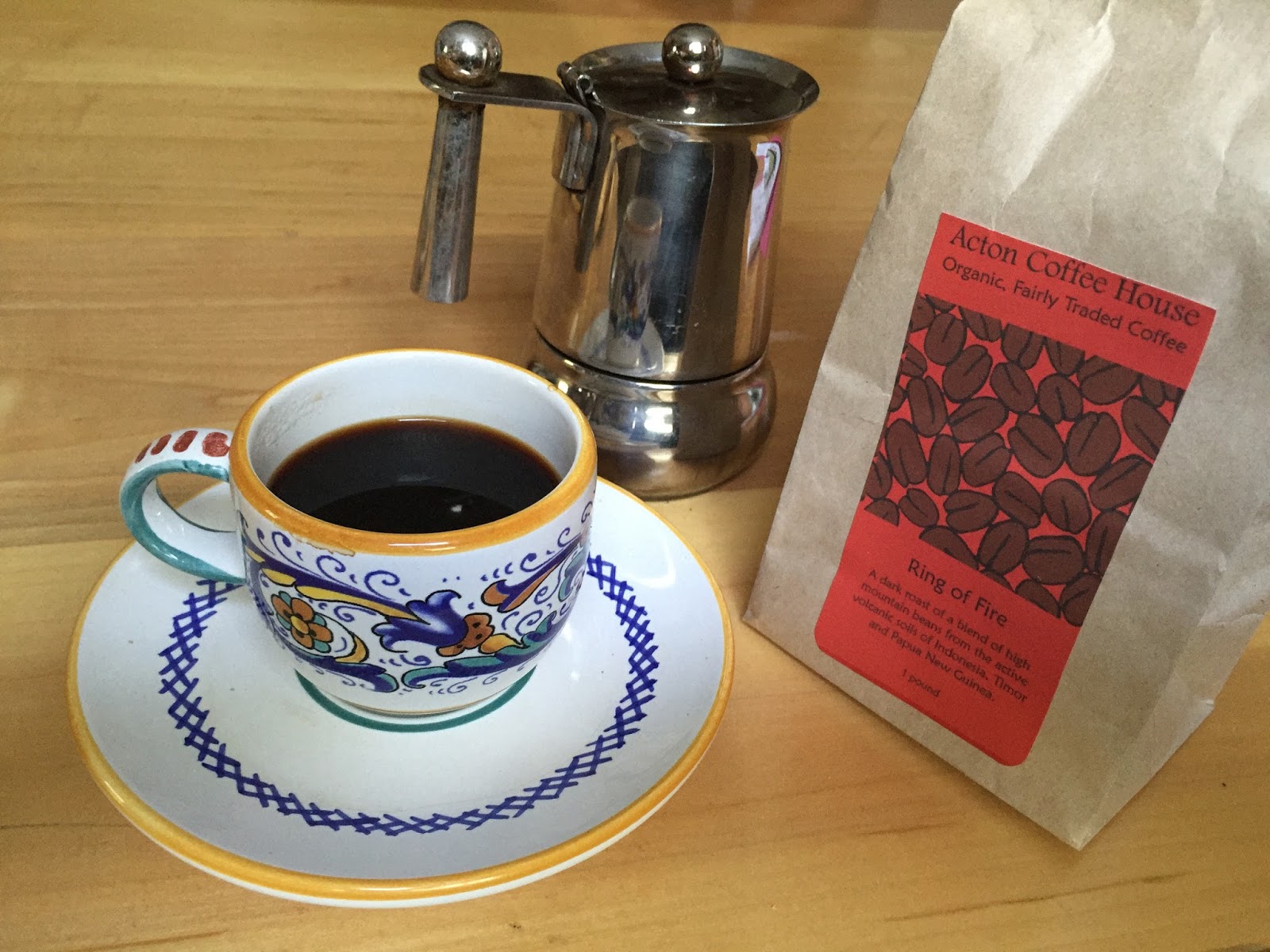
In queste pagine ho scritto alcune volte sulle uve celestiali provenienti dalle regioni vulcaniche (Etna, Vesuvio). Ieri, per la prima volta, ho assaggiato il caffè vulcanico! Dopo un solo sorso, ho saputo di aver trovato il “mio caffè.”

Ho acquistato i grani dalla Acton Coffee House. Loro acquistano i grani da una piccola ditta che si chiama “Dean’s Beans,” situata a Orange, Massachusetts (65 km a nordovest di Worcester, 130 km a ovest di Boston). La ditta utilizza solo i grani bio, e si impegna solo nel commercio equo con i coltivatori di caffè. Secondo il loro sito web:
Da oltre due decenni, la nostra missione è chiara: utilizzare caffè speciali di alta qualità, come veicolo di cambiamento progressivo in tutte le terre del caffè dell’Asia, dell’Africa e delle Americhe. Realizziamo questo attraverso l’attivismo, la responsabilità ecologica e i programmi di sviluppo diretti e innovativi  con i nostri partner di cooperazione.
Questa miscela vulcanica si chiama “Ring of Fire.” I grani crescono nel terreno vulcanico delle alte montagne di Indonesia, Timor, e Papua Nuova Guinea. Difficile immaginare un terreno più ricco. Difficile immagine un caffè di un sapore più ricco.
  In Naples, two things are sacred: pizza, and coffee.

The sanctity of coffee is not limited to Naples; elsewhere in Pensieri Meridionali I told you about the time that a Florentine said to me, "After an Italian puts coffee in his mouth, if you offered him rabbit with truffles, he wouldn't eat it." So important is it that the coffee comes last, after-dinner liqueurs are called Ammazzacaffè ("coffee killers").

For this reason, I was always very curious why so few Neapolitans grind their own beans.  Why do they content themselves so easily with vacuum-packed bricks of ground espresso, which upon opening become stale almost immediately.  Today the situation is even worse, with the immense popularity of coffee capsules, both in Italy and in America.

The coffee revolution began in Seattle in 1966, by the Dutch-American coffee roaster Alfred Peet (1920-2007). The revolution was spread to Boston by the legendary coffee guru, George Howell.  Today, in Massachusetts one can find many artigianal coffee roasters, several of whom produce beans which – I say with great pride – make the most delicious coffee in the world.

In these pages I have written several times about the heavenly grapes that grow in the volcanic regions (Etna, Vesuvius).  Yesterday, for the first time, I tasted volcanic coffee! One sip, and I knew that I had found "my coffee."

I purchased the beans at the Acton Coffee House. They buy the beans from a small company called "Dean’s Beans," located in Orange, MA (40 miles northwest of Worcester, 80 miles west of Boston). The company uses only organic beans, and engages only in fair trade with coffee growers. According to their website:
For over two decades our mission has been clear: To use high quality specialty coffee as a vehicle for progressive change throughout the coffeelands of Asia, Africa and the Americas. We do this through activism, ecological responsibility and innovative direct development programs with our cooperative partners.
This volcanic blend is called "Ring of Fire." The beans grow in the volcanic soil of the high mountains of Indonesia, Timor, and Papua-New Guinea. Difficult to imagine a richer soil. Difficult to imagine a coffee with a richer taste.


Foto; L.C. (16 maggio 2016)
Foto: deansbeans.com

domenica 15 maggio 2016

Buon compleanno, Salvatore Fisichella!

Qua il grandissimo tenore siciliano canta "A te, o cara" da "I Puritani" del compositore catanese, Vincenzo Bellini.

Here the great Sicilian tenor sings "A te, o cara" from "I Puritani" by the composer from Catania, Vincenzo Bellini. 


domenica 10 aprile 2016

Foto della Settimana / Photo of the Week

Acquedotto Carolino (note anche come Acquedotto di Vanvitelli)
Caroline Aqueduct (a.k.a. Aqueduct of Vanvitelli)

Foto: Wikipedia

venerdì 1 aprile 2016

E' l'April! / 'Tis April!

APRILE 
Music by F. Paolo Tosti (1846-1916) 
Words by Rocco Pagliara (1857-1914)

Non senti tu ne l’aria
il profumo che spande Primavera?
Non senti tu ne l’anima
il suon de nova voce lusinghiera?
È l’April! È la stagion d’amore!
Deh! vieni, o mia gentil
su’ prati’n fiore!

Il piè trarrai fra mammole,
avrai su’l petto rose e cilestrine,
e le farfalle candide
t’aleggeranno intorno al nero crine.
È l’April! È la stagion d’amore!
Deh! vieni, o mia gentil
su’ prati’n fiore!
Do you not smell in the air
the perfume that Spring spreads?
Do you not hear in your soul
the sound of a new, enticing voice?
'Tis April! 'Tis the season of love!
Come, sweetheart,
to the meadow in bloom!

Your foot will tread among violets,
you will wear roses and sky-blue flowers,
and the white butterflies
will hover around your black mane.
'Tis April! 'Tis the season of love!
Come, sweetheart,
to the meadow in bloom!