|
| Photo: Leonardo Ciampa (16 August 2021) |
Il Sacro Rito del Caffè di Leonardo Ciampa (ultimo aggiornamento: 16 agosto 2021) A Napoli, la preparazione del caffè è un rito sacro. In un pranzo italiano, l’ordine dei corsi è ben definito, e immutabile:
*primo piatto
*secondo piatto, con contorni e verdure serviti su piatti separati
*insalata
*frutta fresca e formaggi freschi
*dolce
*caffè
Come un fiorentino mi disse una volta: “Dopo che un italiano mette il caffè in bocca, se tu dovessi offrirgli coniglio al tartufo, non lo mangerebbe.” Così importante è che il caffè venga per ultimo, i digestivi bevuti dopo pranzo si chiamano gli “ammazzacaffè.”
La prima famiglia italiana con cui sono mai stato, nell’estate del 1995, era la famiglia Schettino, a Sant’Antonio Abate (vicino a Pompei, nella provincia di Napoli). La matriarca della famiglia si chiamava Amalia Sorrentino. Il suo rito speciale per fare il caffè era indimenticabile! Il pranzo iniziava alle ore 13, secondo l’ordine descritto in precedenza — meno il caffè. Verso le 14, ognuno prendeva il riposo. Alle 16 circa, eravamo svegliati da un particolarissimo suono metallico. Amalia faceva il caffè in modo normale, sopra la stufa con la caffettiera Bialetti. Nel frattempo, in una piccola brocca di metallo, metteva una quantità precisamente misurata di zucchero. Quando le prime gocce di caffè spuntavano, le versava nella brocca e mescolava energicamente, facendo una pasta. Quando il resto del caffè emergeva, lo versava nella pasta. Bevevamo il nostro caffè, e l’avanzo andava in una piccola fiala di vetro, che si poneva nella porta del frigorifero. La mattina successiva, a prima colazione, faceva il latte caldo, macchiato con il caffè zuccherato della fiala.
Di quale metallo è stata fatta questa preziosa brocca? La logica direbbe o alluminio o inox. Ma il modo in cui la ricordavo io — erroneamente, senza dubbio — è di esser stata di peltro. Sicuramente questo ricordo era colorato dalle mie origini bostoniane. (Le brocche di caffè in peltro erano comuni in Inghilterra e nell’America coloniale.) Questa “memoria emotiva” (se non “memoria fattuale”) si registrò in me. Ecco perché un paio di anni fa, quando fui in un negozio di seconda mano, il mio cuore sobbalzò quando vidi questa brocca di peltro inglese. Lo lucidai e — anche se il caffè lo prendo sempre nero come l’asso di picche — preparai la pasta di caffè e zucchero, in onore della cara e indimenticabile Amalia. (Infatti fu proprio Amalia che mi regalò
la mia primissima moka — Bialetti, naturalmente — a Sant’Antonio Abate quella memorabile estate.)
Per decenni, pensavo che il motivo di questa procedura con la pasta e la brocca fosse semplicemente quello di mescolare lo zucchero in modo uniforme in tutto il caffè. Solo nel 2014 ho appreso che i cubani di una volta usavano la stessa identica tecnica, e che il motivo era quello di replicare la “crema” — quell’apprezzatissima schiuma giallastra che si forma nella parte superiore di una buona tazza di espresso. Osserverete gli italiani versare un cucchiaio di zucchero sopra l’espresso ed aspettare, per vedere quanto lentamente lo zucchero affonda attraverso la crema — un mezzo per giudicare la qualità dell’espresso.
|
The Sacred Rite of Coffee by Leonardo Ciampa (latest update: 16 August 2021) In Naples, the preparation of coffee is a sacred rite.
In an Italian dinner, the order of the courses is well-defined, and immutable:
*first course
*second course, with side dishes and vegetables served on separate plates
*green salad
*fresh fruit and fresh cheeses
*dessert
*coffee
As a Florentine once told me, “After an Italian puts the coffee in his mouth, if you were to offer him rabbit with truffles, he would not eat it.” So important is it that the coffee comes last, after-dinner liqueurs are called ammazzacaffè (“coffee killers”).
The first Italian family with whom I ever stayed, in the summer of 1995, was the Schettino family, in Sant’Antonio Abate (near Pompeii, in the province of Naples). The matriarch of the family was named Amalia Sorrentino. Her special coffee-making rite was unforgettable! The pranzo began at 1:00 following the order as described above — minus the coffee. Around 2:00, everyone took a siesta. Around 4:00, we were awakened by a very particular metallic sound. Amalia made the coffee in the normal way, with a Bialetti stove-top coffeemaker. Meanwhile, she placed a carefully measured amount of sugar in a small, metal pitcher. When the first drops of coffee rose, she poured them into the pitcher and stirred energetically, making a paste. When the rest of the coffee emerged, she poured it into the paste. We drank our coffee, and the remainder went into a small glass vial, which was placed in the door of the refrigerator. The next morning, for breakfast, she made latte macchiato, “marked” with the sweetened coffee of the vial.
With what metal was this precious pitcher made? Logic would say aluminum or stainless steel. The way I remembered it — undoubtedly wrongly — is having been of pewter. Surely this memory was colored by my Bostonian upbringing. (Pewter coffee pots were common in England and in Colonial America.) This “emotional memory” (if not “factual memory”) was recorded in me. Which is why a couple of years ago, when I was in a second-hand store, my heart jumped when I saw this English pewter pitcher. I polished it, and — though I always take my espresso black as the ace of spades — I made the coffee-sugar paste, in honor of the dear and unforgettable Amalia. (In fact it was Amalia herself who bought me my very first stovetop espresso maker — Bialetti, of course — in Sant’Antonio Abate that memorable summer.)
For decades, I thought that the reason for this procedure with the paste and the pitcher was simply to mix the sugar evenly throughout the coffee. Only in 2014 did I learn that the old-timers in Cuba used the exact same technique, and that the reason was to replicate the “crema,” that prized, yellowish foam that forms at the top of a good cup of espresso. You will see Italians pour a spoonful of sugar onto their espresso and wait to see how slowly it sinks through the crema, as a means of judging the quality of that espresso.
|
 |
| Photo: Leonardo Ciampa (16 August 2021) |
| Mi stupisce sempre, però, che gli italiani meridionali prendano il loro caffè così sul serio, ma raramente macinino i loro propri chicchi. Naturalmente, si faceva nei tempi antichi (con i macinacaffè come quello raffigurato sotto). Ma perché ora si contentano così facilmente con le mattonella di caffè, che all’apertura diventa stantio quasi subito? Oggi la situazione è ancora peggio, con la popolarità immensa del caffè in capsule e in cialde, sia in Italia che in America. Io compro i chicchi che provengono dalla regione vulcanica del Pacifico che si chiama la Cintura di Fuoco. Se stimiamo il vino che provenga da una singola origine, perché non stimiamo anche il caffè dei posti specifici? Qui nel Massachusetts abbiamo il lusso di molti torrefattori artigianali, come George Howell (considerato uno dei guru del caffè più famosi al mondo). Abbiamo anche Dean’s Beans, che infatti produce una miscela che si chiama Cintura di Fuoco, con chicchi da Timor, Sumatra e Papua Nuova Guinea. Quando io ero l’unico bevitore di caffè in casa, consumavo un sacchetto (340 g) di chicchi George Howell al mese. Uno dei più grandi momenti del mese: il momento in cui presi le forbici e aprii il sacchetto. Non è possibile comprendere l’aroma paradisiaco che scappò in quell’istante! Quando si fa il caffè, si deve usare acqua fredda e depurata. Se si disponga di un fornello a gas, si dovrebbe usare una fiamma bassa. (Con un fornello elettrico, che va da 1 a 10, impostatelo su 6.) Per parecchi anni ho avuto il dilemma su come conservare i chicchi. Ho provato diversi prodotti, nessuno soddisfacente. Alla fine ho improvvisato il mio proprio sistema: Con un imbuto, ho trasferito i chicchi in un barattolo di vetro. L’ho reso ermetico con un Vacuvin. Finalmente, un prodotto è venuto sul mercato che si è dimostrato soddisfacente! La società Planetary Design produce un prodotto di nome Airscape® Coffee Canister. È semplice quanto ingegnoso: basta spingere verso il basso una maniglia di plastica all’interno del contenitore, forzando fuori l’aria. Ma cu sti mode, oje Bríggeta, tazza ’e café parite: sotto tenite ’o zzuccaro, e ’ncoppa, amara site... ma tanto ch’aggi’ ’a vutà... ma i’ tanto ch’aggi’ ’a girá... ca ’o ddoce ’e sott’ ’a tazza, fin’a ’mmocca mm’ha da arrivá!... Questo post è l’aggiornamento di un post pubblicato per la prima volta il 14 gennaio 2013. Questa nuova versione è dedicata alla cara memoria della signora Amalia Sorrentino (1 aprile 1939 – 6 febbraio 2018). |
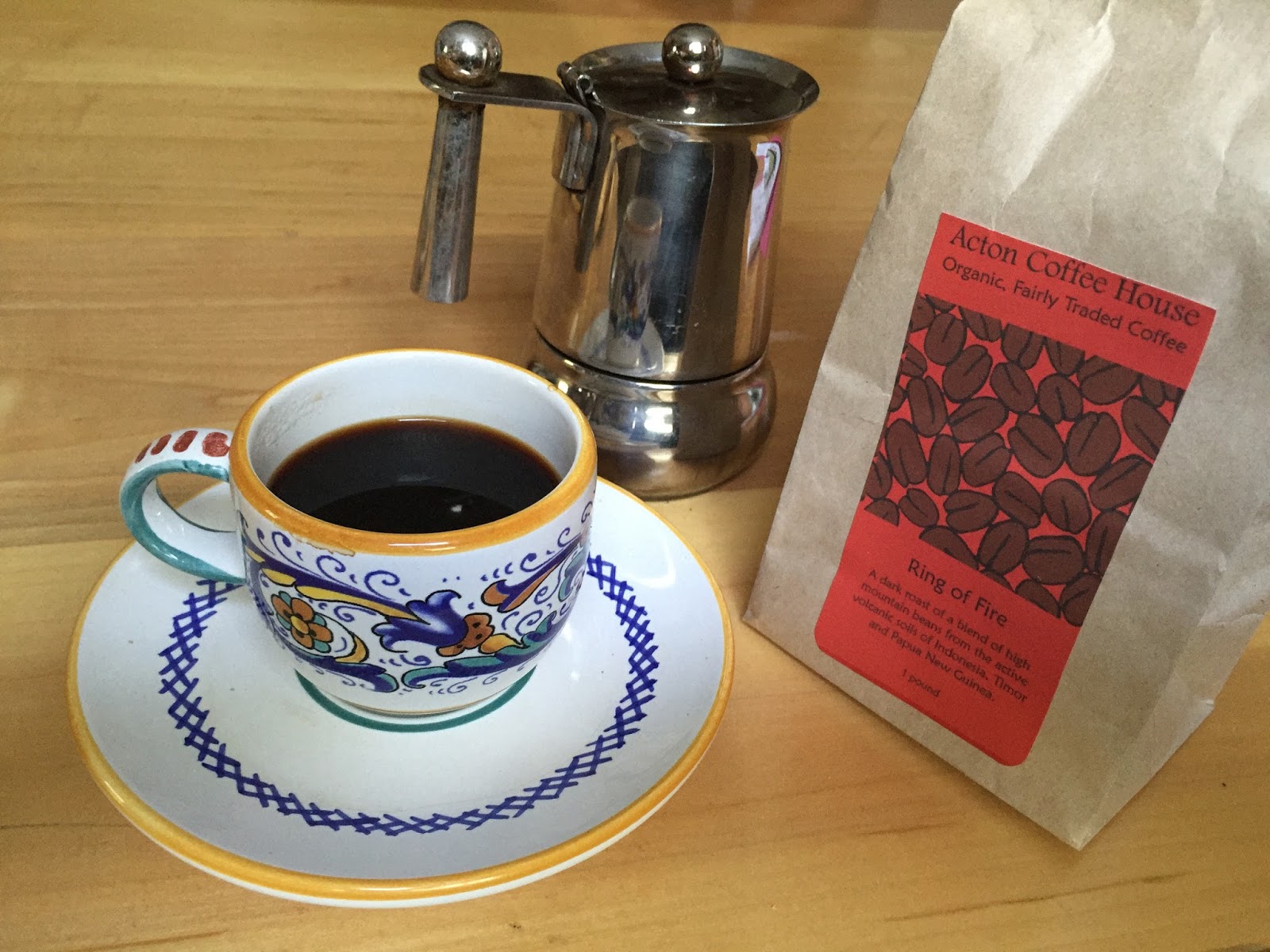
I am always amazed, however, that Southern Italians are so serious about their coffee, yet they rarely grind their own beans. Naturally, they did in the olden times (with grinders such as the one pictured below). But why do they now content themselves so easily with bricks of ground espresso, which upon opening become stale almost immediately? Today the situation is even worse, with the immense popularity of coffee capsules and pods, both in Italy and in America. I buy beans that come from the volcanic Pacific region known as the Ring of Fire. If we prize wine that comes from a single origin, why shouldn’t we prize coffee from specific places? Here in Massachusetts we have the luxury of many artisanal coffee roasters, such as George Howell (considered one of the world’s leading coffee gurus). We have also Dean’s Beans, which in fact produces a blend that they call Ring of Fire, with beans from Timor, Sumatra, and Papua New Guinea. When I was the only espresso-drinker in the house, I consumed one bag (12 oz.) of George Howell beans per month. One of the greatest moments of my month: that moment when I took the scissors and cut open the bag. You can’t fathom the heavenly aroma that escaped in that moment! When making espresso, you must use cold, purified water. If you have a gas stove, you should use a low flame. (With an electric stove that goes from 1 to 10, set it on 6.) For many years I had the dilemma of how to store the beans. I tried several products, none satisfactory. Finally, I improvised my own system: With a funnel, I transferred the beans into glass jar. I made it airtight with a Vacuvin. Finally, a product came on the market that proved satisfactory! The company Planetary Design makes a product called the Airscape® Coffee Canister. It is as simple as it is ingenious: you simply push down on a plastic handle inside the canister, forcing out the air. But to me, Bridget, You are like a cup of coffee: Sweet as sugar at the bottom, And bitter at the top. So I’ll stir and I’ll stir, And I’ll keep stirring Until the sweetness from the bottom of the cup Finally rises and reaches me! This post is an update of a post first published on 14 January 2013. This new version is dedicated to the dear memory of signora Amalia Sorrentino (1 April 1939 – 6 February 2018). |
 |
| Sul patio (Foto: Leonardo Ciampa, 9 July 2012) On the patio (Photo: Leonardo Ciampa, 9 July 2012) |
 |
| L’autore con il gran guru del caffè, George Howell (10 febbraio 2012) The author with the great coffee guru, George Howell (10 February 2012) |
 |
| Photo: Leonardo Ciampa (13 February 2018) |
 |
| Una volta collezionavo le caffettiere. Mi vergogno a dire che questa era solamente una parte della collezione ... (Foto: Leonardo Ciampa, 13 febbraio 2018) Once upon a time I used to collect espresso pots. I'm embarrassed to say that this was only part of the collection ... (Photo: Leonardo Ciampa, 13 February 2018) |
 |
| La collezione anche includeva una vecchia caffettiera vesuviana. Non la usai mai; non avevo la minima idea di come funzionasse! (fotografo ignoto) The collection even included an old caffettiera vesuviana. I never used it; I hadn't the slightest idea how it worked! (photographer unknown) |
 |
| Oggi uso solamente le mie cinque Bialetti... Today I use only my five Bialettis... |
 |
| ... e ogni tanto per nostalgia, la classica caffettiera napoletana (foto L.C. 16 agosto 2021). ... and every so often, for nostalgia, the classic Neapolitan caffettiera (photo: L.C. 16 August 2021). |
 |
| fotografo ignoto photographer unknown |