Visualizzazione post con etichetta Piatti unici. Mostra tutti i post

domenica 29 maggio 2022

Pasta 'ncasciata: pasta al forno alla Siciliana / Sicilian baked pasta

Foto per gentile concessione di Salvatore Candia.
Photo courtesy of Salvatore Candia.
[N]el frigorifero non c’era niente, nel forno troneggiava una teglia con quattro enormi porzioni di pasta ’ncasciata, piatto degno dell’Olimpo[.] [Montalbano] se ne mangiò due porzioni, rimise la teglia nel forno, puntò la sveglia, [e] dormì piombigno per un’ora[.]
Camilleri, Il cane di terracotta (1996)

Lo scorso settembre vi ho presentato un piatto che “mi ha portato alla distrazione,” i fenomenali ”Spaghetti ’ncastagnati”, la “pasta fritta” che per generazioni è stata l’amata cena domenicale. Lo stesso chef siciliano che ha preparato questo delizioso piatto, sig. Salvatore Candia, mi ha “distratto” ancora una volta ieri. La sua stupenda “Pasta ’ncasciata” è la risposta siciliana alla pasta al forno. È uno dei grandi piatti siciliani, con tanti ingredienti spiccatamente siciliani: gli anelletti, le melanzane e la superficie di pangrattato (il “formaggio dei poveri” che abbellisce tanti piatti siciliani).

Questo piatto unico ricco e saporito, senza dubbio una creazione dei Monzù in epoca borbonica, viene spesso preparato per le feste. Tuttavia, come la “pasta fritta,” è un piatto che si prepara spesso la domenica. Infatti, quando i siciliani vanno al mare la domenica, potrebbero portare con sé questo piatto! (Come avrete intuito, il cibo da picnic nel sud Italia è molto più interessante del nostro qui in America!)

Non esiste una ricetta corretta. Ogni chef siciliano aggiunge i suoi tocchi personali. Cercare di trovare “la ricetta autentica” è un esercizio esasperante. Un cuoco messinese insiste che un certo ingrediente sia assolutamente vietato. Un cuoco palermitano insiste che omettere quello stesso ingrediente sia un crimine efferato. E così va.

Particolarmente problematica è la questione delle melanzane. Nella Sicilia occidentale la tendenza è quella di utilizzare le grosse melanzane nere, affettate e fritte come nella Parmigiana, e addizionate a strato (alcuni insistono che lo strato superiore debba per forza essere di melanzane, come nel Timballo di melanzane). Nella Sicilia orientale la tendenza è quella di utilizzare le melanzane viola piccole, tagliate a cubetti e fritte (come nella Pasta alla Norma), e mescolate (non a strati) con gli altri ingredienti. Non si può dire che una versione sia “più siciliana” dell’altra. È semplicemente una vostra scelta personale: stratificare gli ingredienti o mescolarli insieme?

Ho scelto il metodo di stratificazione (che è quello che fa il signor Candia). Quella che segue è la ricetta mia, basata sull’aver letto molte altre ricette (ciascuna autentica, ciascuna “corretta”).

Ingredienti
  • anelletti (MOLTO al dente)
  • mortadella o salame (è assolutamente consentito il prosciutto cotto affettato)
  • tuma o caciocavallo (è assolutamente consentita la mozzarella a fette)
  • uova sode, affettate
  • ragù di carne (pomodori, evo o strutto, carne macinata, cipolle e/o aglio, basilico, una spruzzata di vino)
  • grandi melanzane nere – sbucciate, affettate e fritte
  • pangrattato casereccio, mescolato con pecorino grattugiato e un po’ di evo o di strutto
Preparazione
Stratificate gli ingredienti (lo strato inferiore deve essere il ragù, lo strato superiore deve essere il pangrattato). Fate cuocere in forno fino a quando l’interno bollirà e la superficie superiore sarà ben dorata.
   [T]here was nothing in the refrigerator, in the oven there was a pan with four huge portions of pasta ’ncasciata, a dish worthy of Olympus[.] [Montalbano] ate two portions, put the pan back in the oven, set the alarm clock, [and] slept like a log for an hour[.]
Camilleri, The terracotta dog (1996)

Last September, I presented to you a dish that "drove me to distraction," the phenomenal "Spaghetti ’ncastagnati," the "fried pasta" that for generations was the beloved Sunday-evening cena. The same Sicilian chef who prepared this delectable dish, Mr. Salvatore Candia, "distracted" me once again yesterday. His stupendous Pasta ’ncasciata is Sicily’s answer to baked pasta. It is one of the great Sicilian dishes, with so many distinctly Sicilian ingredients: the anelletti (Sicilian pasta rings), the eggplant, and the topping of breadcrumbs (the "poor man’s cheese" that graces so many Sicilian dishes).

This rich and flavorful one-course meal, undoubtedly a creation of the Monzù during the Bourbonic era (pre-Garibaldi), is often prepared for holidays.  However, like the "fried pasta," it is a dish that is often made on Sundays.  In fact, when Sicilians go to the beach on Sundays, they might bring this dish with them!  (As you may have surmised, the picnic food in Southern Italy is much more interesting than ours here in America!)

There is no one correct recipe. Every Sicilian chef adds his or her own personal touches. Trying to find "the authentic recipe" is an infuriating exercise. A cook from Messina insists that a certain ingredient is absolutely forbidden. A cook from Palermo insists that omitting that same ingredient is a heinous crime. And so it goes.

Particularly problematic is the question of the eggplant. In western Sicily, the tendency is to use large black eggplants, sliced and fried as if making Eggplant parmigiana, and added as a layer (some insisting that the top layer must be eggplant, as in Timballo di melanzane). In eastern Sicily, the tendency is to use the small purple eggplants, cut in cubes and fried (as if making Pasta alla Norma), and mixed (not layered) with the other ingredients. One cannot say that one version is "more Sicilian" than the other. It is simply your personal choice: do you layer the ingredients, or do you mix them together?

I have chosen the layering method (which is what Mr. Candia does). The following is my own recipe, based on having read many other recipes (each authentic, each "correct").

Ingredients
  • anelletti (VERY al dente)
  • mortadella or salami (sliced ham is absolutely permissable)
  • tuma or caciocavallo (sliced mozzarella is absolutely permissable)
  • hard-boiled eggs, sliced
  • meat sauce (plum tomatoes, EVOO or lard, ground meat, onions and/or garlic, basil, a splash of wine)
  • large black eggplants – peeled, sliced, and fried
  • homemade breadcrumbs, mixed with grated pecorino and a little EVOO or lard
Preparation
Layer the ingredients (the bottom layer must be sauce; the top layer must be the breadcrumbs). Bake in the oven until the inside is bubbling and the top surface is nicely browned.

domenica 16 maggio 2021

La Bellissima Nonna XXXV

Che epoca meravigliosa in cui vivere! Nei tempi antichi, se aveste voluto una vecchia ricetta tradizionale, o avreste consultato un libro di cucina, ove la ricetta era complicata da essere irriconoscibile, oppure avreste cercato un italiano che magari ricordava o magari non ricordava gli ingredienti della nonna. (Sicuramente aveva scordato che Nonna usava lo strutto al posto dell’olio d’oliva ...)

Ma oggi! Possiamo andare su YouTube! Dobbiamo guadare attraverso molti Tizi e Cai e Semproni e Pinchi Pallino. Ma poi! Troviamo Nonna! Bellissima Nonna! Non solo una nonna qualsiasi – la nonna che fa ancora le cose alla vecchia maniera.

Mi sono portato avanti e vi ho risparmiato la fatica: ho fatto io il guado per voi. Vi presento una serie di video della nonna, mostrandoci le ricette non di oggi ma di ieri.
   What an amazing era to live in! In the olden days, if you wanted an old traditional recipe, either you consulted a cookbook, where the recipe was complicated beyond recognition, or you searched for an Italian who maybe did or maybe didn’t remember Grandma’s ingredients. (Undoubtedly he forgot that Grandma used lard instead of olive oil...)

But today! We can go to YouTube! We have to wade through many Toms and Dicks and Harrys and Joe Schmoes. But then! We find Nonna! Bellissima Nonna! Not just any grandma – the grandma that still does things the old way.

I went ahead and saved you the trouble: I have done the wading for you. I present to you a series of videos of Grandma, showing us the recipes not of today but of yesterday.
LA BELLISSIMA NONNA XXXV
Il timballo (antica ricetta pugliese)
Timballo (ancient recipe from Apulia)
“Ricette delle nonne”
Da quando uscì il famoso film Big Night nel 1996 (25 anni fa!), la gente è affascinata dal Timballo. Si potrebbe chiamarla “la pasta al forno sotto steroidi”! Ci sono tante ricette quante sono le stelle nel cielo; ogni famiglia ne ha la sua propria ricetta. Qui Nonna Maria ci mostra una ricetta autentica che la sua famiglia prepara da generazioni.    Since the famous film Big Night was released in 1996 (25 years ago!), people have had a fascination with the Timballo. You might call it, “baked pasta on steroids”! There are as many recipes as there are stars in the sky; every family has its own recipe. Here Nonna Maria shows us an authentic recipe that her family has been making for generations.

venerdì 10 maggio 2019

Pasta Matteo

In queste pagine avete letto della Pasta Giulio, inventata da mio figlio di 7 anni. Stasera condivido con voi la Pasta Matteo, inventata da Matteo Giovanni Ciampa (8 anni).

In effetti si tratta di macaroni & cheese con le polpettine.

Ingredienti
Per la pasta:

750 gr Rotelline (Matteo voleva che voi sapeste che le Rotelle sono la sua pasta preferita, ma le Rotelline sono ciò che lui vuole in questo piatto.)

Per il condimento:

1/2 L panna. 1/2 L latte
500 gr formaggi grattugiati (cheddar, Emmentaler e pecorino romano)
500 gr carne macinata (manzo, maiale e vitello) 30 gr burro
sale e pepe frescamente macinati
un pizzico di noce moscata frescamente grattugiata
la scorza di 1 limone, grattugiata

Preparazione
Nella carne macinata, mescolate il sale, pepe e scorza di limone. (Ho chiesto a Matteo se potevo aggiungere prezzemolo e aglio, ma Matteo ha risposto di no.) Formate polpettine. Matteo ha detto di non friggere le polpettine separatamente, ma di cucinarle direttamente nel condimento. Unite le polpettine con tutti gli altri ingredienti (eccetto la pasta). Fate cuocere alla fiamma PIÙ BASSA, mescolando continuamente per non bruciare il fondo della pentola.

Nel frattempo, in un'altra pentola fate cuocere la pasta in abbondante acqua salata, scolate, aggiungete al condimento e Buon appetito!

La variante di Papà:
Sottraete due minuti dal tempo di cottura della pasta. Scolate la pasta dura. In una pirofila, unitela al condimento, cospargete di pangrattato e pecorino e fate cuocete nel forno fino a quando farà bolle. Devo chiedere a Matteo se gli piaccia questa variante. Vi farò sapere la sua risposta!
   In these pages you have read about Pasta Giulio, invented by my 7-year-old son. Tonight I share with you Pasta Matteo, invented by Matteo Giovanni Ciampa (8 years old).

In effect it is macaroni & cheese with little meatballs.

Ingredients 
For the pasta:

1.5 lb Mini wagon wheels (Matteo wanted you to know that Wagon wheels are his favorite pasta, but Mini wagon wheels are what he wants in this dish.)

For the sauce: 

1 quart Half & half
1 lb shredded cheese (cheddar, Swiss, and pecorino romano)
1 lb ground meat (beef, pork and veal)
2 TB butter
freshly ground salt and pepper
a pinch of freshly grated nutmeg
the rind of one lemon, grated

Preparation
In the ground meat, mix the salt, pepper and lemon rind. (I asked Matteo if I could add parsley and garlic, but Matteo said no.) Form little meatballs. Matteo said not to fry the meatballs separately, but to cook them directly in the sauce. Add the meatballs with all the other ingredients (except the pasta). Cook on the LOWEST heat, stirring constantly so as not to burn the bottom of the pan.

Meanwhile, in another pan cook the pasta in plenty of salted water, drain, add to the sauce and enjoy!

Daddy's variant: Subtract two minutes from the pasta cooking time. Drain the hard pasta. In a baking dish, combine it with the sauce, sprinkle with breadcrumbs and pecorino, and bake until bubbling. I have to ask Matteo if he likes this variation. I will let you know his answer!

sabato 3 novembre 2018

Ciambellone salato (per Mimmo Corcione) / Savory Bundt cake (for Mimmo Corcione)

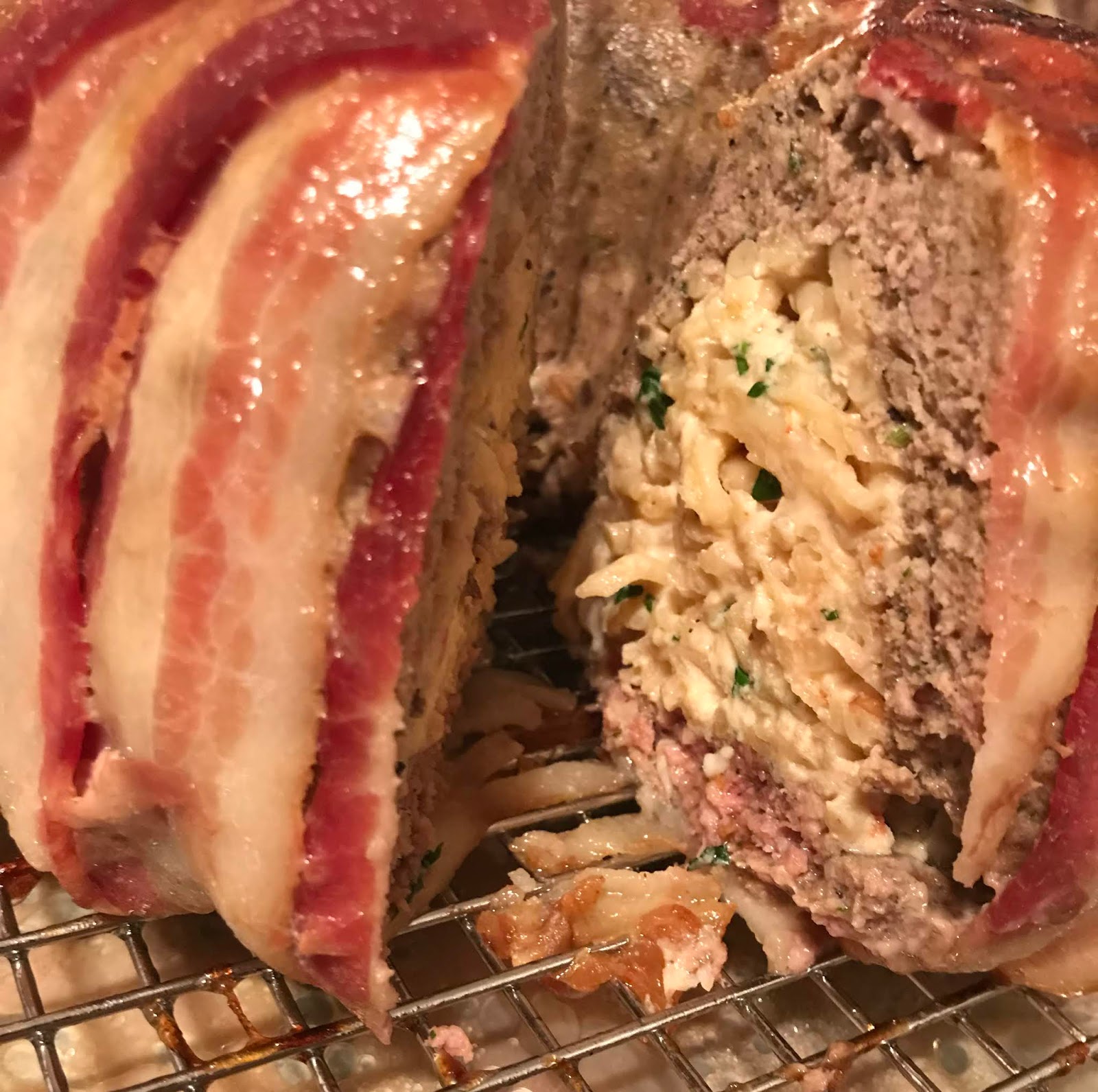
CIAMBELLONE SALATO
di carne trita, bucatini,
ricotta & bacon. 
Ricetta dedicata a Mimmo Corcione.

Mimmo Corcione è il chef napoletano più famoso dell’Internet. Il suo canale YouTube (a partire da novembre 2018) ha più di 55.000 abbonati e più di 21 milioni di visualizzazioni! Non c’è davvero modo di trasmettere quanto sono rimasto sbalordito, e onorato, quando il mese scorso, Mimmo ha creato una ricetta e l’ha dedicata a me! E ha citato il mio nome nel video! Ero abbagliato come un adolescente!

Restituisco il favore in umiltà totale e senza nessune manie di grandezza. Le ricette di Mimmo sono simultaneamente rustiche e nobili. Miravo a questa dualità quando ho creato questo ciambellone salato, segno della mia più sincera stima e gratitudine a Mimmo Corcione.


Ingredienti

PER LA CARNE:

1,5 kg carne macinata
     (750 gr manzo, 750 gr maiale, oppure
     500 g ciascuno di manzo, maiale e vitello)
prezzemolo fresco, tritato
menta fresca, tagliata a pezzi grossi
3 uova
pecorino, frescamente grattugiato
pane multicereali, raffermo
1 o 2 spicchi d’aglio
un pizzico di cannella, frescamente macinata
un po’ di scorza di arancia, frescamente grattugiata
un po’ di latte intero
sale
pepe

PER IL RIPIENO:

250 gr bucatini o perciatelli
     (cotti in anticipo), freddi
2 o 3 cucchiai sugo di pomodoro
     (cotto in anticipo), freddo
500 gr ricotta
2 uovo sbattuto
pecorino, frescamente grattugiato
scamorza o mozzzarella, grattugiata
noce moscata, frescamente macinata
prezzemolo fresco, tritato
sale
pepe

PER LA CROSTA:

28 fette abbastanza spesse (c.750 gr) pancetta affumicata (tipo bacon)


ATTREZZATURE NECESSARIE:

stampo per ciambellone (diametro di 25 cm),
      con maniglie
griglia di raffreddamento
teglia da forno
grande pentola per la pasta
2 grande ciotole
un paio di forbici

Preparazione

Qualche ora prima (oppure il giorno prima), portate ad ebollizione una grande pentola di abbondante acqua salata. Buttate la pasta. Quando l’acqua tornerà ad ebollizione, fate cuocere per due minuti al di sotto del tempo di cottura consigliato (probabilmente 7 minuti – solitamente i bucatini e i perciatelli impiegano 9 minuti). Nel frattempo, aggiungete il sugo freddo a una delle due grandi ciotole. Scolate la pasta e aggiungetela alla ciotola con il sugo freddo. Amalgamate bene e fate raffreddare.

Preriscaldate il forno a 180 ° C.

Mettete la carne nell’altra grande ciotola. Aggiungete il prezzemolo e la menta.  In una robot da cucina, mescolate i successivi 9 ingredienti.  Aggiungete alla ciotola questo composto, e mescolate bene con la carne. Mettete da parte.

Nella ciotola con la pasta e il sugo, aggiungete tutti gli ingredienti del ripieno, e amalgamate bene.

Foderate lo stampo con le fette di bacon. (Una parte di ogni fetta sporgeranno oltre i lati dello stampo. Notate bene nella prima foto che non si fodera il tubo centrale. Se lo facciate, il bacon all’interno non diventerebbe croccante.)  Aggiungete 2/3 della carne sul fondo dello stampo e spalmate su i lati e al centro dello stampo, facendo una “grondaia” per il ripieno. Aggiungete il ripieno nella “grondaia.” Coprite il ripieno con la carne rimanente e appianate. Piegate le parti sporgenti del bacon sopra la parte superiore della carne. (Usate i forbici per tagliare e trasferite pezzettini del bacon come necessario.)  Coprite con un foglio di alluminio, e infornate per 30 minuti.  Rimuovete il foglio e fate cuocere per altri 30 minuti (un’ora in totale). Durante la cottura, se troppo grasso si raduni sopra, potrebbe essere necessario farne defluire un po’.

Se dopo un’ora il bacon sopra non è ancora croccante, mettetelo sotto il grill, fiamma alta, per 5 minuti

Quando cotto, sfornate lo stampo. Posizionate una griglia di raffreddamento e una teglia da forno sulla parte superiore dello stampo. Attentamente, con guanti da forno, afferrate le maniglie dello stampo, la griglia e la teglia.  Attentamente capovolgetelo. Sollevate via lo stampo. (Scivolerà fuori facilmente, a causa del grasso del bacon.) Mettete in forno sotto il grill, fiamma alta, per 5 minuti o fino a quando il bacon sarà croccante.

Variazione
Per il ripieno, si potrebbe sostituire la pasta con la purè di patate (preparata nel modo normale, senza sugo ovviamente). In questo caso, non mettete troppo latte nelle patate.
  
SAVORY BUNDT CAKE
with ground meat, bucatini,
ricotta & bacon. 
Recipe dedicated to Mimmo Corcione. 

Mimmo Corcione is the most famous Neapolitan chef on the Internet. His YouTube channel (as of November 2018) has over 55,000 subscribers and over 21 million views! There's really no way to convey how stunned, and honored, I was when last month, Mimmo created a recipe and dedicated it to me! And mentioned my name in the video! I was like a star-struck teenager!

I return the favor in total humility and without any delusions of grandeur. Mimmo's recipes are simultaneously rustic and noble. I was aiming for this duality when I created this savory cake, a sign of my sincerest esteem and gratitude a Mimmo Corcione.


Ingredients

FOR THE MEAT:

3 lb ground meat
     (1.5 lb beef, 1.5 lb pork, or
     1 lb each of beef, pork, and veal)
fresh parsley, chopped
fresh mint, coarsely cut
3 eggs
pecorino, freshly grated
multigrain bread, stale
1 or 2 cloves garlic
a smidgen of cinnamon, freshly ground
a little orange rind, freshly grated
a little whole milk
salt
pepper

FOR THE FILLING:

1/2 lb bucatini or perciatelli
     (cooked beforehand), cold
2 or 3 TB tomato sauce
     (cooked beforehand), cold
1 lb ricotta
2 egg, beaten
pecorino, freshly grated
scamorza or mozzarella, shredded
fresh parsley, chopped
nutmeg, freshly ground
salt
pepper

FOR THE CRUST:

28 slices (c. 24 oz.) bacon (hickory smoked or applewood smoked. NOT the kind sweetened with maple syrup.)


NECESSARY EQUIPMENT:

Bundt pan (10” in diameter), with handles
cooling rack
baking pan
large pot for the pasta
2 large bowls
a pair of scissors

Preparation

A few hours beforehand (or the day before), bring a large pan of abundant salted water to a boil.  Put in the pasta. When the water returns to a boil, cook for two minutes below the recommended cooking time (probably 7 minutes – usually bucatini and perciatelli take 9 minutes). Meanwhile, add the cold tomato sauce to one of the two large bowls.  Strain the pasta and add it to the bowl with the cold sauce. Mix well and let cool.

Preheat oven to 350°F.

Place the meat in the other large bowl.  Add the parsley and mint.  In a food processor, mix the next 9 ingredients. Add this mixture to the bowl, and mix well with the meat. Set aside.

In the bowl with the pasta and sauce, add all of the filling ingredients, and mix well.

Line the Bundt pan with the slices of bacon. (Part of each slice will hang over the sides of the pan.  Note well in the first photo that you don't line the central tube. If you do, the bacon in the inside would not become crispy.)  Add 2/3 of the meat to the bottom of the pan and spread up the sides and up the middle of the pan, making a “gutter” for the filling. Add the filling into the “gutter.” Top the filling with the remaining meat and smooth out. Fold the overhanging parts of the bacon over the top of the meat. (Use the scissors to cut and relocate little pieces of the bacon, as necessary.)  Cover with foil and bake for 30 minutes.  Remove the foil and bake for another 30 minutes (1 hour in total). During cooking, if too much fat gathers on top, it might be necessary to drain off some of it.

If after an hour the bacon on top is not crispy, broil on high for 5 minutes.

When done, remove the Bundt pan from the oven.  Place a cooling rack and baking sheet on top of it. Carefully, with oven mitts, grab hold of the handles of the Bundt pan, cooling rack, and baking sheet.  Carefully flip it over.  Lift away the Bundt pan. (It will slide off easily, because of the grease from the bacon.) Broil on high for 5 minutes or until the bacon is crispy.

Variation
For the filling, you could substitute the pasta with mashed potatoes (prepared in the normal way, without sauce obviously). In this case, don't put too much milk in the potatoes.

Notate che il tubo centrale non si fodera con il bacon. (Vedete la nota sopra.)
Note that the central tube is not lined with bacon. (See the note above.)
Servirà i forbici per questo passo. (Vedete le istruzioni sopra.)
You will need the scissors for this step. (See the instructions above.)

venerdì 25 agosto 2017

Spaghettoni alla Campolattaro

Tordo bottaccio (foto: ilcacciatore.com)
Song thrush (photo: ilcacciatore.com)
Vi è mai capito che avete fatto una grande zuppa di pollo o di manzo, e rimanevano così tanti avanzi di carne e di brodo che non sapevate cosa farne?

La seguente è una ricetta “nobile”, ma potete facilmente adattarla per approffitare di questi avanzi nel vostro frigo!

Ci sono due fonti per questa ricetta. La prima è Jeanne Caròla Francesconi, che ricevette tre ricette dal conte Paolo Gaetani (1901-1986), ciascuna delle quali si dice che sia venuta da Don Emilio Capomazza Marchese di Campolattaro. (La seguente è la seconda delle tre ricette con il nome Campolattaro.) La seconda fonte per la ricetta è il marchese Franco Santasilia di Torpino, che era in realtà il nipote del conte. Non solo, ma Santasilia si ricorda di mangiare questo piatto nella villa di Gaetani a Torre del Greco, preparato dal chef di Gaetani, Monzù Francesco ’e Gaetani! E se non bastasse, uno degli ospiti quella sera fu Totò!

Ingredienti

500 gr spaghettoni (oppure bucatini o perciatelli) (Stasera io ho usato gli spaghetti normali.)
1 kg gamboncello (oppure un altro tipo di carne di manzo)
1 pollo
1 coscia di tordo (facoltativa) (Io non l’ho usato!)
1 mazzetto guarnito (sedano, cipolla, carota e prezzemolo, legati con filo)
120 gr burro
150 gr parmigiano, frescamente grattugiato
prezzemolo, tritato frescamente
pepe nero, macinato al momento

Preparazione

Immergete in abbondante acqua leggermente salata, e in ebollizione, il manzo, il pollo, l’eventuale coscia di tordo, il mazzetto guarnito ed una macinatina di pepe. Quando tutte le carni risultano ben cotte, estraetele dal brodo di cottura. Filtrate il brodo e tenetelo da parte. Disossate completamente il pollo ed eliminate le parti grasse del manzo. Tagliate quindi pollo e manzo a dadolini. In un casseruolino, liquefate a fuoco moderato il burro con un bicchiere di brodo di cottura delle carni e tenetelo in caldo. Cuocete al dente gli spaghettoni nel brodo di cottura delle carni allungato, se necessario, con acqua, scolateli e conditeli con il burro liquefatto, due terzi del parmigiano grattugiato ed una manciata di prezzemolo tritato. Versate gli spaghettoni nel piatto fondo di portata, cospargete tutta la superficie di una buona parte dei pezzetti di carne lessa e terminate con il resto del parmigiano grattugiato. Servite caldo.
   Has it ever happened to you that you made a big chicken or beef soup, and you had so much leftover meat and broth and you didn't know what to do with it?

The following is a "nobile" recipe, but you can easily adapt it to use up those leftovers in your fridge!

There are two sources for this recipe. One is Jeanne Caròla Francesconi, who was given three recipes by Count Paolo Gaetani (1901-1986), each of them said to have come from Don Emilio Capomazza Marquis of Campolattaro. (The following is the second of the three recipes named for Campolattaro.) The second source for the recipe is the marquis Franco Santasilia di Torpino, who was actually the Count’s nephew. Not only that, but Santasilia remembers eating the dish at Gaetani’s villa in Torre del Greco, prepared by Gaetani’s own chef, Monzù Francesco ’e Gaetani! And if that’s not enough, one of the dinner guests that evening was Totò!

Ingredients

500 gr spaghettoni (thick spaghetti, nearly impossible to find in America. You can substitute bucatini or perciatelli.) (Tonight I used normal spaghetti.)
1 kg (2.2 lb) beef shank (or other type of beef)
1 chicken
1 thrush thigh (optional) (I didn't use it!)
1 bouquet garni (celery, onion, carrot, and parsley, bound with string)
1 stick (½ C) butter
150 gr parmigiano, freshly grated
parsley, freshly chopped
black pepper, freshly ground


Preparation

In a large pan of salted boiling water, place the meats, bouquet garni, and fresh-ground black pepper.  When all the meat is cooked, remove it from the broth. Strain the broth and keep it aside. Bone the chicken completely and eliminate the fatty parts of the beef. Then cut the chicken and beef into little cubes. In a saucepan, on medium heat, melt the butter with a cup of the broth, and keep it warm. In the rest of the broth (adding some water if necessary), cook the pasta al dente. Strain the pasta, and add the melted butter, two-thirds of the grated parmigiano, and a handful of parsley. Pour the pasta into a serving bowl, sprinkle the whole surface with a good part of the chopped meats, and finish with the rest of the parmigiano.  Serve hot.
AGGIORNAMENTO

Lo Snobismo. Non ho mai immaginato che la ricetta qui sopra avrebbe incitato una discussione focosa (ora cancellata) su Facebook! I miei lettori sanno che io non sono fan dello snobismo. Gli italiani sono molto difensivi della cucina della loro propria provincia. Insistono sul fatto che una ricetta di un’altra provincia “non è italiana.” E quando la ricetta veramente li disturba, dicono che sia “americana.”

Gli snob più grandi sono gli italoamericani che ci credono di essere italiani nativi. Dicono con aria erudita, “Non esiste un’unica cucina italiana; ogni regione ha la propria cucina.” Una dichiarazione veritiera. Ma nella prossima frase dicono, “Ho domandato a molti italiani, e tutti hanno risposto che la ricetta sia inautentica.”

Notate benissimo che gli “italiani” a cui hanno parlato non hanno incluso né i napoletani né i siciliani.

Lo Snobismo.

Basti dire che, in Italia (non America, Italia), esistano ricette tradizionali che – Dio non voglia! – includono sia pasta che pollo.  
  
UPDATE

Snobbery. I never imagined that the above recipe would incite a fiery discussion (now deleted) on Facebook! My readers know that I am not a fan of snobbery. Italians are very defensive of the cuisine of their own province. They insist that a recipe from another province is "not Italian." And when the recipe really bothers them, they say it is "American."

The biggest snobs are the Italian-Americans who believe themselves to be native Italians. They say with an air of erudition, "There is no such thing as 'Italian cuisine'; every region has its own cuisine." Which is true. But in the very next sentence they say, "I asked several Italians, and they all said that the recipe is inauthentic."

Note well that the "Italians" to whom they spoke did not include Neapolitans and Sicilians.

Snobbery.

Suffice it to say that, in Italy (not America, Italy), there exist traditional recipes that – perish the thought! – include both pasta and chicken.

martedì 29 luglio 2014

Fusilli con carni macinate e santoreggia / Fusilli with ground meat and savory

Una delle erbe preferite del mio orticello è la santoreggia montana. A me, il sapore è a metà strada fra il rosmarino e il timo. Per questa ragione è un esaltatore meraviglioso delle carni. Questa ricetta è stata un pretesto, una scusa per usare la santoreggia!

Ingredienti
500 gr fusilli bucati corti
125 gr manzo macinato
125 gr maiale macinato
125 gr vitello macinato
125 gr funghi cremini, tritati fine
½ di una piccola cipolla, tritata fine
1 spicchio d’aglio, tritato fine
un po’ di EVO
una noce di burro
santoreggia fresca
pepe nero frescamente macinato
sale

Preparazione
Fate scaldare l’olio, poi aggiungete il burro. Quando il burro comincia a schiumare, aggiungete la cipolla, l’aglio, e i funghi. Quando i funghi cambiano colore e la cipolla e l’aglio diventano traslucidi, aggiungete il resto degli ingredienti.  Quando il colore rosa della carne scompare, è pronto. Combinate con i fusilli cotti, servite con formaggio frescamente gratuggiato, e Buon Appetito!

  One of my favorite herbs in my garden is winter savory. To me, the taste is halfway between rosemary and thyme. For this reason it is a wonderful enhancer of meats. This recipe was a pretext, an excuse to use the savory!

Ingredients
1 lb fusilli bucati corti
¼ lb ground beef
¼ lb ground pork
¼ lb ground veal
¼ lb baby bella mushrooms, chopped fine
½ of a small small onion, chopped fine
1 garlic clove, chopped
a little extra-virgin olive oil
a knob of butter
fresh savory
freshly ground black pepper
salt

Preparation
Heat the oil, then add the butter.  When the butter begins to foam, add the onion, garlic, and mushrooms.  When the mushrooms change color and the onion and garlic become translucent, add the rest of the ingredients.  When the pink color of the meat disappears, it's ready.  Combine with the cooked fusilli, serve with fresh grating cheese, and Buon Appetito!

giovedì 24 aprile 2014

Pasta allo Schmalz Pasquale / Pasta with Easter Schmalz


Una ricetta paradisiaca per Pasquetta.

Dedicata al grandissimo chef
Mimmo Corcione,
una variazione sulla sua “Pasta Allardiata.”

Ingredienti
  • 500 gr. bucatini (Divella nr. 6), oppure la pasta della vostra scelta
  • pepe nero, macinato grossolanamente
  • pecorino romano, grattugiato frescamente
  • 30 foglie di vasinicola bio
  • fettine piccoline del cosciotto d’agnello pasquale
  • 60 gr. dello schmalz pasquale – cioè, la sugna dalla teglia che ha contenuto il cosciotto arrostito d’agnello, che include:
    • l’unto d’agnello,
    • lo strutto di maiale,
    • l’olio extravergine d’oliva,
    • i sapori dell’aglio, della cipolla, delle giovani patatine fresche di fattoria, e del rosmarino dall’orticello
Questa ricetta si prepara in dieci minuti.

A heavenly Easter Monday recipe.

Dedicated to great chef 
Mimmo Corcione,
a variation on his “Pasta allardiata.”

Ingredients
  • 500 gr. bucatini (Divella #6), or the pasta of your choice
  • coarsely ground black pepper
  • freshly grated pecorino romano
  • 30 organic basil leaves
  • little slices of the Easter leg of lamb
  • 60 gr. (4 TB) of the Easter Schmalz – i.e., the oils from the pan that contained the roast leg of lamb, which include:
    • the lamb drippings
    • the pork lard
    • the extra-virgin olive oil
    • the flavors of the garlic, onion, farm-fresh baby potatoes, and garden rosemary

This recipe takes ten minutes to prepare.

Versione 2016

Lo Schmalz Pasquale
The Paschal Schmalz
28 March 2016

La ricetta originale corcionese:
Mimmo’s original recipe:

domenica 16 marzo 2014

Gulasch!

Wikipedia
520 anni fa, oggi — 16 marzo 1494 — Massimiliano I, imperatore del Sacro Romano Impero ed arciduca d'Austria, sposò Bianca Maria Sforza. Per Massi non fu né le prime nozze né le ultime! Comunque questo matrimonio di breve durata si marcò di qualcosa di lunghissima durata: fu per questo sposalizio che lui commissionò il "Goldenes Dachl," il Tettuccio d'Oro. Fino ad oggi, è il più famoso simbolo della città d'Innsbruck.

Accanto al Tettuccio d'Oro, alla "Gasthaus Goldenes Dachl", un altro avvenimento storico ebbe luogo nel luglio del 2001: ho assaggiato il mio primo gulasch!
  
VirtualTourist
520 years ago today — 16 March 1494 — Maximilian I, Holy Roman Emperor and Archduke of Austria, married Bianca Maria Sforza. For Max it was neither the first nor the last marriage! However, this short-lived marriage was marked by something very long-lasting: it was for this wedding that he commissioned the "Goldenes Dachl," the Golden Roof. To this very day, it is the most famous symbol of the city of Innsbruck.

Next to the Golden Roof, at the Gastgaus Goldenes Dachl, another historic event took place in July of 2001: I tasted my first gulasch!
chefkoch.de
fotocommunity.de
journalextime.blogs-de-voyage.fr
practicality.wordpress.com
Questo gulasch di manzo si servì in stile Fiaker. I Fiaker erano i cocchieri delle carrozze a cavalli. Avevano bisogno di un sacco di proteine ​​per il loro duro lavoro. Così, il gulasch viene servito con un gran Semmelknödel (canèderlo di pane), un uovo all'occhio di bue, un Würstl decorativamente tagliato, e alcuni cetriolini (come nelle quattro foto sopra).

La mia seconda gulasch fu al Café Niveau a Seefeld-in-Tirol. Il gusto fu fuori di questo mondo! Fino ad oggi, non ho mai mangiato un gulasch che ha superato quello.  Due altri grandi ricordi si collegano a questo pasto. Accanto al Café c'era un mercato che vendeva i salamini affumicati. In questa calda giornata di luglio, mentre mangiavo questo gulasch al fresco, ogni tanto un venticello mi portò gli odori fumosi ... Avrei potuto morire dal piacere! Ah sì, l'altro gran ricordo: fui a Seefeld anzitutto perché feci un concerto d'organo alla chiesa parrocchiale — il mio primissimo concerto mai in Europa.
  This beef gulasch was served Fiaker-style. The Fiaker were the coachmen of the horse-drawn carriages. They needed lots of protein for their hard work. Thus, the gulasch is served with one large Semmelknödel (bread dumpling), one egg sunny side up, a decoratively cut Würstl (hot dog), and a few cornichons (as in the four photos above).

My second gulasch was at the Cafe Niveau in Seefeld-in-Tirol. The taste was out of this world! To this day, I have never eaten a gulasch that surpassed it. Two other great memories are attached to this meal. Next door to the café was a store that sold smoked dry sausages. On this warm July day, as I ate this gulasch al fresco, every so often a breeze would carry the smoky smells to me ... I could have died from the pleasure! Oh yes, the other great memory: I was in Seefeld in the first place because I was playing an organ concert in the Parish Church — my very first concert ever in Europe.
La chiesa parrocchiale di Seefeld-in-Tirol. (sn) Wikipedia (dx) Foto di L.C., 23 luglio 2008
The parish church of Seefeld-in-Tirol. (left) Wikipedia (right) Photo by L.C., 23 July 2008
Tornai in America, e per due anni sognai il gulasch del Café Niveau.

Lessi molte ricette. Ne provai dieci, in tedesco, inglese, e italiano (italiano perché il gulasch con i canederli si fa nel Sudtirolo). Guidato dalla memoria del gusto, creai una mia ricetta, con elementi delle altre dieci.

Due anni passarono. Tornai a Seefeld. Visitai il Café Niveau. Ordinai il gulasch. E non potei credere quanto ne fu simile il gusto!

Ovviamente non fu esatto — i carni sono diversi, ecc. Diciamo che, se la ricetta non sia esattamente come quella del Café Niveau, è esattamente come il mio ricordo di ciò.  E quel ricordo è fra i più teneri che ho.
  I returned to America, and for two years I dreamed of the gulasch at the Cafe Niveau.

I read many recipes.  I tried ten of them, in German, English, and Italian (Italian because in the South Tyrol they do, in fact, make gulasch with bread dumplings). Guided by the memory of the taste, I created my own recipe, with elements of the other ten.

Two years passed.  I returned to Seefeld.  I visited the Cafe Niveau.  I ordered the gulasch.  And I couldn't believe how similar the taste was!

Obviously it wasn't exact — the meats are different, etc. Let's say that, if the recipe isn't exactly like that of the Cafe Niveau, it is exactly like my memory of it.  And that memory is one of the fondest that I have.

Cafe Niveau, Seefeld-in-Tirol
(sn/left) Tripadvisor (dx/right) Foursquare
  

Attrezzatura

  • una pentola grande (per lo spezzatino)
  • una pentola media (per il brodo)
  • una piccola padella (per il roux)

Ingredienti

  • strutto (non olio d'oliva, Olio d'oliva non rovinerà la ricetta, ma ne toglierà dell'autenticità.)
  • 75 gr pancetta affumicata o guanciale affumicato, tritato (Per una maggiore autenticità, è possibile sostituire salsicce austriache ​​affumicate oppure salsicce "papricate" ungheresi.)
  • 1⅓ kg spalla di manzo, tagliata per lo spezzatino (a pezzi c. 2,5 cm3) (Non usare controfiletto o un altro taglio troppo magro; un po’ di grasso è necessario.)
  • 2 grosse cipolle gialle, tritate
  • 4 spicchi d'aglio, dimezzati
  • 1½ cucchiai colmi di paprika ungherese piccante
  • 1½ cucchiai colmi di paprika ungherese dolce
  • 3 cucchiai colmi (o di più!) di semi di carvi, alias cumino dei prati (Questi semi sono ciò che dà al gulasch il suo sapore particolare, anche di più che la paprika. NOTA: il cumino dei prati e il cumino sono due cose diversissime.)
  • 500 ml vino rosso, a temperatura ambiente (Ideale è una bottiglia che è già stata aperta 2 o 3 giorni prima, anche una settimana.  Avrà quella piccola quantità di acidità che sarà perfetto qua.  Se la bottiglia sia nuovamente aperta, si potrebbe aggiungere un goccio — ma solo un goccio! — di aceto di vino rosso.)
  • 500 ml brodo casereccio di carne, tenuto caldo sul fornello (Mi è capitato di avere nel frigo del brodo di coda di bue. Era perfetto!)
  • 2-3 cucchiai colmi di roux, abbastanza caldo (Roux è una combinazione di grasso e farina in quantità uguali. Il grasso può essere o strutto o burro. Per la farina io personalmente uso quella integrale. Per preparare il roux: nella piccola padella, sciogliete il grasso nella farina. Quando i due sono ben miscelati, il roux è pronto. Attenzione: si addenserà nel sugo. Se si desideri, sarebbe possibile cuocere il roux più a lungo in padella. Avrà un sapore più scuro che ricorderà un po’ le noci, e si addenserà di meno nel sugo.)
  • 340 gr pomodori frullati
  • sale
  • pepe nero, frescamente macinato
  • maggiorana fresca (facoltativa) (Alcune ricette richiedono la maggiorana per il gulasch. Secondo me non è necessaria per creare il sapore distinto. D'altro canto, ho la maggiorana nell'orto mio. Se capita che la stagione sia giusta e le foglie siano belle, ne aggiungerò un poco.)
Preparazione
Nella grande pentola, a fuoco medio (non alto), fate scogliere lo strutto e fate imbiondire le cipolle, l'aglio, e la pancetta. Aggiungete il manzo, sale e pepe, e fate cuocere solo fino a quando la carne perde il suo colore esterno, non più di 10 minuti. Aggiungete il vino; fate cuocere fino a quando il liquido arriva a bollore. Aggiungete il brodo e fate cuocere fino a quando il liquido arriva a bollore. Aggiungete del roux. Mescolate bene. Poi aggiungete il resto degli ingredienti (pomodori, cumino e paprika)  NOTA: non aggiungere la paprika quando stai rosolando il manzo, o si brucerà.

Questo è importante: l'obiettivo a questo punto è che il livello del liquido sia appena sufficiente per sommergere la carne. Qualsiasi pezzo della carne che non è sommerso non cuocerà correttamente. Comunque, troppo liquido non è desiderabile neppure. Controllate attentamente i quantitativi di vino, brodo, e roux.

Fate cuocere a fuoco basso (non elevato, o la farina si brucerà al fondo della pentola).  Dopo 90 minuti dovrebbe essere pronto, ma il giorno dopo è ancora meglio!

Per servire

Servite con una birra bavarese. Certamente piace a me il gulasch stile Fiaker, con un gran canederlo di pane sul piatto (vedi la ricetta sotto). Al posto dei canederli, servite con pane — o di segale, o di grano intero.  Mia moglie ama il gulasch con la pasta piccola, delle dimensioni degli gnocchetti sardi. (A me piaciono le campanelle.) A dire il vero, il sugo del gulasch — con tutti i sapori di pomodori, carni e vino — è magnifica sulla pasta. Con la pasta avrete uno splendido piatto unico; oppure, si può servire prima la pasta e poi il manzo.

Ricetta per il Tiroler Semmelknödel  
(canederli di pane, stile tirolese) 

Ingredienti

4 panini raffermi (di 1-3 giorni)
240 ml latte
2 grandi uova
250 gr pancetta affumicata e/o salsiccia affumicata, bene tritata
strutto (o burro)
½ cipolla media, tritata
c. 125 gr farina
prezzemolo frescamente tritato (non utilizzare il prezzemolo secco)
un pizzico di maggiorana fresca
un pizzico di noce moscata, frescamente macinata
sale (ma senza pepe)

Preparazione

Tagliate i panini a dadini. Sbattete insieme le uova e il latte. Versate sopra il pane, date qualche mescolata, e lasciate macerare per 30 minuti. Nel frattempo, fate sciogliere lo strutto a fiamma media (NON alta), e fate soffriggere la carne per 3 o 4 minuti. Poi aggiungete la cipolla e fate soffriggete per 3 o 4 minuti (abbastanza tempo per renderla morbida e traslucida, ma non così tanto tempo che si carmelizza o si brucia). Togliete la padella dal fuoco, e con una spatola di gomma trasferite la carne e la cipolla sopra il pane. Aggiungete poco a poco la farina. (Non fare l'impasto così denso che non si può mescolarlo.) Aromatizzate con gli altri quattro ingredienti. Mescolate bene. Con un cucchiaio di legno, premete insieme la miscela. Con le mani umide, formate i canederli. (Rendeteli grandi, non piccoli come un uovo. Probabilmente ne otterrete sei.) Fate cuocere in acqua bollente e salata per 10/15 minuti.
    Equipment

  • large pot (for the stew)
  • saucepan (for the stock)
  • small frying pan (for the roux)

Ingredients
  • lard (not olive oil. Olive oil won't ruin the recipe, but it will detract from its authenticity.)
  • 2-3 oz. bacon, diced (For greater authenticity, you can substitute Austrian smoked sausages or Hungarian paprika sausages.)
  • 3 lbs beef chuck, cut for stew (in pieces c. 1 in3) (Don't use sirloin or another cut that is too lean; a little fat is necessary.)
  • 2 large yellow onions, diced
  • 4 garlic cloves, halved
  • 1½ TB hot Hungarian paprika
  • 1½ TB mild Hungarian paprika
  • 3 heaping TB (or more!) caraway seeds (These are what give the gulasch its particular flavor, even moreso than the paprika.)
  • 500 ml (⅔ bottle) red wine, room temperature (A bottle that has been opened 2 or 3 days, even a week, is ideal.  It will have just the right amount of acidity.  If it's a newly opened bottle, you could add a drop — but only a drop! — of red wine vinegar.)
  • 500 ml (c. 2 cups) homemade beef stock, kept warm on the stove. (I happened to have ox tail stock in the fridge. It was perfect!)
  • 2-3 heaping TB roux, warm (Roux is a combination of fat and flour in equal quantities.  The fat can be lard or butter.  For the flour I personally use whole-wheat flour.  To make roux: In the small skillet, simply melt the fat into the flour.  When the two are well mixed, the roux is ready.  Be careful: it will thicken in the sauce. If you want, you can cook the roux longer in the frying pan.  It will have a darker, nuttier flavor, and it will thicken less in the sauce.)
  • 1½ C puréed tomatoes
  • salt
  • freshly ground black pepper
  • fresh marjoram (optional) (Several recipes call for marjoram for the gulasch. In my opinion it isn't necessary for creating the distinct flavor.  On the other hand, I have marjoram in my garden.  If it so happens that the season is right and the leaves are beautiful, I'll add a little.)

Preparation

In the large pot, on medium heat (not high), melt the lard and lightly brown the onions, garlic, and bacon.  Add the beef, salt, and pepper, and cook just long enough that the beef loses its external color, no more than 10 minutes.  Add the wine; cook until the liquid comes to a boil.  Add the stock; cook until the liquid comes to a boil.  Stir in some of the roux. Mix well. Then add the remaining ingredients (tomato, caraway, and paprika).  NOTE: don't add the paprika when you're browning the beef, or it will burn.

This is important: the object at this point is that the liquid level is just high enough to submerge the meat.  Any meat that is not submerged will not cook properly.  However, took much liquid is not desirable, either.  Carefully monitor the quantities of wine, stock, and roux. 

Simmer on low heat (not high, or the flour will burn at the bottom of the pan).  In 90 minutes it should be done; but the next day it's even better!

Serving

Serve with a Bavarian beer.  Of course, I like gulasch Fiaker-style, with one large bread dumpling on the plate (see recipe below).  In lieu of dumplings, serve with bread — either pumpernickel, rye, or whole wheat.  My wife loves gulasch with small pasta, something about the size of gnocchetti sardi.  (I like campanelle.) Admittedly, the gulasch sauce — with all the flavor of the tomato, meat, and wine — is magnificent on pasta. With the pasta you have a wonderful piatto unico; or, you can serve the pasta as the first course and the beef as the second.

Recipe for the Tiroler Semmelknödel (Tyrol-style bread dumplings)

Ingredients
4 stale rolls (1-3 days old)
1 C milk
2 jumbo eggs
½ lb. bacon and/or smoked sausage, chopped fine
lard (or butter)
½ medium onion, minced
flour (approx. 1 C)
fresh parsley, finely chopped (don't use dry parsley)
a pinch of fresh marjoram
a pinch of nutmeg, freshly ground
salt (but no pepper)

Preparation
Cut the rolls into cubes.  Whisk the eggs and milk together.  Pour over the bread, give a few stirs, and let soak for 30 minutes.  In the meantime, melt the lard to medium (NOT high), and sauté the meat for 3 or 4 minutes. Then add the onion and sauté for 3 or 4 minutes (long enough to make it soft and translucent, but not so long that it carmelizes or burns). Remove the pan from the heat, and with a rubber spatula transfer the meat and onions on top of the bread. Add flour little by little. (Don't make it so dense that you can't stir it.) Season with the other four ingredients. Mix well.  Press mixture together with a wooden spoon.  With wet hands, form dumplings. (Make them big, not small like an egg.  You'll probably get six.)  Cook in boiling salted water for 10-15 minutes.

mercoledì 5 marzo 2014

Cena di S. Patrizio, stile italiano / St. Patrick's Day dinner, Italian style

Carlow Cathedral
(Foto: Wikipedia)
Durante gli anni di Ellis Island, America provò un enorme afflusso dʼitaliani e dʼirlandesi. Oggi, il paese intero celebra il Columbus Day e la Festa di San Patrizio in grande stile. Anche gli italoamericani celebrano la Festa di San Patrizio, e diligentemente consumano il piatto tradizionale, corned beef e cavolo.

Il problema è che io non riesco a sopportare il manzo sotto sale. Il maiale sotto sale – è tutta unʼaltra cosa. Per me, il manzo sotto sale è immangiabile. Capisco che milioni di persone in tutto il mondo mangiano qualche tipo di manzo sotto sale. Mi spiace dire che, per me, tra il pastrami e il prosciutto non cʼè paragone.

A casa mia, le costine di maiale con cavolo era la “cena bollita” della scelta – nel 17 marzo, o in qualsiasi momento durante lʼanno. (Mia cara nonna la faceva spesso.  Nata a Mineo, nella Sicilia, viveva sempre ad East Boston.) Questa è la mia ricetta originale – non quella né di mia madre né di mia nonna.

Ingredienti

1,15 kg costine di maiale (Il supermercato non aveva le costine normali. Così ho comprato un “lombo di maiale, semi-disossato” e ho separato le costole con un coltello.)
1 gran testa di verza, tagliata ad 8 (ogni pezzo ha una parte del torsolo)
800 gr piccole patate rosse, intere*
olio dʼoliva extravergine
2 cipolle, affettate
2 spicchi dʼaglio, interi
sale marino
pepe nero, frescamente macinato
2 pomodori
1 foglia di alloro
prezzemolo fresco
1 scorza dura parmigiano
un goccio di aceto di vino bianco

* = È possibile utilizzare qualsiasi tipo di patate che vi piaciono. In aggiunta, è possibile utilizzare altre radici, come la rapa o la pastinaca. (Qui in America abbiamo queste meravigliose radici in abbondanza.) Ma siate consapevoli del tempo di cottura. Il più grande e più duro la radice, il più piccolo dovete tagliarle, per replicare il tempo di cottura delle patate piccole. I più piccoli sono i pezzi – il più breve è il tempo di cottura.

Preparazione

La cosa più semplice è di utilizzare due grandi pentole.

In una pentola (NON la pentola che state utilizzando per questa ricetta), tenete 3 o 4 litri di acqua al punto di ebollizione.

Nel frattempo, nella grande pentola che state utilizzando per questa ricetta, scaldate lʼolio dʼoliva. Rosolate delicatamente le costine, le cipolle, e lʼaglio. Aggiungete tutti gli altri ingredienti e abbastanza acqua bollente per coprirne tutto. Non aggiungere troppa acqua – solo il minimo che vi serve per coprirne tutto. Ci vorranno alcuni litri, ma NON 4.  (Ho detto 4 in modo che se ne avrà in più.) 

Per quanto riguarda il tempo di cottura ... difficile da dire. Dipende dalla quantità di acqua, la forza della fiamma, ecc. Conservando una parte del torsolo in ciascun pezzo della verza, si può cuocere a piuttosto lungo senza disintegrarsi. E il più a lungo che cucinate la carne, il più sapore che emergerà dalle ossa ... Un tempo di cottura approssimativo sarebbe 90 minuti.

Da bere: Questo pasto viene consumato non con il vino, ma con la birra. Qui in America c’è un produttore di birra il cui nome è degno di essere menzionato congiuntamente alle grandi birrerie d’Europa. Quel nome è Samuel Adams. Se siete in Italia, si prega di bere una birra di classe mondiale come Menabrea. Non bere qualcosa cattiva, come Moretti o Peroni.
  During the Ellis Island years, America experienced an enormous influx of both Italians and Irish. Today, the whole country celebrates both Columbus Day and St. Patrickʼs Day in grand fashion. Even the Italian-Americans celebrate St. Patrickʼs Day, and they dutifully consume the traditional dish, corned beef and cabbage.

The problem is that I cannot abide salt-cured beef. Salt-cured pork – that is a whole other thing. For me, salt-cured beef is inedible. I understand that millions of people around the world eat some type of salt-cured beef. Iʼm sorry to say that, to me, between pastrami and prosciutto there is no comparison.

In my home, pork spare ribs and cabbage was the "boiled dinner" of choice – on March 17th, or anytime during the year. (My dear grandmother made it often. She was born in Mineo, Sicily, but always lived in East Boston.) This is my original recipe – it is not that of my mother or my grandmother.

Ingredients 

2.5 lb  pork spare ribs (The supermarket did not have normal spare ribs. So I bought a "semi-boneless pork loin" and separated the ribs with a knife.)
1 large head of savoy cabbage, cut in 8 (each piece having part of the core)
1.75 lb small red potatoes, whole*
extra-virgin olive oil
2 onions, sliced
2 garlic cloves, whole
sea salt
freshly ground black pepper
2 tomatoes
1 bay leaf
fresh parsley
1 hard Parmesan rind
a shot of white wine vinegar

* = You can use any type of potatoes that you like. In addition, you can use other roots, like turnips or parsnips. (Here in America we have these wonderful roots in abundance.)  But be aware of the cooking time.  The larger and harder the root, the smaller you have to cut it, to replicate the cooking time of the small potatoes. The smaller the pieces – the shorter the cooking time.

Preparation

The easiest thing is to use two large pans.

In a pan (NOT the pan youʼre using for this recipe), keep 3 or 4 quarts of water at the boiling point.

Meanwhile, in the large pot that you ARE using for this recipe, heat the olive oil.  Gently brown the pork, onions, and garlic.  Add all the other ingredients and enough of the boiling water to cover everything.  Donʼt add too much water – just the minimum that you need to cover everything.  It will take several quarts, but NOT 4. (I said 4 so that you will have extra.)

As for the cooking time ... difficult to say. Depends on the amount of water, the strength of the flame, etc. By keeping part of the core in each of the pieces of cabbage, it can cook for rather a long time without disintegrating.  And the longer that you cook the meat, the more flavor will emerge from the bones ... An approximate cooking time would be 90 minutes.

To drink: This meal is consumed not with wine but with beer. Here in America there is one brewery whose name is worthy of being mentioned in the same breath as the great breweries of Europe. That name is Samuel Adams. If you are in Italy, please drink a world-class beer like Menabrea. Don't drink something awful, like Moretti or Peroni.

venerdì 21 febbraio 2014

Tripoline

Un pasto da intenditori che si può preparare in pochissimi minuti!

Ingredienti
500 gr tripoline
olio d’oliva extravergine (non troppo)
150 gr cipolline rosse, squartate
250 gr cremini, affettati
⅔ kg carne macinata (manzo-maiale-vitello)
sale marino
pepe nero, frescamente macinato
timo fresco 
250 ml pinot bianco
250 gr piselli surgelati
250 ml panna da montare
noce moscata, frescamente macinata
formaggio, frescamente grattugiato

Preparazione
Scaldate la padella; aggiungete l’olio (non troppo). Fate imbiondire le cipolline e i funghi. Quando sono biondi aggiungete la carne, sale, pepe e timo; mescolate costantamente.  Appena il colore roseo se ne va, sfumate col vino.  Fate cuocere per 2 minuti. Aggiungete i piselli. Appena il liquido torna ad ebollizione, spegnete la fiamma, aggiungete la panna e la noce moscata, mescolate bene, e buon appetito! Servite con formaggio grattugiato e, per bere, un bicchier di pinot bianco.

Vedete che occorrono pochissimi minuti per preparare questo piatto. Infatti, le tripoline ci vogliono soli 7 minuti da cuocere. 

  A gourmet meal that can be prepared in just a few minutes!

Ingredients
1 lb tripoline
extra-virgin olive oil (not too much)
5 oz. red pearl onions, quartered
½ lb. baby bellas, sliced
1¼ lb. ground meat (beef-pork-veal)
sea salt
freshly ground black pepper
fresh thyme
1 C pinot bianco
½ lb frozen peas
1 C heavy cream
freshly ground nutmeg
freshly grated cheese

Preparation
Heat the skillet; add the oil (not too much). Lightly brown the onions and mushrooms until golden.  Add the meat, salt, pepper, and thyme; stir constantly.  As soon as the pink color goes away, add the wine.  Cook for 2 minutes. Add the peas. As soon as the liquid returns to a boil, shut the heat, add the cream and nutmeg, stir well, and Buon Appetito!  Serve with grated cheese and, to drink, a glass of pinot bianco.

You can see that it takes very few minutes to make this dish.  In fact, the tripoline take only 7 minutes to cook.

lunedì 17 febbraio 2014

Cavatelli di ricotta con carne macinata e santoreggia montana / Ricotta cavatelli with ground meat and winter savory

Oggi celebriamo il Giorno dei Presidenti. In questo giorno ricordiamoci le immortali parole di Giorgio Washington, che una volta disse al padre: “Uhé, Papà, scus’: se io non dica mai una bugia, come diventirò ’u President’, eh?”

Delle erbe nel mio orticello, mi sto sempre vantando in queste pagine della mia santoreggia montana, cui foglie “rimangono verdoni anche sotto un metro di neve!” Allora, oggi ne mostro la prova:
Today we celebrate Presidents' Day.  On this day, let us remember the immortal words of George Washington, who once said to his father, "But Daddy: if I never tell I lie, how am I gonna become President?"

Of the herbs in my garden, I'm always bragging in these pages about my winter savory, whose leaves "remain dark green even under 3 feet of snow!" Well, today I show you the proof:
Allora, dove si scava?
So, where to dig ...
Forse qua ...
Perhaps here ...
Ah, guarda!
Ah, look!
Fogliette verdoni e sane!
Healthy, dark green leaves!
Pochissime erbe ci sono disponibili in questa stagion dell’anno.  Comunque, quest’erba lo compensa! Il sapore metà timo, metà rosmarino, è perfetto colle carni!

Ingredienti
500 gr cavatelli di ricotta
olio d’oliva extravergine (non troppo)
½ cipolla, tritata
1 spicchio d’aglio, intero
500 gr carne macinata (manzo-maiale-vitello)
sale marino
pepe nero, frescamente macinato
un pizzico di peperoncino secco
2 rametti santoreggia montana, freschi
350 ml sugo domenicale (io il sugo dagli ossibuchi di manzo alla pizzaiola!)
abbondante formaggio, frescamente grattugiato

Preparazione
Scaldate l’olio (non troppo). Fate imbiondire la cipolla e l’aglio. Aggiungete la carne. Nota bene: quando il colore roseo se ne va, è pronta! Si può rosolarla un po’ di più al gusto vostro, ma se la stracuocerete diventerà secchissima e non appetitosa.

Quando è pronta, aggiungete il sugo, mescolate bene, aggiungete il formaggio, e buon appetito!

Very few herbs are available to us this time of year.  However, this herb makes up for it! The flavor, in between thyme and rosemary, is perfect with meats!

Ingredients
1 lb ricotta cavatelli
extra-virgin olive oil
½ onion, chopped
1 garlic clove, whole
1 lb ground meat (beef-pork-veal)
sea salt
black pepper, freshly ground
a pinch of crushed red pepper
2 twigs of winter savory, fresh
1½ C Sunday sauce (I used the sauce from the beef ossobuco pizzaiola!)
abundant cheese, freshly grated

Preparation
Heat the oil (not too much). Fry the onion and garlic until blonde (not brown).  Add the meat.  Note well: when the pink color is gone, it's ready!  You can brown it a little more to your taste, but if you overcook it will become very dry and unappetizing.

When it's ready, add the sauce, mix well, add the cheese, and Buon Appetito!
Poi, per bere: Non ero in vena di bere rosso.  Sì, c’è pomodoro, ma non troppo pomodoro.  E coi formaggi ... Avevo un Sauvignon Blanc.  E vi dico che la maggior parte dei Sauv non mi piaciono; ricordano le mele agrissime.  Dei Sauv californiani nella fascia di prezzo 10/15 dollari, Kendall-Jackson ne è il mio preferito.  Il profumo è floreale e fruttoso (ma non dolce).  Colle carni in questo piatto, era un bel partner! Dimostra il fatto che cogli abbinamenti dei vini, come cogli abbinamenti delle persone, non ce n’è formula.Then, to drink: I wasn't in the mood to drink red.  Yes, there's tomato, but not that much tomato.  And with the cheeses ... I had a Sauvignon Blanc.  And I'll tell you that I don't like most Sauvs; they taste like very sour apples.  Of the Californian Sauvs in the $10-15 price range, Kendall-Jackson is my favorite one. The bouquet is floral and frutty (but not sweet).  With the meats in this dish, it was a wonderful partner!  It demonstrates the fact that with wine pairings, as with people pairings, there is no formula.