Visualizzazione post con etichetta Cucina per le feste. Mostra tutti i post

venerdì 28 novembre 2025

Farsumagru / Gigantic braciola

Foto/Photo: Wikipedia
C’è chi sostiene che questo famoso piatto siciliano risalga al XIII secolo. Difficile da credere, dato che i siciliani di allora (e anche di oggi) mangiavano relativamente poca carne. Forse nella ricetta originale il ripieno era composto prevalentemente, o interamente, da pangrattato. Ciononostante, è difficile immaginare come avrebbero potuto trovare questo gigantesco taglio di manzo. Perfino in America ho avuto difficoltà a trovare un pezzo abbastanza grande. Ho cercato di spiegare al macellaio confusissimo che stavo preparando “le braciole, ma invece di quelle più piccole, una enorme”.

Purtroppo questo stupido macellaio non mi ha dato un pezzo solo, ma diversi pezzi più piccoli. Come prevedibile, la mia braciola si è sbriciolata. La buona notizia? Il ripieno ha infuso il sugo, che era sublime! Comunque, questo è il motivo per cui ho incluso una foto da Wikipedia, non mia!

Farsumagru

Ingredienti (per 6–8 persone)

Per la carne esterna

  • 1 fetta grande di carne di manzo (girello o fesa) battuta — circa 800 g – 1 kg

Per il ripieno

  • 200 g di carne macinata di manzo
  • 200 g di salsiccia (spellata)
  • 100 g di mollica di pane raffermo ammorbidita nel latte
  • 50 g di pecorino grattugiato
  • 1 uovo
  • 1 spicchio d’aglio tritato finemente
  • Sale e pepe q.b.
  • Prezzemolo tritato
  • Noce moscata (facoltativa)
  • 3 uova sode
  • 150 g di provolone a bastoncini
  • 100 g di prosciutto cotto o crudo a fette

Per il sugo

  • 1 cipolla
  • 1 carota
  • 1 costa di sedano
  • 500 ml di passata di pomodoro
  • 1 bicchiere di vino rosso
  • Olio extravergine d’oliva
  • Basilico fresco
  • Sale q.b.

Preparazione

1. Prepara la carne

  1. Adagia la fetta di carne su un tagliere, coprila con carta forno e battila con un batticarne fino a renderla sottile e uniforme (circa 1 cm).
  2. Salala e pepala leggermente su entrambi i lati.

2. Prepara il ripieno

In una ciotola, mescola la carne macinata, la salsiccia sbriciolata, la mollica strizzata, l’uovo, il formaggio grattugiato, il prezzemolo tritato, l’aglio tritato, sale, pepe e noce moscata.

3. Farcitura

Disponi sulla carne, nell’ordine:

  • Le fette di prosciutto
  • Uno strato sottile del composto di carne (lascia 2 cm liberi ai bordi)
  • I bastoncini di provolone
  • Le uova sode intere in fila al centro

4. Arrotola e lega

  1. Arrotola la carne ben stretta, partendo dal lato lungo.
  2. Sigilla i bordi laterali verso l’interno.
  3. Lega con spago da cucina.

5. Rosolatura e cottura

  1. In una casseruola capiente, soffriggi cipolla, carota e sedano tritati con olio.
  2. Aggiungi il farsumagru e rosolalo su tutti i lati.
  3. Sfuma con il vino rosso.
  4. Versa la passata di pomodoro, aggiusta di sale e cuoci a fuoco basso, coperto, per 1,5–2 ore, rigirandolo di tanto in tanto.
  5. Alla fine aggiungi il basilico fresco.

Servizio

  1. Lascia riposare 10–15 minuti.
  2. Rimuovi lo spago, taglia a fette e servi con il sugo caldo.
    Some say that this famous Sicilian dish dates back to the 13th century. That is hard to believe, given the fact that Sicilians at that time (and even now) ate relatively little meat. Perhaps in the original recipe, the filling was predominantly, or entirely, breadcrumbs. Even so, it's hard to imagine how they would have found this gigantic slice of beef. Even in America, I had difficulty finding a piece that was large enough. I tried to explain to the very confused butcher that I was making "braciole, but instead of smaller ones, one huge one."

Unfortunately this stupid butcher gave me not one piece but several smaller pieces. Predictably, my great braciola fell apart. The good news? The filling infused the sugo, which was sublime! However, this is the reason that I have included a photo from Wikipedia, not my own!

Farsumagru

Ingredients (serves 6–8)

For the outer meat layer

  • 1 large slice of beef (eye of round or top round), pounded — 1.75–2.2 lb

For the filling

  • 7 oz ground beef
  • 7 oz Italian sausage (casings removed)
  • 3.5 oz bread crumb interior, softened in milk
  • 1.75 oz grated Pecorino
  • 1 egg
  • 1 garlic clove, finely minced
  • Salt and pepper to taste
  • Chopped parsley
  • Nutmeg (optional)
  • 3 hard-boiled eggs
  • 5.3 oz provolone, cut into sticks
  • 3.5 oz cooked or cured ham slices

For the sauce

  • 1 onion
  • 1 carrot
  • 1 celery stalk
  • 2 cups tomato purée
  • 1 glass red wine (about 1/2 cup)
  • Extra-virgin olive oil
  • Fresh basil
  • Salt to taste

Preparation

1. Prepare the meat

  1. Lay the beef slice on a cutting board, cover with parchment, and pound until thin and even (about 1/2 inch).
  2. Season lightly with salt and pepper on both sides.

2. Prepare the filling

  1. In a bowl, mix: ground beef, crumbled sausage, squeezed-out bread, egg, grated cheese, parsley, garlic, salt, pepper, and nutmeg.

3. Assemble

  1. Layer onto the meat:
  • Ham slices
  • A thin layer of the meat mixture (leave 3/4 inch around the edges)
  • Provolone sticks
  • Whole hard-boiled eggs aligned down the center

4. Roll and tie

  1. Roll tightly from the long side.
  2. Tuck in the ends so the filling stays inside.
  3. Tie securely with kitchen twine.

5. Browning and cooking

  1. Sauté onion, carrot, and celery in olive oil.
  2. Brown the farsumagru on all sides.
  3. Deglaze with red wine.
  4. Add tomato purée, adjust salt, and cook covered on low heat for 1.5–2 hours, turning occasionally.
  5. At the end add the fresh basil.

To Serve

  1. Let rest 10–15 minutes.
  2. Remove twine, slice, and serve with hot sauce.

lunedì 11 novembre 2024

La Festa di San Martino / St. Martin's Feast

Veroni.it
(Aggiornato novembre 2025)

Oggi, qua in America, abbiamo festeggiato il Veterans Day. Tuttavia, il mio feed di Facebook è stato inondato di auguri per una buona Festa di San Martino. A 53 anni, confesso che non avevo mai sentito parlare di questa festa!

Oltre a essere il giorno che nel calendario cattolico si dedica a San Martino di Tours (3??-397 d.C.), l’11 novembre è il giorno in cui si stappano le bottiglie di vino novello. Naturalmente, bisogna mangiare qualcosa per assorbire il vino... Così è nata una tradizione gastronomica.

Dalla pletora di post sulla mia bacheca di Facebook, ho potuto vedere che la tradizione è celebrata in tutta Italia. Ho potuto anche vedere che ogni provincia mangia qualcosa di completamente diverso.

Ad agosto ho fatto una visita indimenticabile a Salemi, paese natio ancestrale di mio nonno materno Leonardo (da cui presi il nome). E oggi ho scoperto che a Salemi, e in tutta la provincia di Trapani, la tradizione è quella di cuocere un panino speciale che si chiama mufuletta o mufuletto (con una F, altrove in Sicilia si scrive con due, muffuletta o muffuletto).

Come potete vedere, la muffuletta NON è stata inventata in America, ma in Sicilia. Un sano promemoria per non credere a tutto ciò che leggete su Wikipedia.

Il pane contiene i semi di anice ed è molto profumato quando esce dal forno! Viene subito tagliato e quando è ancora caldo si riempie. Oggigiorno è spesso farcita con fette di mortadella (con pistacchi, ovviamente) e con un filo di olio extravergine di oliva sopra.

La ricetta che segue mi è stata data dalla mia cara amica Rosanna Sanfilippo di Salemi (TP), città natia del mio caro nonno.  Rosanna sottolinea che la mortadella è una tradizione più recente.  Quella classica è pomodoro acciuga olio nuovo, origano e formaggio di pecora fresco. Oppure ricotta e un filo di vino cotto (mosto cotto). Ecco la ricetta di Rosanna:

300 gr di farina grano duro
300 gr di farina grano tenero
 400 gr acqua
15/20 gr di lievito di birra
1 cucchiaino zucchero
1 cucchiaino di sale
1 cucchiaio olio
1 cucchiaio semi di anice o finocchio

Fatto l’impasto, fai per tre volte un paio di pieghe ogni mezz’ora e poi lascia lievitare fino a raddoppio. Poi fai i panini (Fai le pieghe ogni mezz’ora e li lascia lievitare un altro paio d’ore, con abbondante farina sotto e sopra uno accanto all’altro.

Cottura: 200° per 30 minuti (15 statico, 15 ventilato). Una tazzina di acqua in forno per creare po’ di umidita.

Per bere – ovviamente – un bel bicchier di buon vino nuovo. 

   (Updated November 2025)

Here in America we celebrated Veterans Day today. However, my Facebook feed was flooded with wishes for a happy Saint Martin’s Day. At age 53, I confess that I had never heard of that feast!

Besides being the Catholic feast day for St. Martin of Tours (3??-397 A.D.), November 11 is the day when the bottles of vino novello (young wine) are uncorked. Naturally, one needs to eat a little something to absorb the wine … Thus a gastronomic tradition was born.

From the plethora of posts on my Facebook wall, I could see that the tradition is celebrated throughout Italy. I could also see that every province eats something completely different.

In August I made an unforgettable visit to Salemi, the ancestral hometown of my maternal grandfather Leonardo (for whom I was named). And today I learned that in Salemi, and throughout the province of Trapani, the tradition is to bake special rolls, called mufuletta or mufuletto (with one F — elsewhere in Sicily it is spelled with two, muffuletta or muffuletto).

As you can see, the muffuletta was NOT invented in America, but in Sicily.  A healthy reminder not to believe everything that you read on Wikipedia.  

The bread contains anise seeds and is incredibly fragrant when it comes out of the oven! It's immediately sliced ​​and stuffed while still warm. Nowadays, it's often filled with slices of mortadella (with pistachios, of course) and a drizzle of extra virgin olive oil.

The following recipe was given to me by my dear friend Rosanna Sanfilippo from Salemi (TP), my dear grandfather's hometown. Rosanna emphasizes that mortadella is a more recent tradition. The classic version is tomato, anchovies, new olive oil, oregano, and fresh sheep's cheese. Or ricotta and a drizzle of cooked wine (cooked must). Here's Rosanna's recipe:

300 g durum wheat flour
300 g soft wheat flour
400 g water
15-20 g brewer's yeast
1 teaspoon sugar
1 teaspoon salt
1 tablespoon oil
1 tablespoon anise or fennel seeds

Once the dough is made, fold it three times, a couple of times every half hour, and then let it rise until doubled in size. Then make the rolls (fold them every half hour and let them rise for another couple of hours, with plenty of flour on top and bottom, one next to the other).

Baking: 400° Fahrenheit for 30 minutes (15 minutes static, 15 minutes fan-assisted). Add a small cup of water to the oven to create a little humidity.

To drink –  obviously – a nice glass of good new wine.

lunedì 27 marzo 2023

Agnello di Pasqua / Easter lamb

Ecco la ricetta per l’agnello che preparo ogni Pasqua da quasi dieci anni.

AGNELLO (O CAPRETTO) AL FORNO

Ecco una ricetta classica, amata dai napoletani.  Molto semplice, e molto saporita!  Dimostra la gloria della cucina contadinesca.

Questa ricetta è di Jeanne Carola Francesconi, cui ricettaio è la bibbia della cucina partenopea.

Ingredienti
1,8 kg agnello o capretto
50 g strutto [di maiale]
50 g olio [di oliva]
1 spicchio d’aglio
abbondante rosmarino
sale
pepe
c. 10 cipolline
1 kg patatine novelle

Preparazione
Lavate e asciugate la carne; mettetela in un ruoto, cospargetela di strutto a fiocchetti e irroratela di olio; aggiungete il rosmarino, il sale, il pepe, l’aglio e fate cuocere in forno già caldo a calore vivace finché la carne si sarà colorita. Tempo di cottura: da un’ora e un quarto a un’ora e mezzo. Se vi piacesse cuocervi insieme le patatine, aggiungete due fascetti di cipolline fresche tagliate a metà e le patatine, dopo un quarto d’ora di cottura della carne. [Nota dell’editore: io lo cucino in una grande padella di ghisa, in un forno caldo di 230-245°, finché l’interno raggiungerà 60°.]

  
Here is the lamb recipe that I have prepared every Easter for about ten years.

BAKED LAMB (OR KID)

This is a classic recipe, beloved by Neapolitans. Very simple, and very tasty!  It demonstrates the glory of peasant cooking.

This recipe is by Jeanne Caròla Francesconi, whose cookbook is the bible of Neapolitan cuisine.

Ingredients
4 lb lamb or kid
50 g (c. 3½ TB) pork lard
50 g (c. 3½ TB) olive oil
1 clove garlic
abundant rosemary
salt
pepper
c. 10 baby onions
2¼ lb small, young potatoes

Preparation
Wash and dry the meat; put it in a ruoto [a large, round pan], spread dabs of lard on it and drizzle oil on it; add the rosemary, salt, pepper, and garlic, and cook in a preheated oven, on rather high heat, until the meat changes color.  Cooking time: between 1¼ and 1½ hours.  If you’d like to cook the potatoes with the meat: after the meat has been cooking for a quarter of an hour, add two bundles [c. 10] fresh baby onions, halved, and the potatoes.  [Editor's note: I cook it in a large cast-iron pan, in a hot oven of 450-475°, until the internal temperature reaches 140°.]
Pasqua, 2017. Qua l’arrosto è più piccolo – c. 1 kg. Altrimenti, ho seguito la ricetta di Francesconi alla lettera.
Easter, 2017.  Here the roast is smaller – c. 2.25 lbs. Otherwise, I followed Francesconi's recipe to a T.

sabato 24 dicembre 2022

Glögg

Ultimo aggiornamento: 28 dicembre 2022

Per questa ricetta natalizia lasciamo il nostro amato Sud Italia e ci dirigiamo verso il clima molto più freddo del Nord Europa!

Il Glögg è una bevanda alcolica tradizionale, servita calda e consumata in inverno. È una bevanda natalizia amata in tutti i paesi nordici (Danimarca, Finlandia, Islanda, Norvegia, Svezia, Estonia, Isole Faroe e Groenlandia). Tuttavia, sono stati i miei cari amici, i luterani svedesi, a farmi conoscere questa preziosa bevanda calda.

L’usanza di bere vino caldo e speziato risale all’antichità. I Greci e i Romani aggiungevano comunemente spezie al vino, come esaltatori di sapidità ma anche per motivi di salute. Gustavo I di Svezia preferiva una miscela di vino renano, zucchero e miele, condita con bastoncini di cannella, radice di zenzero, baccelli di cardamomo e chiodi di garofano. Ancora oggi la combinazione di spezie è molto simile: chiodi di garofano, cannella, cardamomo, zenzero, arancia amara e pepe in grani. In Italia, il vin brulé ha una combinazione di spezie molto simile: bastoncini di cannella, chiodi di garofano, noce moscata, radice di zenzero e baccelli di cardamomo. Tuttavia, gli italiani aggiungono arancia e limone (o solo la scorza o fette dell’intero frutto). Gli inglesi e gli americani aggiungono anche le fette di arancia e di limone al loro vino caldo che si chiama mulled wine. Si noti, tuttavia, un’importante distinzione: gli italiani e gli anglofoni cucinano via la maggior parte dell’alcool...

Naturalmente ogni famiglia ha la sua propria ricetta tradizionale. La versione che conosco io consiste in un vino rosso (mai bianco), un vino dolce (anche rosso) e un superalcolico (di solito brandy o vodka. Alcune famiglie usano il rum, ma il rum ha una sua speziatura che interferisce con le altre spezie).

Nota bene: il Glögg che NON viene bollito – viene semplicemente “bollito a fuoco lento” e poi “tenuto in caldo”. Secondo un’antica ricetta svedese, Värm upp till 67°. Aldrig över 80°! (“Riscaldare fino a 67°F. Mai sopra 80°!”)

Ingredienti

buccia di 1 arancia (a fette, non grattugiata) buccia di 1 limone (a fette, non grattugiata)
bastoncini di cannella
chiodi di garofano interi
baccelli di cardamomo
radice di zenzero (affettata o grattugiata)
macis o noce moscata (grattugiata, NON intera)*
zucchero q. b. (io miele)

2 bottiglie (1500 ml) di vino rosso (io Merlot)
1 bottiglia (750 ml) di vino dolce (io Florio Marsala Dolce!)
2 tazze di vodka o brandy (io grappa!)
1 tazza di uvetta
1 tazza di mandorle, sbucciate e affettate

*=In grandi quantità, la noce moscata contiene arsenico. La piccola quantità di noce moscata grattugiata che viene utilizzata nelle ricette è ovviamente sicura e in effetti è salutare. Tuttavia un intero pezzo di noce moscata non lo metterei nel cibo.

Preparazione
Mettete tutte le spezie in un sacchetto di garza o in un infusore di metallo. Aggiungete tutti gli ingredienti nella pentola. Fate cuocere LENTISSIMAMENTE per un’ora. Assolutamente NON bollire.

Servite con delle uvette e delle mandorle in ogni tazza.

Potete conservarlo in frigorifero. Semplicemente riempite la tazza, mettetela nel microonde per 30 secondi e salute!

Secondo la tradizione: Il tappo seguente non l’ho fatto, perché ho usato il miele al posto dello zucchero. Ma secondo le antiche ricette tradizionali, aggiungete tutti gli ingredienti nella pentola tranne lo zucchero.  Con un lungo fiammifero accendete la superficie del liquido. Versate lo zucchero sopra. Se non brucia bene, aggiungete altra vodka. Per spegnere il fuoco, mettete il coperchio alla pentola.

Variazione
Se sostituite le scorze di arancia e di limone con fette dei frutti interi, e se lo fate appunto bollire, avrete qualcosa che ricorda il vin brulè angloamericano.
   Latest update: 28 December 2022

For this Christmas recipe we depart our beloved Southern Italy and head for the much colder climate of Northern Europe!

Glögg is a traditional alcoholic drink, served warm and consumed in winter. It is a beloved Christmas beverage in all of the Nordic countries (Denmark, Finland, Iceland, Norway, Sweden, Estonia, the Faroe Islands and Greenland). However, it was my dear friends, the Swedish Lutherans, who introduced me to this warm, cherished beverage.

The custom of drinking warm spiced wine dates back to antiquity. The Greeks and Romans commonly added spices to wine, as flavor enhancers but also for health reasons. Gustav I of Sweden preferred a mixture of Rhenish wine, sugar and honey, seasoned with cinnamon sticks, ginger root, cardamom pods, and cloves. To this very day, the spice combination is very similar: cloves, cinnamon, cardamom, ginger, bitter orange and peppercorns. In Italy, vin brulé has a very similar combination of spices: cinnamon sticks, cloves, nutmeg, ginger root, and cardamom pods. However, the Italians add orange and lemon (either just the rind, or slices of the whole fruit). The English and the Americans also add slices of orange and lemon to their mulled wine. Note, however, an important distinction: the Italians and the Anglophones cook away most of the alcohol ...

Naturally, every family has its own traditional recipe. The version that I know consists of a red wine (never white), a sweet wine (also red), and a hard alcohol (usually brandy or vodka. Some families use rum, however rum has its own spiciness which interferes with the other spices).

Note well: Glögg is NOT boiled – it is simply “simmered” and then “kept warm.” According to an old Swedish recipe, Värm upp till 67°. Aldrig över 80°! (“Warm up to 152°F. Never over 176°F!”)

Ingredients
peel of 1 orange (in slices, not grated)
peel of 1 lemon (in slices, not grated)
cinnamon sticks
whole cloves
cardamom pods
ginger root (sliced or grated)
mace or nutmeg (grated, NOT whole)*
sugar to taste (I use honey)

2 bottles (1500 ml) red wine (I use Merlot)
1 bottle (750 ml) sweet wine (I use Florio Marsala Dolce!)
2 cups vodka or brandy (I use grappa!)
1 cup raisins
1 cup almonds, blanched and sliced

*=In large quantities, nutmeg contains arsenic. The small amount of grated nutmeg that is used in recipes is obviously safe, and in fact is healthy. However a whole piece of nutmeg I would not put into food.

Preparation
Place all of the spices in a cheesecloth sack or a metal infuser. Add all ingredients to the pot. Simmer VERY, VERY slowly for an hour. Absolutely do NOT boil.

Serve with a few raisins and almonds in every cup.

You can store it in the refrigerator. Simply fill your cup, microwave it for 30 seconds, and enjoy!

According to the tradition: The following step I did not do, because I used honey instead of sugar.  But according to the old traditional recipes, add all of the ingredients to the pan except for the sugar.  With a long match light the surface of the liquid. Pour the sugar on top.  If it doesn’t burn well, add more vodka.  To extinguish the fire, add the cover to the pan.

Variation
If you substitute the orange and lemon rinds with slices of the entire fruit, and if you do in fact boil it, you will have something that resembles the Anglo-American mulled wine.

domenica 1 maggio 2022

Biscotti alla Sambuca / Sambuca biscotti

Ultimo aggiornamento: 16 dicembre 2022

Sapete come funziona. Una coppia arrivò da un piccolo villaggio in Italia a Ellis Island con i loro 9 figli. Ciascuno di loro ebbero 9 figli. Ciascuno di LORO ebbero 9 figli. In questo modo, una ricetta di un piccolo villaggio divenne popolare in tutti gli Stati Uniti. È qui che entrano forzatamente i “veri italiani” inserendosi nella conversazione e dichiarando ad alta voce: “Quella ricetta NON è italiana! È AMERICANA!” Il che, ovviamente, è falso. “Americano” e “di un villaggio diverso dal tuo” non sono sinonimi.

Non si può negare la prelibatezza dell’Anisette toast quando inzuppato nel caffè o nel vino. Niente noci. Nessun agrume. Solo il gusto glorioso dell’anisetta. Belli, croccanti, quasi come fette spesse di pane biscottato. (Ai vecchi tempi, usavano l’ammoniaca, invece del bicarbonato di sodio e/o del lievito. L’ammoniaca dà ai biscotti il “sapore dei vecchi tempi.”)

L’azienda Stella D’Oro rese popolarissimo l’Anisette toast negli Stati Uniti. (Rese popolarissimi anche i breadsticks, quegli spessi grissini coperti dei semi di sesamo.) Tuttavia, il fondatore di Stella D’Oro era di Trieste e sua moglie era di Bergamo. Dubito che i Biscotti all’anisetta siano originari di una di quelle due città. Dubito anche che discendano dai cantucci e cantuccini pratesi. Forse non ne sapremo mai l’origine esatta.

Credo che la verità sia che risalgono al Medioevo, quindi diventavano popolari in tutta Italia molti secoli fa, molto prima della (cosiddetta) unità d’Italia.

Mia Zia Antonia, nata nella Sicilia nel 1897, di solito aveva un grande contenitore di biscotti all’anice. Erano una via di mezzo tra il “toast all’anisetta” duro e croccante e i biscotti friabili che sono morbidi come i cookie. Devo dire che non mi piacciono i biscotti in nessuno dei due estremi. I duri anisette toast sono così duri che non sono piacevoli A MENO CHE inzuppati in qualcosa. I biscotti troppo morbidi e friabili sono quasi come una torta. (E ovviamente non si possono inzuppare, perché si disintegreranno subito.) Questa ricetta qua che ho ideato io è da qualche parte nel mezzo: abbastanza dura da inzuppare senza disintegrarsi, ma abbastanza morbida da essere quasi come un cookie. (Io preferisco il gusto della sambuca rispetto all’anisetta.)

Questa mia ricetta è un po’ insolita. Richiede il lievito che useresti per il pane, non quello per i dolci. Dà il sottile sapore di pane e un po’ di “corpo,” ideale per la prima colazione.

INGREDIENTI
1000 g di farina
400 g di zucchero
8 uova
200 g di burro non salato, morbido
32 g di lievito secco attivo
160 ml di Romana Sambuca
120 ml di latte tiepido
sale
strutto di bacon per ungere le teglie

PREPARAZIONE
Sciogliete il lievito in un bicchiere con un cucchiaino dello zucchero e il latte tiepido (assolutamente non bollente). Mescolate bene con il cucchiaino in modo che si sciolgano tutti i granuli e lasciatelo riposare per 10 minuti (o di più). Trascorsi i 10 minuti (o di più), si noterà la formazione di una schiuma, segno che il lievito si è attivato ed è pronto per la lievitazione. Non mettere il lievito nel latte freddo perché si scioglierebbe poco e male. E non sciogliere mai il lievito in un liquido bollente perché il calore eccessivo uccide i lieviti e quindi si vanifica ogni possibilità di lievitazione.

Su una spianatoia oppure in una ciotola grande, versate la farina e formate un pozzo. Nel pozzo aggiungete gli altri ingredienti tranne la Sambuca e il sale. (Alcool e sale sono due cose che uccidono il lievito e bloccano quindi la lievitazione. Aggiungeteli per ultimo.) Impastate, amalgamando bene il tutto. (L’impasto deve essere piuttosto morbido — più come una “pasta densa” che un “impasto.”) Fate lievitare per una mezz’oretta. (Mi piace far lievitare l’impasto a forno freddo ma con la luce del forno accesa.)

Trascorsa la mezz’ora, preriscaldate il forno a 175°C, aggiungete i restanti due ingredienti (sambuca e sale) e amalgamate bene. Se la pasta sia molto appiccicosa, avete fatto benissimo!

Ungete due teglie dello strutto di bacon. Formate quattro “tronchi” su due teglie (due per teglia). Spennellateli con un uovo sbattuto (dando all’esterno il colore dorato). Infornate a 175°C per 20-25 minuti, fino a quando i bordi sono dorati. Sfornate e fateli raffreddare per solo un minuto o due. Tagliateli a fette, metteteli su un lato e rimetteteli in forno per 5-10 minuti finché dorati. Poi rigirateli e fateli cuocere per altri 5-10 minuti. 
   Last updated: 16 December 2022

You know the pattern. A couple came from a tiny village in Italy to Ellis Island with their 9 children. Each of them had 9 children. Each of THEM had 9 children. In this way, a recipe from one tiny village became popular throughout the United States. This is where the “real Italians” forcefully insert themselves into the conversation and loudly declare, “That recipe is NOT Italian! It’s AMERICAN!” Which, of course, is false. “American” and “from a village other than yours” are not synonyms.

There is no denying the deliciousness of Anisette toast when dunked in coffee or in wine. No nuts. No citrus. Just the glorious taste of anisette. Crunchy, crispy, almost like thick pieces of Melba toast. (In the olden days, they used baker’s ammonia, instead of baking soda and/or baking powder. Baker’s ammonia gives cookies that “taste from the olden days.”) 

The Stella D’Oro company popularized Anisette toast throughout the United States. (They also popularized those thick breaksticks covered with sesame seeds.) However, the founder of Stella D’Oro was from Trieste, and his wife was from Bergamo. I doubt that Anisette toast originated from other of those cities. I also doubt that it descended from the cantucci and cantuccini from Prato (near Florence). Maybe we’ll never know the exact origin.

I think the truth is that they date back to Medieval times, thus became popular throughout Italy many centuries ago — long before the (so-called) unification of Italy.

My Auntie Annie, born in Sicily in 1897, usually had a large container of anise biscotti. They were somewhere in between the hard and crunchy “anisette toast” and the crumbly biscotti that are soft like cookies. I have to say that I don’t care for biscotti at either extreme. The hard “anisette toast” are so hard that they not enjoyable UNLESS you dunk them in something. The biscotti that are too soft and too crumbly are almost like cake. (And obviously you cannot dunk them, because they will instantly disintegrate.) This recipe here which I myself devised is somewhere in the middle: hard enough to dunk without disintegration, but soft enough to be almost like a cookie. (I prefer the taste of sambuca over anisette.)

This recipe of mine is a little bit unusual. It calls for the yeast that you would use for bread, not baking powder. It gives a subtle flavor of bread and a little “body,” ideal for breakfast.

INGREDIENTS
1000g flour
400g sugar
8 eggs
200g (14 TB, or 1¾ sticks) soft, unsalted butter
bacon fat
32 g active dry yeast
160 ml Romana Sambuca
120 ml of warm milk
salt
bacon fat for greasing the pans

PREPARATION
Dissolve the yeast in a glass with a teaspoon of the sugar and the warm milk (absolutely not hot). Mix well with the spoon so that all the granules dissolve and let it rest for 10 minutes (or more). After 10 minutes (or more), you will notice the formation of a foam, a sign that the yeast has activated and is ready for leavening. Do not put the yeast in cold milk because it would not dissolve well. And never dissolve yeast in a boiling liquid because excessive heat kills the yeasts and therefore eliminates any possibility of leavening.

On a pastry board or in a large bowl, pour the flour and form a well. Into the well add the other ingredients except the Sambuca and the salt. (Alcohol and salt are two things which kill yeast and stop the dough from rising.  Add them last.) Knead, mixing everything well. (The dough should be rather soft — more like a “thick paste” than a “dough.”) Let rise for a half-hour. (I like to let dough rise in a cold oven but with the oven light on.)

After the half hour, preheat the oven to 350°F, add the remaining two ingredients (Sambuca and salt), and combine well. If the dough is very sticky, you did a good job!

Grease two cookie sheets with bacon lard.  Form four “logs” on two baking sheets (two per sheet).  Brush them with a little beaten egg (giving the outside a golden color). Bake at 350°F for 20-25 minutes, until the edges are brown. Take out of the oven and let them cool for just a minute or two. Cut them into slices, place them on one side, and put them back in the oven for 5-10 minutes until golden. Then flip them over and bake for another 5-10 minutes.

giovedì 17 marzo 2022

Cassoeula italoamericana / Italian-American boiled dinner

Lo sfortunato appuntamento al buio: San Patrizio & Medusa
Questo post è davvero una storia italoamericana.

Cresciuto in un sobborgo di Boston negli anni ’70, la ripartizione etnica era la seguente: (circa) 49% italiani, 49% irlandesi e 2% ebrei.

Oggi, ripensando a quegli anni, mi stupisce che gli italoamericani e gli ibernoamericani abbiano avuto una tale rivalità. Entrambi cattolici, entrambi della classe operaia, avevano molti più punti in comune che differenze.

È comprensibile che il Giorno di San Patrizio fosse ed è una grande festa qui in America. Come si festeggia? È facile rispondere: corned beef (manzo sotto sale) e cappuccio, e un’enorme quantità di birra.

Oltre al fatto che la cultura irlandese mi è molto estranea, non mi piace il manzo sotto sale. Odio il manzo sotto sale. Disprezzo il manzo sotto sale. Il manzo sotto sale è un alimento mangiato da persone che non avevano niente di meglio da mangiare. I salumi di MAIALE – questa è un’altra storia. I salumi di MANZO – il cielo ci aiuti!

Ma qui è dove il grande “Melting Pot” ha fatto la sua magia. Qui in America, mia nonna preparava spesso le costine di maiale con la verza. Anni dopo, seppi che molti italoamericani facevano anche le costine con la verza. Ancora molti anni dopo, seppi che a MILANO (!), esiste un famoso piatto chiamato Cassoeula, che consiste in carne di maiale (costolette, più salsicce) e verza! Questa scoperta mi ha stupito. Il 99% degli italoamericani che passarono da Ellis Island provennero dal sud Italia. Per ogni milanese, ci sono migliaia di irpini! (Forse milioni!)

Quindi, come fecero le costine con la verza a diventare un piatto così popolare fra gli italoamericani? L’idea è venuta da Milano? O veniva dagli irlandesi-americani? Secondo me? Onestamente? Non credo che il primo sia possibile. Penso che la somiglianza tra il piatto milanese e quello che preparava mia nonna fosse pura coincidenza.

Detto questo, l’idea di aggiungere salsicce e strutto a questo piatto - cosa che mia nonna non faceva mai, ma che fanno i milanesi - mi era molto intrigante e allettante! Pertanto, ecco la mia versione di questo piatto – non esattamente Cassoeula, non esattamente il piatto di mia nonna, ma qualcosa nel mezzo. Qualcosa di molto delizioso – ed è questo il punto!

Cassoeula italoamericana

Ingredienti

strutto (oppure evo)
2 spicchi d’aglio, dimezzati
1 cipolla grande, tritata
1 kg di costine di maiale
500 g di salsicce italiane
250 ml di vino bianco
2 pomodori tagliati a metà (ingrediente che farebbe inorridire i milanesi e ANCHE gli irlandesi! Dà però un sapore e un colore meravigliosi.)
2 patate grandi (sbucciate), intere
2 carote grandi (sbucciate), intere
1 testa di verza (NON cappuccio)
sale, macinato al momento
pepe, macinato al momento
herbes de Provence (o altre erbe aromatiche che preferite, preferibilmente fresche)

Preparazione
In una grande pentola di ghisa smaltata (tipo Le Creuset), scaldate lo strutto (o l’evo). Soffriggete la carne, l’aglio e la cipolla. Quando il colore rosato delle carni sarà per lo più scomparso, sfumate con il vino bianco. Quando il vino arriva a bollore, aggiungete tutti gli altri ingredienti tranne la verza. Aggiungete abbastanza acqua per immergere il tutto. Fate cuocere a fuoco lento per un paio d’ore, fino a quando la carne, le patate e le carote non saranno cotte.

Nel frattempo eliminate completamente il torsolo duro della verza. Quindi tagliate la testa in 6 spicchi (o 4 o 8 – dipende dalle dimensioni della testa).

Quando le carni, le patate e le carote sono cotte, a questo punto ci sono due metodi possibili.

Metodo 1: Togliete le carni e le verdure dal brodo nella pentola e mettetele su un vassoio. Aggiungete la verza al brodo nella pentola. Aggiungete sale e pepe se necessario. Mescolate bene. Fate cuocere fino alla tenerezza desiderata (15-30 minuti – dipende dalla dimensione degli spicchi). Rimettete le carni e le verdure nella pentola.

Metodo 2: In una pentola a parte, lessate la verza in acqua bollente salata. Quando è pronta (circa 20 minuti), scolatela e aggiungetela alla prima pentola. Lo svantaggio di questo metodo è che dovete scartare l’acqua nutriente. Tuttavia, ci sono diversi vantaggi. Potete cucinare tutto (meno la verza) la sera prima. Quindi, prendete la pentola dal frigorifero e, mentre si sta riscaldando sul fuoco, potete preparare la verza. Non è necessario togliere le carni e le verdure e rimetterle a posto. Quindi sporcate una pentola in più, ma un vassoio in meno!
   This post is truly an Italian-American story.

Growing up in a suburb of Boston in the 1970s, the ethnic breakdown was as follows: (approximately) 49% Italian, 49% Irish, and 2% Jewish.

Today, looking back on those years, it amazes me that the Italian-Americans and the Irish-Americans had such a rivalry. Both Catholic, both working-class, they had much morein common than differences.

It is understandable that St. Patrick’s Day was and is a huge holiday here in America. How is it celebrated? That is easy to answer: corned beef and cabbage, and a massive quantity of beer.

Besides the fact that Irish culture is very foreign to me, I do not like corned beef. I hate corned beef. I despise corned beef. Corned beef is a food eaten by people who had nothing better to eat. Salted PORK – that is another story. Salted BEEF – heaven help us!

But here is where the great “Melting Pot” did its magic. Here in America, my grandmother often made pork spare ribs and cabbage. Years later, I learned that many Italian-Americans also made spare ribs and cabbage. Still many more years later, I learned that in MILAN (!), there is a famous dish called Cassoeula (pronounced [kaˈsøːla]), which consists of pork (spare ribs, plus sausages) and cabbage! This discovery amazed me. 99% of the Italian-Americans who came through Ellis Island were from Southern Italy. For every one Milanese, there are thousands of Avellinesi! (Maybe millions!)

Therefore, how did spare ribs and cabbage become such a popular dish among Italian-Americans? Did the idea come from Milan? Or did it come from the Irish-Americans? In my opinion? Honestly? I don’t think the first one is possible. I think that the resemblance between the Milanese dish and the dish that my grandmother made was pure coincidence.

That said, the notion of adding sausages and lard to this dish – something my grandmother never did, but which the Milanesi do – was very intriguing and tempting to me! Therefore, here is my version of this dish – not exactly Cassoeula, not exactly the dish of my grandmother, but something in between. Something very delicious – and that is the point!

Italian-American boiled dinner

Ingredients

lard (or EVOO)
2 garlic cloves, halved
1 large onion, chopped
2 lbs pork spare ribs
1 lb Italian sausages
1 cup white wine
2 tomatoes, halved (an ingredient that would horrify the Milanesi AND the Irish! However it gives a marvelous flavor and color.)
2 large potatoes (peeled), whole
2 large carrots (peeled), whole
1 head savoy cabbage (NOT regular cabbage)
freshly ground salt
freshly ground pepper
herbes de Provence (or other herbs that you like, preferably fresh)

Preparation
In a large enameled cast iron pot (such as Le Creuset), heat the lard (or EVOO). Sauté the meats, garlic, and onion. When the pink color has mostly gone from the meats, add the white wine. When the wine comes to a boil, add all the other ingredients except the cabbage. Add enough water to submerge everything. Cook on a low flame for a couple of hours, until the meats, potatoes, and carrots are cooked.

Meanwhile, completely remove the hard core of the cabbage.  Then cut the head into 6 wedges (or 4, or 8 – depends on the size of the head).  

When the meats, potatoes, and carrots are cooked, at this juncture there are two possible methods.

Method 1: Remove the meats and vegetables from the broth in the pot and put them on a platter.  Add the cabbage to the broth in the pot. Add salt and pepper if necessary. Stir well. Cook until the desired tenderness (15-30 minutes – depends on the size of the wedges).  Return the meats and vegetables to the pot.

Method 2: In a separate pot, boil the cabbage in boiling salted water.  When it’s done (c. 20 minutes), strain it and add it to the first pot.  The disadvantage of this method is that you have to discard the nutritious water.  However, there are several advantages.  You can cook everything (minus the cabbage) the night before.  Then, you take the pot from the refrigerator, and while it is reheating on the stove, you can prepare the cabbage. It doesn’t require taking the meats and vegetables out and putting them back.  So you dirty one more pan, but one less platter!

sabato 6 novembre 2021

Il cenone dei 13 (o 7) pesci / The feast of the 13 (or 7) fishes

Pescatori a S. Stefano di Camastra (prov. di Messina)
(foto: Collezione Di Benedetto, scaricata da http://www.istitutoeuroarabo.it)
Fishermen at Santo Stefano di Camastra (province of Messina)
(photo: Di Benedetto collection, downloaded from http://www.istitutoeuroarabo.it)
La storia del cenone dei 13 (oppure 7) pesci

di Leonardo Ciampa
6 novembre 2021

In Calabria la tradizione di preparare esattamente 13 piatti di pesce la vigilia di Natale esiste da secoli, e continua senza interruzione fino ai giorni nostri. (Chi dice che “Nessuno in Italia la fa” non è mai stato in Calabria.)

Anche in Sicilia la tradizione è piuttosto forte. Al di fuori della Calabria (Sicilia, Puglia, Campania, ecc.) il numero di pietanze potrebbe essere 13, o 12, o 9, o 7. Tutti questi numeri avevano un riferimento biblico (13 per i commensali all’Ultima Cena, 12 togliendo Giuda, 9 per i mesi della gravidanza di Maria, 7 per le virtù). Dopo 13, 7 è il numero più comune. (In effetti, durante i periodi di grande povertà, 7 sarebbe stato un numero più gestibile.) Napoli non ha una forte tradizione di contare i piatti, tuttavia la sontuosità del loro cenone della vigilia di Natale è leggendaria! Il loro pasto contiene innumerevoli portate – spesso in eccesso di 13! – comunque, storicamente non li contavano. (Ci sono eccezioni. Un commentatore dalla provincia di Napoli mi disse che dai vecchi tempi la famiglia sua fa 7 pietanze.  Un altro dalla provincia di Salerno raccontò che da generazioni, la famiglia sua fa 13 portate.)

Durante gli anni di Ellis Island, una persona venne in America, ebbe 9 figli, ciascuno di loro ebbe 9 figli, e così via. Ecco come le tradizioni di un paesino potrebbero diventare famose in tutta l’America e poi in tutto il mondo. (Nel North End, la Little Italy di Boston, non è difficile camminare per strada e incontrare qualcuno la cui famiglia era di Montefalcione. Montefalcione è un paese irpino di soli 3000 abitanti!)

In inglese usiamo la parola “feast,” che significa “pranzone” o “cenone.” In seguito è stata tradotta erroneamente come “festa” – e per essere chiari, qualsiasi uso della parola “festa” per questa cena è di origine americana. Tuttavia, indipendentemente dal nome, sapevo assolutamente, quando nel 2017 ho iniziato a ricercare questa tradizione, che il pasto era di origine italiana (non il nome, ma il pasto). Non era possibile che fosse “inventato negli Stati Uniti.” L’idea che uno statunitense ipotetico di nome John Smith “insegnasse” la tradizione agli immigrati di New York era troppo assurda per essere presa in considerazione.

Tuttavia, poi è successo qualcos’altro. Pensate alla storia della pizza. La sua popolarità non si diffuse da Napoli verso nord al Settentrione. Si diffuse verso ovest fino a Ellis Island, e poi verso est nel Settentrione e nel resto del mondo. Lo stesso è accaduto con la Feast of the Fishes. La maggior parte dei napoletani con cui ho parlato che fanno un numero esatto di piatti lo fanno solo da poche generazioni (a differenza dei calabresi, che invece fanno 13 piatti da secoli ininterrottamente).

Il problema, però, è lo snobismo e l’ignoranza che contagiano la discussione. Poiché la stragrande maggioranza degli italoamericani è di origine meridionale, i settentrionali spesso diventano insicuri e sulla difensiva riguardo alle loro particolari tradizioni. Dicono: “Io sono italiano, e questo cenone non esiste, e ho chiesto a tutti i miei amici, e sono tutti d’accordo con me.” La loro logica è: “Nella mia città non lo fanno, quindi non è italiano.” Oppure, se si arrabbiano davvero, fanno un passo avanti e dicono: “Non lo mangiamo; è AMERICANO.” L’ultimo insulto culinario – peggio di, “Non è italiano,” peggio di “Non lo darei nemmeno al cane,” dicono, “Quel piatto è AMERICANO.”

Capisco davvero le basi dello snobismo verso gli americani.  Prima dell’avvento di Marcella Hazan, la cucina “italiana” si componeva da 5 o 10 piatti, ripetuti ripetutissimi ad infinitum.  Uno di questi era gli spaghetti con le polpette di carne.  E capisco benissimo la seccatura degli italiani quando gli americani visitano il Nord, entrano in un ristorante, e rimangono scioccati che gli spaghetti con le polpette non appaiano sul menù!  Credetemi pur: io sento la stessissima seccatura. Quando la gente guarda Il Padrino e I Soprano e ascolta Frank Sinatra e Dean Martin, e poi dice: “Cavolo, quanto amo la cultura ITALIANA!”, mi si accappona la pelle.

Ma io condanno lo snobismo dei settentrionali che poi rendono la dichiarazione falsissima che gli spaghetti con polpette “non sono italiani.” Ovviamente gli italiani non mettono le polpette al di sopra degli spaghetti. Ma non potete trovare un napoletano che non fa le polpette come secondo e utilizza lo squisito sugo per condire gli spaghetti per il primo.  Non potete trovare un libro di cucina napoletano che non contiene una ricetta per le polpette.  E considerate che lo chef rispettato Pellegrino Artusi, nativo dell’Emilia-Romagna ma residente a FIRENZE, scrisse quanto segue, ne La Scienza in Cucina e l’Arte di Mangiar Bene (1891):
Non crediate che io abbia la pretensione d’insegnarvi a far le polpette. Questo è un piatto che tutti lo sanno fare cominciando dal ciuco, il quale fu forse il primo a darne il modello al genere umano. Intendo soltanto dirvi come esse si preparino da qualcuno con carne lessa avanzata; se poi le voleste fare più semplici o di carne cruda, non è necessario tanto condimento.
Lui procede a dare una ricetta a base di carne tritata, pane bagnato nel latte, uova e condimenti, che poi vengono formati in palline che sono fritte. 

Le polpette sono uno dei tanti piatti in Italia in cui il sugo della carne condisce la pasta nel primo piatto, e la carne stessa è il secondo piatto. Un altro esempio – ce ne sono tanti – è l’Aglassato. Mica un piatto “statunitense,” l’Aglassato – infatti, è sconosciuto qua.

***

Oltre al baccalà fritto, che era un must, quali erano alcune delle specialità calabresi che si raffigurano fra le 13 pietanze della Vigilia?

Un commentatore di Paola (provincia di Cosenza) ha scritto: 
Il piatto principale, spaghetti cu la muddica ... Insalata di baccalà, baccalà San Giuanni stufato cu li vrucculi, baccalà frittu, finocchi e pastinachi crudi e essenziale i cudduriaddi i grispeddi, i turdiddri, i cassateddi e dolci vari con impasto con le uova e passati con la melassa di fichi, frutta secca e fresca, vino a volontà. La tavola si lascia apparecchiata e si lascia qualcosa per il Bambinello Gesù, e poi tutta la famiglia intorno al camino o al braciere sull’asse tondo.
Lo chef cosentino Francesco Algieri nel suo sito web descrive una scena molto simile:
I piatti principali che si preparano sono: un primo Spaghetti con alici e mollica di pane, in sostanza conditi con la mollica abbrustolita e le alici salate o sott’olio. Come secondo piatto invece si prepara il baccalà in tutti i modi, fritto, al pomodoro, con le olive. A questi due piatti si aggiungono poi ad esempio un primo con le vongole o con il sugo del baccalà, mentre per secondo le cozze gratinate, polipo e patate, fritto di paranza, e tante altre gustose preparazioni locali. Si mangiano, a fine pasto, lupini, castagne, arance, mele e dolci della tradizione: Turdilli, scalille, pitta ’mpigliata, chinulille. Un tempo le famiglie si riunivano intorno al focolare o intorno ai grandi bracieri e cenavano, alzandosi dal tavolo solo a notte inoltrata.
Un commentatore da Terranova da Sibari (dalla stessa provincia di Cosenza), offre un menu diversissimo:
Impepata di cozze, filatielli fatti a mano tipo scialatielli con sugo di pesce e broccoli, frittelle varie di mare e verdure, gamberetti fritti, gamberoni al forno, paranza, sauté di vongole, calamari in umido, seppie arrostite, orate al forno, pesce crudo ([con] il nostro rosmarino) su crostoni di pane, e poi frutta di stagione e frutta secca, dolci i cannaricoli fatti in casa con miele di fichi buonissimi, panettoni, lenticchie di mezzanotte.
Vedete, poi, che anche all’interno della stessa provincia le famiglie hanno menù diversi. La cosa in comune è che nessuna delle portate contiene carne. Quindi, si potrebbero intervistare persone in tutta la Calabria, e non ci sarebbe fine alle ricette e alle tradizioni! 

Immaginate, quindi, se si intervistino persone provenienti da altre parti d’Italia ... Ecco un esempio dell’ampia gamma di variazioni che si trovano:

* La maggior parte della gente fanno il cenone il 24 dicembre, ma molti lo fanno il 31 dicembre – per portare fortuna nel prossimo anno.

* Quasi tutti hanno detto che il numero 13 simboleggia il numero dei commensali all’Ultima Cena. Per il numero 7, la maggior parte ha detto che significhi il numero di sacramenti. Una persona l’ha spiegato in modo più cabalistico: 3 (per simboleggia la Santissima Trinità) + 4 (per simboleggia l’equilibrio). Tuttavia, c’è anche un’altra teoria – più pertinente al Natale – che il viaggio di Maria e Giuseppe da Nazareth a Betlemme durò sette giorni.

* Diverse persone, tra cui una di Acireale (Catania) e un’altra di Tiriolo (Catanzaro), hanno descritto una tradizione in cui, a fine cena, sul tavolo viene lasciata una piccola parte di tutte le 13 portate, più un tocchetto di pane, per gli angeli che durante la Notte Santa vengono a fare visita.

* La maggior parte di quelli che fanno 13 piatti hanno detto che molti dei 13 erano a base di pesci, ma non tutti – alcuni dei 13 erano portate di verdure e di dolci. 

* Un piatto comunissimo nella Sicilia era i cardi fritti in pastella. I cardi assomigliano al sedano, ma sono qualcosa di completamente diversa. Sono la pianta di cui il carciofo è il fiore. Forse questa spiegazione è superfluo per voi italiani. Negli Stati Uniti i cardi sono praticamente sconosciuti. 

* Per quanto riguarda l’anguilla, a.k.a. il capitone ... Era noto qua in America perché tutte le famiglie ce lo facevano, e anche perché a noi americani era così esotico, e così spaventoso, che ne derivavano tantissimi aneddoti! (“Poi per ammazzarlo Nonna ha picchiato la testa sulla tavola! BUM! Poi l’ha affettato, ma i pezzi si muovevano ancora!”) Ahimè, oggi non è tanto popolare come lo era nelle passate generazioni. Gli aneddoti rimangono, ma fra un’altra generazione, scompariranno anche loro. 

***

Il baccalà fritto in pastella non scomparirà a breve. Volevo trovarne una ricetta che avesse un’aria di autenticità. Dopo aver ricercato e letto molte ricette, ho trovato questa su www.monrealenews.it

RICETTA PER IL BACCALÀ FRITTO IN PASTELLA

Ingredienti

per quattro persone:

700 grammi di baccalà ammollato
150 grammi di farina di grano duro (semola rimacinata)
100 grammi di farina 00
25 grammi di lievito di birra
acqua tiepida
olio
sale e pepe q.b.

Preparazione

La preparazione del baccalà in pastella, comincia al “mattino del dì di festa”...

Sciacquate sotto l’acqua corrente il baccalà per dissalarlo ulteriormente e fatelo sbollentare, per qualche secondo, in acqua bollente non salata. Disponetelo su un canovaccio da cucina o una tovaglia, privatelo della pelle e delle spine, e lasciatelo riposare ed asciugare per almeno quattro ore.

Appena sarà completamente freddo, riducetelo in piccoli tocchetti, tenetelo da parte, sempre su un canovaccio asciutto, e preparate la pastella che dovrà lievitare per almeno un paio d’ore.

Sciogliete il lievito di birra in mezzo bicchiere di acqua tiepida. In una ciotola setacciate i due tipi di farina, unite il lievito di birra sciolto in acqua ed un pizzico di sale. Amalgamate accuratamente con un cucchiaio di legno o, meglio ancora, con le mani (la velocità del mixer, infatti, potrebbe compromettere la corretta lievitazione). Mescolate con cura, in modo da evitare la formazione di grumi. La consistenza ideale del composto dovrà essere semifluida. Se, invece, dovesse risultare troppo denso, diluite con qualche altro cucchiaio di acqua tiepida.

Coprite la ciotola con un telo e fate riposare la pastella, in un luogo riparato (l’ideale, per esempio, è il forno di casa; acceso e spento dopo un paio di minuti, tanto da raggiungere una temperatura appena tiepida). Trascorse due ore, osservate la superficie dell’impasto che, se presenterà delle piccole bolle in superficie, vi indicherà il raggiungimento di una ottimale lievitazione.

Prendete un pentolino abbastanza capiente e profondo (potete usare anche la friggitrice elettrica, avendo però cura, di lasciare aperto il coperchio, per evitare che il vapore condensando ricada nell’olio bollente, abbassi la temperatura e comprometta la consistenza croccante della pastella) e riempitelo abbondantemente d’olio. Accendete la fiamma.

Appena l’olio avrà raggiunto una temperatura elevata, passate alcuni pezzetti di baccalà nella pastella e tuffateli, pochi pezzi alla volta, nell’olio bollente.

Aiutandovi con una paletta forata (schiumarola), girate i pezzi di baccalà e spingeteli verso il basso, in modo da farli dorare omogeneamente. Il fritto deve letteralmente “nuotare” nell’olio. In questo modo, infatti, ne assorbe meno, risulta più digeribile ed assume anche un gusto più delicato!!! Man mano che i tocchetti di baccalà saranno dorati e croccanti, prelevateli e fateli asciugare su carta assorbente [oppure carta marrone – L.C.] e proseguite, fino a quando non avrete fritto tutto il pesce a vostra disposizione.

Servite i pezzetti di baccalà fritti su un piatto da portata precedentemente riscaldato, cospargendoli di un pizzico di sale e, se gradite, pepe nero macinato al momento.

Infine, per una pastella particolarmente croccante potrete sostituire parte dell’acqua con della birra bionda o con dello spumante [MOLTO freddo, quasi ghiacciato – L.C.].


The story of the feast of the 13 (or 7) fishes

by Leonardo Ciampa
6 November 2021

In Calabria, the tradition of exactly 13 fish dishes on Christmas Eve has existed for centuries, and continues without interruption to the present day.  (Anyone who says that “No one in Italy does this” has never been to Calabria.)

In Sicily, the tradition is also quite strong. Outside of Calabria (Sicily, Apulia, Campania, etc.), the number of dishes might be 13, or 12, or 9, or 7.  All of these numbers had a Biblical reference (13 for the guests at the Last Supper, 12 taking away Judas, 9 for the months of Mary’s pregnancy, 7 for the virtues).  After 13, 7 is the most commonly-found number. (Indeed, during the times of great poverty, 7 would have been a more manageable number.)  Naples does not have a strong tradition of counting the dishes, however the sumptuousness of their Christmas Eve meal is legendary!  Their meal contains innumerable dishes – often in excess of 13! – however, historically they did not count them. (There are exceptions. One commenter from the province of Naples told me that his family has had 7 courses since the olden days. Another from the province of Salerno told me that her family has had 13 courses for generations.)

During the Ellis Island years, a person came to America, had 9 children, each of them had 9 children, and so forth. That is how the traditions of one town might become famous throughout America, and then throughout the world.  (In the North End, the Little Italy of Boston, it is not difficult to walk down the street and meet someone whose family was from Montefalcione.  Montefalcione is an Avellinese town of only 3000 inhabitants!)

In English we use the word “feast,” which means pranzone or cenone.  It was later was mistranslated as festa – and to be clear, any use of the word festa for this meal is American in origin.  However, regardless of the name, I absolutely knew, when I started researching this tradition in 2017, that the meal was Italian in origin (not the name, but the meal). There was no possible way that it was “invented in the United States.”  The idea that some hypothetical American named John Smith “taught” the tradition to the immigrants in New York was too preposterous to consider.

However, then something else happened.  Think of the history of pizza.  Its popularity did not spread from Naples northward to Northern Italy.  It spread westward to Ellis Island, and then eastward to Northern Italy and the rest of the world.  The same happened with the Feast of the Fishes.  Most of the Neapolitans to whom I spoke who do an exact number of dishes have been doing so only for a few generations (unlike the Calabrese, who by contrast have been doing 13 dishes for centuries without interruption).

The problem, however, is the snobbery and ignorance that infect the discussion.  Because the huge majority of Italian-Americans are of Southern descent, Northern Italians often become insecure and defensive about their particular traditions.  They say, “I’m from Italy, and this feast doesn’t exist, and I asked all my friends, and they all agree with me.”  Their logic is, “They don’t do that in my town; therefore it is not Italian.”  Or, if they become really angry, they go one step further and say, “We don’t eat that – it’s AMERICAN.”  The ultimate culinary insult – worse than, “It’s not Italian,” worse than, “I wouldn’t even give it to the dog,” they say, “That dish is AMERICAN.”  

I really do understand the basis for the snobbery towards the Americans.  Before the advent of Marcella Hazan, “Italian” cuisine consisted of 5 or 10 dishes, repeated and repeated ad infinitum. One of these was spaghetti and meatballs.  And I do understand the irritation of the Italians when Americans visit Northern Italy, they enter a restaurant, and they are shocked that spaghetti and meatballs do not appear on the menu! Believe me that I feel the very same irritation. When people watch The Godfather and The Sopranos and listen to Frank Sinatra and Dean Martin, and then they say, “Gosh, I just love ITALIAN culture!”, my skin crawls.

But I condemn the snobbery of the Northern Italians who then make the utterly false statement that spaghetti and meatballs are “not Italian.” Obviously Italians do not put meatballs on top of spaghetti.  But you could not find a Neapolitan who does not make meatballs as a second course and use the exquisite sauce with spaghetti for the first course.  You couldn’t find a Neapolitan cookbook that didn’t contain a recipe for polpette.  And consider that the respected chef, Pellegrino Artusi, native of Emilia-Romagna but resident of FLORENCE, wrote the following, in La Scienza in Cucina e l’Arte di Mangiar Bene (1891):
Do not think that I have the pretension to teach you how to make meatballs. This is a dish that everyone knows how to make, even a donkey, who perhaps was the first one to give the idea to the human race.  What I’m trying to tell you is that they can be made with leftover cooked meat; if then you’d like to make them more simply or with raw meat, you don’t need that much seasoning. 
He proceeds to give a recipe consisting of chopped meat, bread soaked in milk, eggs, and seasonings, which is then formed into balls and fried.

Meatballs are one of many dishes in Italy in which the gravy from the meat dresses the pasta in the first course, and the meat itself is the second course. Another example – there are many in Italy – is Aglassato. Aglassato is hardly an American dish – in fact, it is unknown in the United States.

***

Other than fried cod, which was a must, what were some of the Calabrian specialties that figure among the 13 Christmas Eve courses?  

One commenter from Paola (province of Cosenza) wrote: 
The main course, spaghetti cu la muddica [spaghetti with toasted breadcrumbs and minced anchovies] ... Cod salad, salt cod stewed with broccoli, fried cod, raw fennel and parsnips, then the essential desserts including  cudduriaddi, grispeddi, turdiddri, cassateddi, and various sweets with egg dough and fig molasses, nuts and fresh fruits, and as much wine as you want.  The table is kept set and a something is left for the Baby Jesus, and the family all goes around the fireplace or at the brazier on the round wooden board [which encircled it].  
The chef from Cosenza, Francesco Algieri, on his website describes a very similar scene:
The main dishes that are prepared are: a first course, Spaghetti with anchovies and breadcrumbs, essentially seasoned with toasted breadcrumbs and anchovies (salted or packed in oil). As a second course, cod is prepared in every way: fried, with tomato sauce, with olives. In addition to these two dishes, a first course would be for instance with clams or with the sauce from the cod, while a second course would be mussels au gratin, octopus and potatoes, fritto di paranza [various smaller fishes, fried], and many other tasty local preparations. At the end of the meal, lupins, chestnuts, oranges, apples and traditional sweets are eaten: Turdilli, scalille, pitta mpigliata, chinulille. Once upon a time, families gathered around the hearth or around the large braziers and dined, not getting up from the table until late at night.
A commenter from Terranova da Sibari (from the same province of Cosenza), offers a very different menu:
Steamed mussels with black pepper, homemade filatielli (like scialatielli) with a fish-and-broccoli sauce, various fish fritters and vegetable fritters, fried shrimp, baked prawns, [frittura di] paranza [various smaller fishes, fried], clam sauté, calamari in umido, roasted cuttlefish, baked gilthead, raw fish [pâté] with fresh rosemary spread on crostini, then fresh fruit and nuts, sweets including homemade cannaricoli with fig honey, panettone, lentils at midnight.
You see, then, that even within the same province, different families have different menus.  The only thing in common is that none of the dishes contain meat. Therefore, one could interview people throughout Calabria, and there would be no end to the recipes and traditions!  

Imagine, then, if you interview people from elsewhere in Italy ... Here is a sampling of the wide range of variations that are found:

* Most people have the feast on December 24, but many have it on December 31 – to bring good luck throughout the coming year.

* Almost everyone said that the number 13 symbolizes the number of those eating at the Last Supper. For the number 7, most said that it signifies the number of sacraments. One person explained it in more kabbalistic terms: 3 (signifying the Holy Trinity) + 4 (signifying equilibrium). However, there is also a theory – more pertinent to Christmas – that Mary and Joseph’s journey from Nazareth to Bethlehem took seven days.

* Several people, including one from Acrireale (Catania, Sicily) and another from Tiriolo (Catanzaro, Calabria), have described a tradition in which, at the end of dinner, a small portion of all thirteen courses, plus a small piece of bread, are left for the angels who come during the Holy Night to visit.

* The majority of people who make 13 dishes said that most of the 13 were fish-based, but not all – some of the 13 were vegetable dishes and desserts.

* A very common dish in Sicily was fried cardoons in batter. Cardoons look like celery, but are something completely different. They are the plant of which the artichoke is the flower.  Perhaps this explanation is superfluous to you Italians.  In the US cardoons are virtually unknown. 

* Regarding eel ... It was known here in America because all the families made it, and also because it was so exotic, and so frightening, to us Americans that so many anecdotes resulted from it! (“Then to kill it, Grandma whacked its head on the table! BOOM! Then she sliced it, but the pieces were still moving!”) Alas, today it is not nearly as popular as it was in past generations. The anecdotes remain, but in another generation even they will disappear.

***

Fried cod in batter is not going to disappear any time soon.  I wanted to find a recipe with an air of authenticity. After researching and reading many recipes, I found this one at www.monrealenews.it (The following is my English translation.)

RECIPE FOR FRIED, BATTERED CODFISH

Ingredients

for four people:

700 grams of salt cod, soaked
150 grams of double-milled Sicilian durum wheat flour (semola rimacinata)
100 grams of flour 00
25 grams of active dry yeast
lukewarm water
oil
salt and pepper to taste  

Preparation

The preparation of the cod begins on the “morning of the feast” ...

Rinse the cod under the running water to get rid of the salt, then blanch it for a few seconds in unsalted boiling water. Place it on a kitchen towel or tablecloth, peel off the skin and the spine, and let it rest and dry for at least four hours.

As soon as it is completely cold, cut it into small pieces, put them aside, always on a dry cloth, and prepare the batter that will have to rise for at least a couple of hours.

Dissolve the yeast in a glass of lukewarm water. In a bowl sift the two types of flour, combine the dissolved yeast and a pinch of salt. Mix carefully with a wooden spoon or, better still, with your hands. (The mixer speed could, in fact, compromise the rising). Mix thoroughly to avoid lumps. The ideal consistency of the batter must be semifluid. If, however, it should be too dense, dilute with a few tablespoons of lukewarm water.

Cover the bowl with a towel and put the batter in a dark place. (An ideal place, for example, would be the oven, turned on but switched off after only a couple of minutes, in order to reach a warmish temperature). After two hours, look at the surface of the dough; if you see small bubbles on the surface, it means that the rising was optimal.

Take a large, deep pan (you can also use the electric fryer, but be careful to leave the lid open to prevent the steam condensing into the hot oil, lowering the temperature and compromising the crisp texture of the batter) and fill it abundantly with oil. Turn on the gas.

As soon as the oil has reached a high temperature, dip some chunks of cod into the batter and place them, a few pieces at a time, in the hot oil.

With a slotted spoon or skimmer, turn the pieces of cod and push them down, so that they brown evenly. The cod must literally “swim” in the oil. In this way, they absorb less oil, are more digestible and also take on a more delicate taste! As the cod become golden and crunchy, take them and let them dry on paper towels [or brown paper – L.C.] and continue until you have fried all the fish at your disposal.

Serve the pieces of fried cod on a previously heated serving dish, sprinkle with a pinch of salt and, if you like, freshly ground black pepper.

Finally, for a particularly crisp batter you can replace some of the water with a light beer or sparkling wine [VERY cold, almost frozen – L.C.].

(The above English translation is by Leonardo Ciampa.)


***
Wikipedia
Le mie interviste hanno rivelato un’altra incantevole tradizione della Vigilia di Natale. Diverse persone mi hanno raccontato che, dopo cena, vanno alla Messa a mezzanotte o alle 00:30, tornano a casa alle 1:30 o alle 2, e giocano a carte tutta la notte, fino all’ora di preparare il pranzo di Natale! Il gioco per lo più citato era Sette e Mezzo. 

***

Grazie a tutti per i vostri commenti informativi! Sono sempre desideroso di conoscere meglio le tradizioni culinarie (plurale) del Sud Italia. Se nella vostra città natale in Italia abbiate una cena della Vigilia di Natale con 13 o 7 portate (o un altro numero), raccontatecene nei Commenti!
   My interviews revealed another lovely Christmas Eve tradition.  Several people told me that, after dinner, they attend Mass at Midnight or 12:30, return home at 1:30 or 2, and play cards all night, until it is time to start preparing Christmas pranzo!  The game mostly often mentioned was Seven and a Half.

***

Thank you all for your informative comments! I am always eager to learn more about the culinary traditions (plural) of Southern Italy. If in your hometown in Italy you have a Christmas Eve dinner with 13 or 7 courses (or another number), please tell us about it in the Comments!
In senso orario da in alto a sinistra / Clockwise from top left:
cudduriaddi (cullurialli), grispeddi (crispeddi), turdiddi (turdilli), a.k.a. cannarìculi (cannarìcoli), pitta ’mpigliata, chinuliddi (chinulille), scaliddi (scalille), cassateddi (cassatelle)

Collage di foto da / Collage of photos from
blog.giallozafferano.com

domenica 4 aprile 2021

PIZZA CHIENA

4 aprile 2021

Ultimo aggiornamento: 21 aprile 2023

Pizza chiena! Una delle specialità pasquali più amate della casa italoamericana! Il piatto di cui si parla di più in conversazione, magari ancor di più dell’agnello! E quest’anno, a 50 anni, io l’ho preparata per la primissima volta!

Innanzitutto, un po’ di storia. Come già sappiamo, le più grandi ricette del mondo hanno avuto origine dagli avanzi. A Napoli l’antipasto di Pasqua era la fellata, un grande e sontuoso tagliere di salumi – tanto più sontuoso se si pensa che, a quei tempi, i salumi erano FATTI IN CASA.

La Pasquetta (altrimento detto “Lunedì dell’angelo”), gli italiani fanno un bel picnic – una tradizione che, tragicamente, si è persa in America, dove tutti lavorano il lunedì ... Uno dei piatti più famosi per questo picnic è stata la pizza chiena. Chiena è la parola napoletana per “piena”. A volte si chiama anche Pizza rustica. È una torta, ripiena di formaggi, salumi e uova – tutti gli avanzi della fellata, in altre parole.

Poiché in America non facciamo il picnic di Pasquetta, la “pizza ghena” (come la pronunciamo) si mangia proprio a Pasqua. Crescendo io non l’ho avuto spesso, principalmente perché la versione italoamericana è molto costosa! Fare una pizza chiena con il prosciutto domestico invece del prosciutto di Parma era considerato di classe molto bassa – e di classe anche PIÙ bassa usare il salamino piccante! Doveva includere CUBETTI di Parma, o non era la pizza chiena.

Alcune famiglie usano strati di salumi affettati, che ricordano la fellata. Tuttavia la pizza chiena che ricordo io era ricotta, uova sbattute, cubetti di Parma (e nessun altro salume), cubetti di scamorza e tanto pepe nero grossolano (quell’ultimo ingrediente mi ricordo bene). L’impasto è la pasta per la pizza (lo stesso dell’impasto del pane, solo che si batte di più per renderlo più elastico). La parte superiore è spennellata con tuorlo d’uovo per renderla lucida. Questa è la classica pizza chiena che ricordo dalla mia infanzia e che, secondo gli irpini, sia l’unica pizza chiena autentica.

Eppure gli italoamericani usano spesso la pasta frolla. Alcuni usano la pasta brisè (l’impasto usato per una quiche o per il pasticcio di pollo). Alcuni usano anche la pasta sfoglia. Sono queste versioni “non autentiche”?

Non secondo i tre chef napoletani più stimati della storia! Vincenzo Corrado ne Il cuoco galante (1773) propose la pasta sfoglia. Ippolito Cavalcanti in Cucina Teorico-pratica (1837) propose la pasta frolla. Jeanne Caròla Francesconi ne La cucina napoletana (1963) concordò con Cavalcanti.

Storicamente, le torte salate erano già popolari nel Medioevo. Pragmaticamente, in America, la pasta frolla ha molto senso qua. Non facciamo il picnic di Pasquetta, quindi la pizza chiena va servita la domenica di Pasqua. Come incorporare un piatto così ricco in un pranzo già così ricco? Utilizzando la pasta frolla, diventa una “torta salata” che può essere servita verso la fine con la frutta e i dolci.

La fellata napoletana comprendeva anche le uova sode, oltre ai salumi e ai formaggi. In onore di questa tradizione, ho aumentato il rapporto fra uova e ricotta – 3 (non 2) uova per libbra di ricotta. (Normalmente, quando preparo le lasagne, i ravioli, gli ziti al forno, ecc., uso il rapporto di 2 uova per libbra di ricotta.)

Ingredienti (per quattro pizze)

Per il ripieno:

1800 g di ricotta (Purtroppo in America abbiamo solo la ricotta di mucca. In Italia è la ricotta di pecora, che è molto speciale!)
12 uova
450 g di prosciutto di Parma, a cubetti
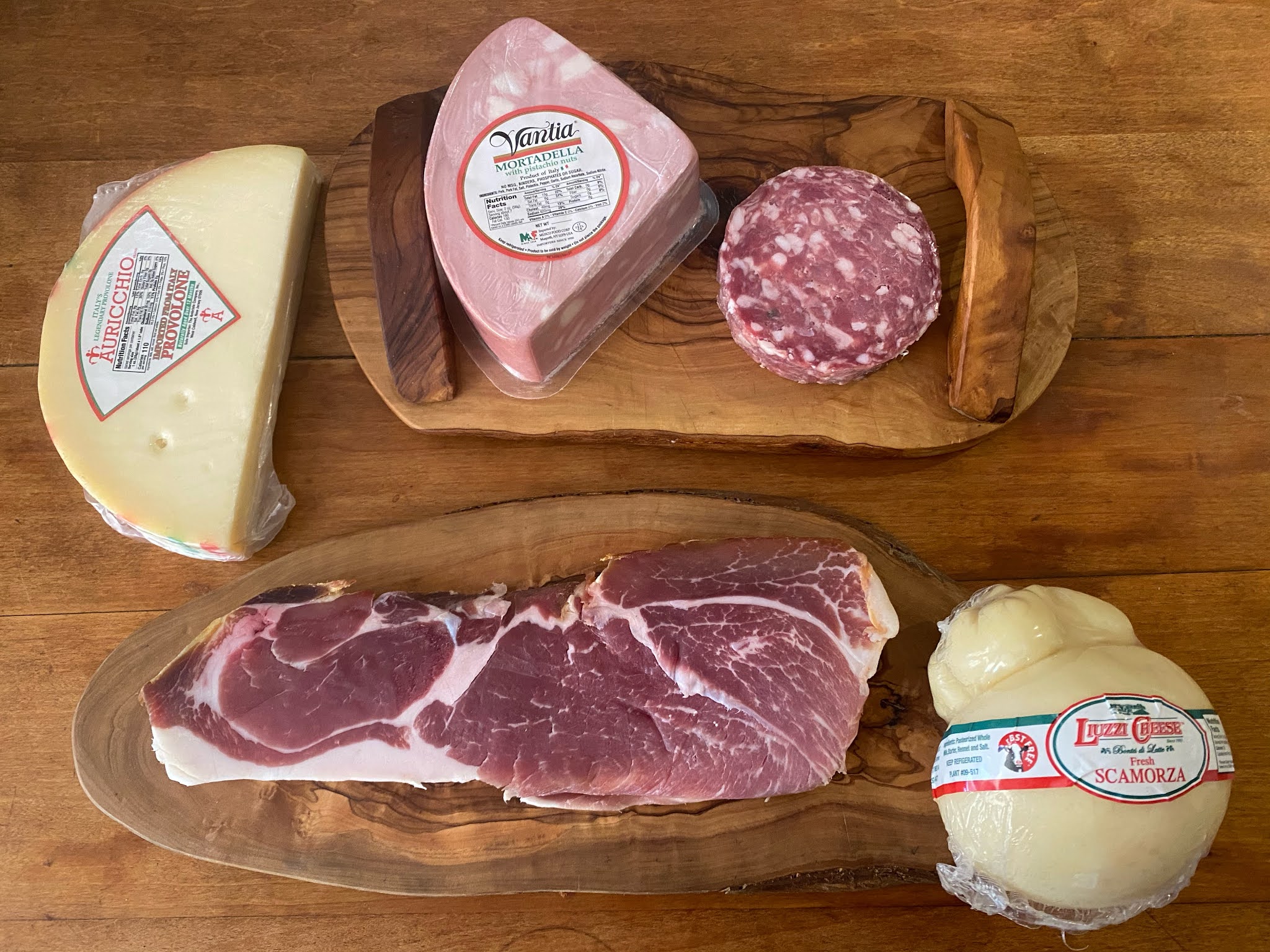
225 g di mortadella, a cubetti
225 g di soppressata, a cubetti
225 g di provolone Auricchio, a cubetti (stagionata e piccantissima, tanto amata ad Avellino come in America!)
450 g di caciocavallo o scamorza, a cubetti
Pecorino, grattugiato fresco (Non troppo! L’Auricchio è già piccante, e gli affettati sono già ricchi di sodio.)
Noce moscata, grattugiata frescamente
Pepe nero, macinato grossolanamente (una quantità generosa)

Per l’impasto:

O pasta per la pizza, pasta frolla, pasta brisé o pasta sfoglia – come desiderate. (Scrollate fino alla fine della pagina per una spiegazione delle diverse paste.)

Procedura

Unite gli ingredienti del ripieno. Aggiungete all’impasto di vostra scelta. Infornate a 190° per un’ora o fino a quando la pizza sarà dorata. Lasciate riposare per almeno 30 minuti. Servite tiepido o freddo.
  
4 April 2021

Latest update: 21 April 2023

Pizza chiena!  One of the most beloved Easter specialities in the Italian-American home!  The dish that is most talked about in conversation, maybe even more than lamb!  And this year, at age 50, I made it for the very first time!

First, a little history.  As we know, the world’s greatest recipes originated with leftovers.  In Naples, the Easter antipasto was fellata, a large and sumptuous platter of coldcuts – all the more sumptuous when you think that, in those days, the coldcuts were HOMEMADE.

On Easter Monday, called Pasquetta (or sometimes “il lunedì dell’angelo”, “Monday of the angel”), Italians have a wonderful picnic – a tradition which, tragically, has been lost in America, where everyone works on Mondays ... One of the most famous dishes for this picnic was pizza chiena.  Chiena is the Neapolitan word for piena, or “filled.”  It is also sometimes called pizza rustica. It is a pie, filled with cheeses, coldcuts, and eggs – all of the leftovers of the fellata, in other words.  

Because in America we don’t have the Easter Monday picnic, “pizza gayna” (as we pronounce it) is eaten on Easter itself.  I did not have it often growing up – mainly because the Italian-American version in very expensive!  It was considered very low class to make a pizza chiena with domestic prosciutto instead of prosciutto di Parma – and even lower class to use pepperoni!  It had to have CUBES of Parma, or it wasn’t pizza chiena.  

Some families use layers of sliced coldcuts, reminiscent of the fellata.  However the pizza chiena that I remember was ricotta, beaten eggs, cubes of Parma (and no other meats), cubes of scamorza, and lots of cracked black pepper (that last ingredient I remember well).  The crust is pizza dough (the same dough as bread dough, only beaten more to make it more elastic).  The top is brushed with egg yolk to make it shiny.  This is the classic pizza chiena that I remember from my childhood and that, according to the Avellinesi, is the only authentic pizza chiena. 

And yet, Italian-Americans often use pie crust.  Some use shortcrust pastry (the dough used for a quiche or for chicken pot pie).  Some even use puff pastry. Are these versions “unauthentic”?

Not according to history’s three most esteemed Neapolitan chefs! Vincenzo Corrado in Il cuoco galante (1773) suggested puff pastry.  Ippolito Cavalcanti in Cucina Teorico-pratica (1837) suggested pie crust. Jeanne Caròla Francesconi in La cucina napoletana (1963) agreed with Cavalcanti.

Historically, savory pies were already popular in the Middle Ages.  Pragmatically, in America, pie crust makes a lot of sense here. We don’t have the Easter Monday picnic, so the pizza chiena has to be served on Easter Sunday. How do you incorporate such a rich dish into a meal that is already so rich?  By using pie crust, it becomes a “savory pie” that can be served at the end with fruit and desserts.  

The Neapolitan fellata also included hard-boiled eggs, in addition to the meats and cheeses. In honor of this tradition, I increased the ratio of eggs to ricotta – 3 (not 2) eggs per pound of ricotta.  (Normally, when I make lasagne, ravioli, baked ziti, etc., I use the ratio of 2 eggs per pound of ricotta.)

Ingredients (for four pies)

For the filling:

64 oz ricotta (Unfortunately in America we have only cow’s milk ricotta. In Italy it is sheep’s milk ricotta, which is very special!)
12 eggs
1 lb prosciutto di Parma, cubed
1/2 lb mortadella, cubed
1/2 lb soppressata, cubed
1/2 lb Auricchio provolone, cubed (aged and very piccante, as beloved in Avellino as in America!)
1 lb caciocavallo or scamorza, cubed
Pecorino, freshly grated (Not too much! The Auricchio is already piccante, and the coldcuts are already high in sodium.)
Nutmeg, freshly grated
Cracked black pepper (a generous amount)

For the crust:

Either pizza dough, pie crust, shortcrust, or puff pastry – as you wish. (Scroll down to the bottom of the page for an explanation of the different pastry crusts.)

Procedure

Combine the ingredients of the filling. Add to the dough of your choice. Bake at 375° for 1 hour or until the crust is golden brown. Let sit for at least 30 minutes. Serve warm or cold.
C’è confusione intorno al termine inglese “pie crust”, che non si traduce molto facilmente in italiano. In italiano ci sono tre tipi fondamentali di pasta. Solo uno di loro si traduce direttamente.

La pasta sfoglia corrisponde alla “pâte feuilletée” in francese, la “puff pastry” in inglese. Qui non ci sono problemi di traduzione. La pasta sfoglia si prepara con farina, acqua e burro. Si usa sia in ricette dolci che salate, dalla millefoglie ai vol-au-vent.

La pasta brisè ovviamente corrisponde alla “pâte brisée” in francese. È un impasto friabile che non contiene uova. Come la pasta sfoglia, può essere usata per preparazioni salate oppure, opportunamente aromatizzata, per ricette dolci.

La pasta frolla generalmente non viene utilizzato per torte salate. La ricetta base si costituisce di farina, uova, zucchero e burro. Corrisponde alla “pâte sucrée” in francese.

Pertanto, non esiste una traduzione diretta della“pie crust” americana. Generalmente una quiche oppure una torta salata utilizzerebbe la pasta brisè (senza uova). Una torta dolce potrebbe usare quella, oppure una pasta frolla (con uova) oppure un tipo completamente diverso di impasto.
   There is confusion surrounding the English word “pie crust”, which does not translate very easily into Italian. In Italian there are three basic types of pastry crust. Only one of them translates directly.

Pasta sfoglia corresponds to “pâte feuilletée” in French, “puff pastry” in English. Here there are no translation problems. Pasta sfoglia is prepared with flour, water and butter. It is used in both sweet and savory recipes, from millefeuille to vol-au-vent.

Pasta brisè obviously corresponds to “pâte brisée” in French. It is a crumbly dough that does not contain eggs. Like puff pastry, it can be used for either savory or sweet recipes.

Pasta frolla is generally not used for savory pies.  The basic recipe consists of flour, eggs, sugar and butter. It corresponds to “pâte sucrée” in French.

Thus, there is no direct translation of the American “pie crust.” Generally a quiche or a savory pie would use a pasta brisè (without eggs). A sweet pie might use that, or a pasta frolla (with eggs), or a different type of crust entirely.
PARTE II (21 aprile 2023)

Solo ieri ho saputo da mia cugina di primo grado che nostra nonna non usava né l’impasto per il pane né l’impasto per torte. Usava invece l’impasto della pizza ma con l’aggiunta di due uova. In altre parole, un tipo di pasta brioche. (Intendiamoci, in Irpinia l’impasto del pane e quello della pizza sono esattamente la stessa ricetta -- l’unica differenza è che quest’ultimo viene lavorato di più, per renderlo più elastico.)

C’è confusione in America per quanto riguarda i formaggi. Gli italiani di seconda generazione usavano qualcosa che chiamavano “fresh cheese” (“formaggio fresco”). Lo chiamavano anche “basket cheese” (“formaggio da cestino”). Qui sta la confusione. Un “formaggio fresco” sarebbe il formaggio più giovane: un formaggio a base di cagliata fresca che non è stata pressata o stagionata. Si fa il formaggio e si lascia asciugare per un giorno, massimo due. Tuttavia un “formaggio da cestino” è quello che è stato scolato ed essiccato in un cestino; si può vedere la dentellatura del cestino all’esterno del formaggio. Pertanto, ovviamente, un formaggio da cestino sarebbe più stagionato di un formaggio fresco.

Un esempio di formaggio fresco è uno che conoscete benissimo: la ricotta. Quindi una ricetta che preveda la ricotta e anche il formaggio fresco è ridondante!

Un esempio di formaggio da cestino è la ricotta salata, un formaggio semiduro utilizzato in Sicilia per la Pasta alla Norma. Tuttavia in Irpinia il formaggio semiduro più utilizzato nella pizza chiena è il primosale. Primosale è un pecorino ovviamente più giovane e morbido del pecorino che si grattugia. In Italia, una delle cugine di mio padre (ne sono rimaste pochissime!) usa il “formaggio scamosciato,” che è un tipo di primosale.

Alla fine, la pizza chiena contiene una combinazione di formaggi morbidi e formaggi più stagionati.


   PART II (21 April 2023)

Only yesterday, I learned from my first cousin that our grandmother used neither bread dough nor pie dough. She used pizza dough but with the addition of two eggs. In other words, a type of brioche dough. (Mind you, in Avellino bread dough and pizza dough are exactly the same recipe -- the only difference is that the latter is worked more, to make it more elastic.)

There is confusion in America regarding the cheeses. The second-generation Italians used something that they called “fresh cheese.” They also called it “basket cheese.” Therein lies the confusion. A “fresh cheese” would be the youngest cheese: a cheese made from fresh curds that have not been pressed or aged. You make the cheese and you let it dry for a day, two maximum.  However a “basket cheese” is one that has been drained and dried in a basket; you can see the indentations of the basket on the outside of the cheese. Therefore, obviously a basket cheese would be older than a fresh cheese.

An example of a fresh cheese is a cheese that you know very well: ricotta. Therefore, a recipe that calls for ricotta and also fresh cheese is redundant!

An example of basket cheese is ricotta salata, a semisoft cheese used in Sicily for Pasta alla Norma. However in Avellino the semisoft cheese most commonly used in pizza chiena is primosale. Primosale is a pecorino that is obviously younger and softer than the pecorino that you grate. In Italy, one of my father’s cousins (there are very few still remaining!) uses formaggio scamosciato, which is a type of primosale.

At the end of the day, the pizza chiena contains a combination of soft cheeses and harder cheeses.