Visualizzazione post con etichetta Signature dishes. Mostra tutti i post

venerdì 17 settembre 2021

Timpano d' 'o Vesuvio

Alcune ricette classiche, come l’Amatriciana, hanno un procedimento ben definito; se non viene seguito, il piatto semplicemente non è autentico. Altri piatti, come gli Spaghetti Caruso, possono fare riferimento a diverse ricette differenti e non correlate, e per nessuna di esse esiste una versione autentica (una con i fegatini, una con le zucchine, una con la besciamella...).

Timpano d’ ’o Vesuvio rientra nella seconda categoria.

Ho cercato tra molte ricette. Ciascuna di loro era differente. Alcune usavano l’impasto della pizza. Altre usavano la pasta frolla. Alcune avevano un “cratere” in alto. Altre non avevano un’apertura. Alcune erano solide come un frittata di pasta e venivano servite a fette pulite. Altre non includevano uova o altri ingredienti leganti e il contenuto sfuso veniva scavato con un cucchiaio da portata. Alcune contenevano verdure. Altre no. Alcune contenevano gli spaghetti o i bucatini. Altri contenevano pasta corta. Tutte queste ricette diversissime erano tutte chiamate “Timpano d’ ’o Vesuvio.”

Avevano qualcosa in comune? Be’, tutte erano coperte da una crosta superiore (o l’impasto per pizza o la pasta frolla). E tutte contenevano i ripieni che vi aspettereste di vedere in una pasta al forno nel Sud Italia. Onestamente, questi erano gli unici due denominatori comuni. 

Pertanto non ho esitato a creare il mio proprio tributo a questo amato vulcano. Volevo che fosse tre cose: terroso, focoso e fumoso. Per la terra, i portobellini (cremini). Per il fuoco, la carne delle salsicce piccanti. Per il fumo, la pancetta affumicata.

INGREDIENTI PER DUE “VULCANI”

PER IL SUGO
2 scatole (1600 g) di pomodori pelati italiani, passati
EVO (non troppo)
2 strisce di pancetta affumicata, tagliate a quadretti con le forbici
450 g della carne di salsiccia piccante (senza budello)
1/2 cipolla piccola, tritata
2 spicchi d’aglio, affettati
sale & pepe
basilico fresco (aggiunto solo alla fine)
6 portobellini (cremini), affettati (saltati separatamente nel burro, sale e pepe, aggiunti al sugo solo alla fine)

PER IL RIPIENO
1 kg di bucatini o perciatelli
1 kg di ricotta
4 grandi uova
pecorino, grattugiato fresco
un po’ di scamorza grattugiata
noce moscata, grattugiata fresca
prezzemolo, tritato fresco
sale & pepe

PER LA CROSTA
Per ciascun timpano, un gran disco di pasta frolla per il fondo, un disco più grande di pasta frolla per la superficie (quindi 4 dischi).

PROCEDURA

Per il sugo: soffriggete l’olio, la pancetta, l’aglio e la cipolla. Aggiungete la carne della salsiccia, mescolando continuamente. Quando la maggior parte del colore rosa è sparita, aggiungete i pomodori, lavando le scatole con acqua o con vino rosso. Fate cuocere per diverse ore. Aggiungete il basilico e i funghi solo alla fine.

Per il ripieno: unite tutti gli ingredienti del ripieno tranne i bucatini.

Per la pasta frolla: utilizzate la tua ricetta preferita. (Per una maggiore autenticità, usate lo strutto di maiale casereccio invece del burro.) Usate le tortiere rotonde al diametro di 23 cm. Posizionate il disco più piccolo d’impasto sul fondo. Fate un buco al centro del disco più grande.

Cercate di avere tutto quanto sopra pronto per il montaggio quando i bucatini sono pronti.

Per i bucatini: In una pentola capiente fate bollire abbondante acqua salata. Quando raggiunge il bollore, aggiungete i bucatini, mescolate bene e, quando riprende il bollore, fate cuocere per solo cinque minuti. Scolate e sciacquate immediatamente con acqua fredda per un paio di minuti. (N.B.: normalmente non sciacquerei MAI la pasta. Lo faccio solo per la pasta al forno o per le lasagne.) Scolate, mettete in una grande ciotola o pentola, e subitissimo mescolate con uno o due mestoli di sugo (cosicché i bucatini non si attacchino).

Ai bucatini, mettete il composto di ricotta e abbastanza sugo per creare un bel colore rosa. Mescolate bene. Riempite le tortiere, facendo una cupola o “montagna.” Completate con una mestolata di sugo al centro. Coprite con il disco più grande. Sigillate bene il perimetro! Infornate a 190° per c.60 minuti o fino a quando la crosta sarà dorata e il ripieno inizierà a bollire leggermente. Sfornate, lasciate riposare per 15 minuti, versate un po’ di sugo caldo sul cratere per una presentazione drammatica, poi affettate e servite! (Dovrebbe essere rimasto molto sugo, da servire sopra le fette.)
   Some classic recipes, such as Amatriciana, have a very clearly defined procedure; if it is not followed, the dish is simply not authentic. Other dishes, such as Spaghetti Caruso, can refer to several different and unrelated recipes, and there is no authentic version for any of them (one with chicken livers, one with zucchini, one with béchamel...).

Timpano d’ ’o Vesuvio falls into the latter category.

I searched through many recipes. Every one of them was different. Some used pizza dough. Others used pie crust. Some had a “crater” at the top. Others didn’t have a hole. Some were solid like a pasta pie, and were served in clean slices. Others did not include eggs or any other binding ingredient, and the loose contents were scooped out with a serving spoon. Some contained vegetables. Others did not. Some contained spaghetti or bucatini. Others contained short pasta. All of these very different recipes were all called “Timpano d’ ’o Vesuvio.”

Did they have anything in common? Well, all of them were covered by a top crust (either pizza dough or pie crust). And all of them contained fillings that you would expect to see in a baked pasta in Southern Italy. Honestly, these were the only two common denominators.

Therefore I felt no hesitation to create my own tribute to this beloved volcano. I wanted it to be three things: earthy, fiery, and smoky. For the earth, baby bella mushrooms. For the fire, hot sausage meat. For the smoke, bacon.

INGREDIENTS FOR TWO “VOLCANOES”

FOR THE SUGO
2 cans (1600 g) Italian peeled tomatoes, puréed
EVOO (not too much)
2 strips bacon, cut in squares with scissors
1 lb (450 g) hot sausage meat (without casings)
1/2 small onion, chopped
2 garlic cloves, sliced
salt & pepper
fresh basil (added only at the end)
6 baby bellas, sliced (sautéed separately in butter, salt, and pepper, added to the sugo only at the end)

FOR THE FILLING
2 lbs bucatini or perciatelli
2 lbs ricotta
4 eggs
pecorino, freshly grated
a little shredded scamorza
nutmeg, freshly grated
parsley, freshly chopped
salt & pepper

FOR THE PIE CRUST
For each timpano, one large disk of dough for the bottom, one larger disk of dough for the top (therefore 4 disks).

PROCEDURE

For the sugo: sauté the oil, bacon, garlic, and onion. Add the sausage meat, stirring constantly. When most of the pink color has gone away, add the tomatoes, washing the cans either with water or red wine. Cook for several hours. Add the basil and mushrooms only at the end.

For the filling: combine all of the filling ingredients except the pasta.

For the pie crust: use your favorite recipe. (For more authenticity, use homemade pork lard instead of butter.) Use round pie pans 9” in diameter. Place the smaller disk of dough on the bottom. Cut a hole in the middle of the larger disk.

Try to have all of the above ready for assembly when the pasta is ready.

For the pasta: In a large pot, boil abundant salted water. When it reaches a boil, add the pasta, stir well, and when it returns to a boil, cook for ONLY five minutes (NOT the cooking time suggested on the box). Strain, and immediately rinse with cold water for a couple of minutes. (Note: normally I would NEVER rinse pasta. I do it only for baked pasta or lasagne.) Strain, put in a large bowl or pot, and immediately mix with one or two ladles of sauce (so that the bucatini do not stick together).

Into the bucatini, put the ricotta mixture, and enough sauce to create a nice pink color. Stir well. Fill the pie pans, making a dome or “mountain.” Top with one ladle full of sauce in the middle. Cover with the larger disk. Seal the perimeter well! Bake at 375° for c.60 minutes or until the crust is golden brown and the filling starts to bubble somewhat. Remove from oven, let set for 15 minutes, poor a little hot sugo over the crater for a dramatic presentation, then slice, and serve! (There should be plenty of sauce left over, to serve on top of the slices.)
Cartolina dalla mia collezione personale. Postcard from my personal collection.

martedì 2 giugno 2020

Conchigliette Leonardo

Ho preparato questo alcune sere fa. Il contrasto dei sapori dolci (pomodori, basilico) e dei sapori più scuri (i pistacchi tostati, e i peperoni che sono “scuri ma dolci”) è stato irresistibile! Non ce ne sono foto, perché è svanito rapidamente!

Ingredienti
500 gr conchigliette
evo
50 gr pistacchi
qualche fetta di cipolla, tritata
1/2 peperone dolce rosso, detorsolato e tagliato a quadratini
550-650 gr di pomodori dell’uva (non pomodori ciliegini), interi (non tagliateli)
basilico fresco

Preparazione
In una padella con coperchio, riscaldate l’olio d’oliva. Tostate i pistacchi fino a quando diventeranno dorati (non bruni). Aggiungete la cipolla e i peperoni e fate cuocere per qualche minuto. Aggiungete i pomodori e il basilico. Coprite. Fate cuocere a fuoco medio-basso, fino a quando i pomodori saranno morbidi ma non disintegrati. Nel frattempo, fate cuocere le conchigliette in abbondante acqua salata, aggiungete alla salsa e Buon Appetito!
   I made this a few nights ago. The contrast of the sweet flavors (the little tomatoes and the basil) and the darker flavors (the toasted pistachios, and the peppers which are "dark yet sweet") is irresistible! There are no photos, because it vanished quickly!

Ingredients 
1 lb conchigliette (small shells)
EVOO
50 gr pistachios
a few slices onion, chopped
1/2 red bell pepper, cored and cut in little squares
2 pints (550-650 gr) grape tomatoes (not cherry tomatoes), whole (do not cut)
fresh basil

Preparation
In a skillet with a cover, heat the olive oil. Toast the pistachios until they become golden (not brown). Add the onion and peppers and cook for a few minutes. Add the tomatoes and basil. Cover. Cook on medium low heat, until the tomatoes are soft but not disintegrated. Meanwhile, cook the conchigliette in abundant salted water, add to the sauce, and Buon Appetito!

sabato 10 agosto 2019

Peperoni Leonardo (ripieni di salsicce, pane & Champagne) / Peppers Leonardo (stuffed with sausages, bread & champagne)

PEPERONI LEONARDO
(RIPIENI DI SALSICCE, PANE & CHAMPAGNE)


Ingredienti
Le seguenti sono le proporzioni. Le quantità non posso essere esattissime, siccome ogni peperone ha una dimensione diversa, ogni fetta di pane ha uno spessore diverso, ecc. Il pane che è più raffermo richiederà più liquido, ecc. Ma questi sono i rapporti di base:

olio d’oliva extravergine
1 cipolla media, tritata
1 costa di sedano, tritato
6 portobellini (cremini), tritati grossolanamente
1 o 2 spicchi d’aglio, tritato
3 salsicce dolci, gli involucri rimossi
Champagne
6 fette pane multicereali, a cubetti
latte intero
pecorino grattugiato al momento (una generosa quantità)
un pizzico di noce moscata, macinata al momento
3 grandi peperoni rossi dolci (Usate solo quei rossi. I verdi sono troppo amari, e gli arancioni e i gialli non sono abbastanza saporiti.)
basilico fresco
6 fette di pomodoro
sale e pepe macinati al momento

Preparazione

Lavate e asciugate i peperoni. Con uno spelucchino tagliate intorno al picciolo ed estraetelo. Poi dimezzate longitudinalmente i peperoni, ed estraete i filamenti e i semini interni. Mettete da parte i peperoni.

In una grande ciotola, mescolate il pane, il pecorino, il sale e pepe e la noce moscata. Aggiungete una goccia di latte; la quantità dipende dalla durezza del pane. (Se il pane sia molto raffermo, fatelo bagnare nel latte, poi strizzatelo e scartate il latte eccedente.) Mescolate bene, finché il pane sarà ben sbriciolato.

In una padella capiente, fate riscaldare l’olio. Aggiungete la cipolla; fate saltare finché comincerà a cambiare colore, ma NON fatela rosolare. Aggiungete il sedano; fate saltare finché comincerà ad ammorbidirsi. Aggiungete i funghi; fate saltare finché comincerà a cambiare colore. Aggiungete il sale e pepe. Aggiungete la carne di salsiccia. NON STRACUOCERE; cuocete solo finché la maggior parte (ma non necessariamente tutto) del colore rosa scomparirà. Aggiungete lo champagne, ma riducete solo per un minuto o due. Spegnete la fiamma e trasferite il contenuto della padella nella ciotola. Mescolate con un cucchiaione. Se il composto è troppo secco, aggiungete una goccia di latte, olio e / o champagne.

Ungete una teglia da forno con olio. Disponete i peperoni. Riempite con il ripieno. Mettete il ​​basilico fresco su ciascuno. Mettete una fetta di pomodoro su ciascuna. Spennellate la parte superiore del pomodoro con olio. Fate cuocere in forno a 175 ° per 60-75 minuti.

Se i peperoni non siano abbastanza cotti, sarebbero troppo amari. Se siano cotti troppo, sarebbero troppo morbidi. Quindi, cuoceteli finché abbastanza dolci ma abbastanza al dente.

N.B.: Si potrebbe considerare questo piatto per la vostra cena di San Valentino – un peperone se per un antipasto, alcuni peperoni se per il secondo piatto!
   PEPPERS LEONARDO
(STUFFED WITH SAUSAGES, BREAD & CHAMPAGNE)


Ingredients
The following are the proportions. The quantities cannot be very exact, as each pepper is a different size, each slice of bread has a different thickness, etc. Bread that is more stale will require more liquid, etc. But these are the basic ratios:

extra-virgin olive oil
1 medium onion, chopped
1 stalk of celery, minced
6 baby bellas (cremini), coarsely chopped
1 or 2 cloves of garlic, chopped
3 sweet Italian sausages, the casings removed
Champagne
6 slices of multigrain bread, cubed
whole milk
freshly grated pecorino (a generous amount)
a pinch of nutmeg, freshly ground
3 large red bell peppers (Use only the red ones. The green ones are too bitter, and the orange and yellow ones aren't flavorful enough.) 
fresh basil
6 slices of tomato
freshly ground salt & pepper

Preparation

Wash and dry the peppers. With a paring knife cut around the stalk and remove it. Then cut the peppers in half lengthwise and remove the internal filaments and seeds. Put the peppers aside.

In a large mixing bowl, mix the cubed bread, pecorino, salt, pepper, and nutmeg. Add a drop of milk; the amount depends on the hardness of the bread. (If it's very stale, soak it in milk, then then squeeze it out and discard the excess milk.) Mix well, until the bread is well crumbled.

In a large skillet, heat the oil.  Add the onion; sauté until it starts to change color, but DON'T brown. Add the celery; sauté until it starts to soften. Add the mushrooms; sauté until it starts to change color.  Add the salt, pepper, and sausage meat. DO NOT OVERCOOK; cook only until most (but non necessarily all) of the pink color is gone. Add the champagne, but reduce only for a minute or two. Shut the heat, and transfer the contents of the skillet to the mixing bowl.  Stir with a wooden spoon. If the mixture is too dry, add a drop more milk, oil, and/or champagne.

Grease an oven pan with oil.  Arrange the pepper halves.  Fill with the stuffing.  Place the fresh basil on each.  Place one slice of tomato on each.  Brush the top of the tomato with olive oil.  Bake at 350° for 60-75 minutes.

If the peppers aren't cooked enough, they will still be bitter.  If they are cooked too much, they will be too soft.  Thus, cook them until they are sweet yet still al dente. 

Note: You might consider this dish for your Valentine's Day meal – one pepper if as an appetizer, or several if as the second course!

sabato 3 novembre 2018

Ciambellone salato (per Mimmo Corcione) / Savory Bundt cake (for Mimmo Corcione)

CIAMBELLONE SALATO
di carne trita, bucatini,
ricotta & bacon. 
Ricetta dedicata a Mimmo Corcione.

Mimmo Corcione è il chef napoletano più famoso dell’Internet. Il suo canale YouTube (a partire da novembre 2018) ha più di 55.000 abbonati e più di 21 milioni di visualizzazioni! Non c’è davvero modo di trasmettere quanto sono rimasto sbalordito, e onorato, quando il mese scorso, Mimmo ha creato una ricetta e l’ha dedicata a me! E ha citato il mio nome nel video! Ero abbagliato come un adolescente!

Restituisco il favore in umiltà totale e senza nessune manie di grandezza. Le ricette di Mimmo sono simultaneamente rustiche e nobili. Miravo a questa dualità quando ho creato questo ciambellone salato, segno della mia più sincera stima e gratitudine a Mimmo Corcione.


Ingredienti

PER LA CARNE:

1,5 kg carne macinata
     (750 gr manzo, 750 gr maiale, oppure
     500 g ciascuno di manzo, maiale e vitello)
prezzemolo fresco, tritato
menta fresca, tagliata a pezzi grossi
3 uova
pecorino, frescamente grattugiato
pane multicereali, raffermo
1 o 2 spicchi d’aglio
un pizzico di cannella, frescamente macinata
un po’ di scorza di arancia, frescamente grattugiata
un po’ di latte intero
sale
pepe

PER IL RIPIENO:

250 gr bucatini o perciatelli
     (cotti in anticipo), freddi
2 o 3 cucchiai sugo di pomodoro
     (cotto in anticipo), freddo
500 gr ricotta
2 uovo sbattuto
pecorino, frescamente grattugiato
scamorza o mozzzarella, grattugiata
noce moscata, frescamente macinata
prezzemolo fresco, tritato
sale
pepe

PER LA CROSTA:

28 fette abbastanza spesse (c.750 gr) pancetta affumicata (tipo bacon)


ATTREZZATURE NECESSARIE:

stampo per ciambellone (diametro di 25 cm),
      con maniglie
griglia di raffreddamento
teglia da forno
grande pentola per la pasta
2 grande ciotole
un paio di forbici

Preparazione

Qualche ora prima (oppure il giorno prima), portate ad ebollizione una grande pentola di abbondante acqua salata. Buttate la pasta. Quando l’acqua tornerà ad ebollizione, fate cuocere per due minuti al di sotto del tempo di cottura consigliato (probabilmente 7 minuti – solitamente i bucatini e i perciatelli impiegano 9 minuti). Nel frattempo, aggiungete il sugo freddo a una delle due grandi ciotole. Scolate la pasta e aggiungetela alla ciotola con il sugo freddo. Amalgamate bene e fate raffreddare.

Preriscaldate il forno a 180 ° C.

Mettete la carne nell’altra grande ciotola. Aggiungete il prezzemolo e la menta.  In una robot da cucina, mescolate i successivi 9 ingredienti.  Aggiungete alla ciotola questo composto, e mescolate bene con la carne. Mettete da parte.

Nella ciotola con la pasta e il sugo, aggiungete tutti gli ingredienti del ripieno, e amalgamate bene.

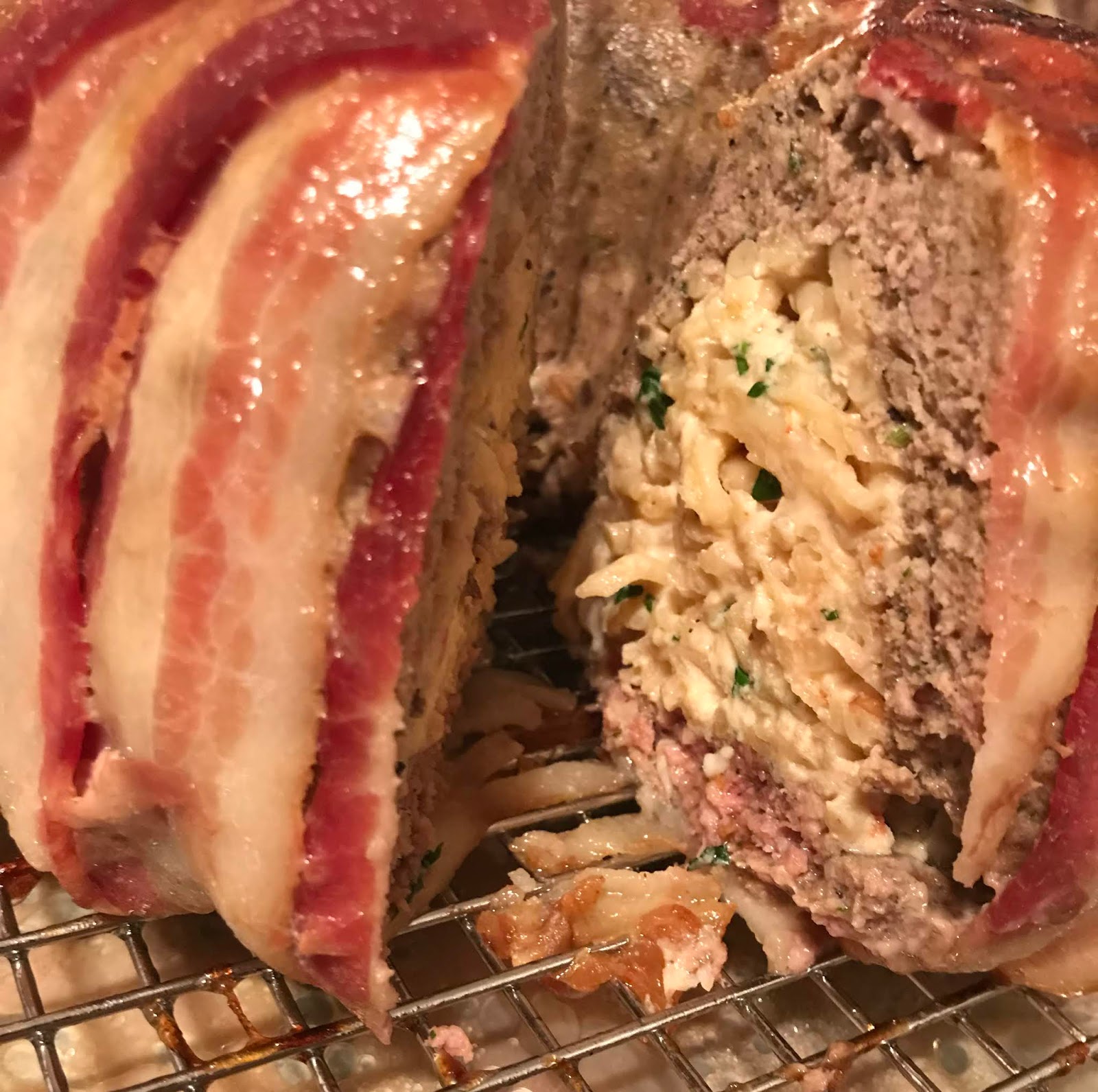
Foderate lo stampo con le fette di bacon. (Una parte di ogni fetta sporgeranno oltre i lati dello stampo. Notate bene nella prima foto che non si fodera il tubo centrale. Se lo facciate, il bacon all’interno non diventerebbe croccante.)  Aggiungete 2/3 della carne sul fondo dello stampo e spalmate su i lati e al centro dello stampo, facendo una “grondaia” per il ripieno. Aggiungete il ripieno nella “grondaia.” Coprite il ripieno con la carne rimanente e appianate. Piegate le parti sporgenti del bacon sopra la parte superiore della carne. (Usate i forbici per tagliare e trasferite pezzettini del bacon come necessario.)  Coprite con un foglio di alluminio, e infornate per 30 minuti.  Rimuovete il foglio e fate cuocere per altri 30 minuti (un’ora in totale). Durante la cottura, se troppo grasso si raduni sopra, potrebbe essere necessario farne defluire un po’.

Se dopo un’ora il bacon sopra non è ancora croccante, mettetelo sotto il grill, fiamma alta, per 5 minuti

Quando cotto, sfornate lo stampo. Posizionate una griglia di raffreddamento e una teglia da forno sulla parte superiore dello stampo. Attentamente, con guanti da forno, afferrate le maniglie dello stampo, la griglia e la teglia.  Attentamente capovolgetelo. Sollevate via lo stampo. (Scivolerà fuori facilmente, a causa del grasso del bacon.) Mettete in forno sotto il grill, fiamma alta, per 5 minuti o fino a quando il bacon sarà croccante.

Variazione
Per il ripieno, si potrebbe sostituire la pasta con la purè di patate (preparata nel modo normale, senza sugo ovviamente). In questo caso, non mettete troppo latte nelle patate.
  
SAVORY BUNDT CAKE
with ground meat, bucatini,
ricotta & bacon. 
Recipe dedicated to Mimmo Corcione. 

Mimmo Corcione is the most famous Neapolitan chef on the Internet. His YouTube channel (as of November 2018) has over 55,000 subscribers and over 21 million views! There's really no way to convey how stunned, and honored, I was when last month, Mimmo created a recipe and dedicated it to me! And mentioned my name in the video! I was like a star-struck teenager!

I return the favor in total humility and without any delusions of grandeur. Mimmo's recipes are simultaneously rustic and noble. I was aiming for this duality when I created this savory cake, a sign of my sincerest esteem and gratitude a Mimmo Corcione.


Ingredients

FOR THE MEAT:

3 lb ground meat
     (1.5 lb beef, 1.5 lb pork, or
     1 lb each of beef, pork, and veal)
fresh parsley, chopped
fresh mint, coarsely cut
3 eggs
pecorino, freshly grated
multigrain bread, stale
1 or 2 cloves garlic
a smidgen of cinnamon, freshly ground
a little orange rind, freshly grated
a little whole milk
salt
pepper

FOR THE FILLING:

1/2 lb bucatini or perciatelli
     (cooked beforehand), cold
2 or 3 TB tomato sauce
     (cooked beforehand), cold
1 lb ricotta
2 egg, beaten
pecorino, freshly grated
scamorza or mozzarella, shredded
fresh parsley, chopped
nutmeg, freshly ground
salt
pepper

FOR THE CRUST:

28 slices (c. 24 oz.) bacon (hickory smoked or applewood smoked. NOT the kind sweetened with maple syrup.)


NECESSARY EQUIPMENT:

Bundt pan (10” in diameter), with handles
cooling rack
baking pan
large pot for the pasta
2 large bowls
a pair of scissors

Preparation

A few hours beforehand (or the day before), bring a large pan of abundant salted water to a boil.  Put in the pasta. When the water returns to a boil, cook for two minutes below the recommended cooking time (probably 7 minutes – usually bucatini and perciatelli take 9 minutes). Meanwhile, add the cold tomato sauce to one of the two large bowls.  Strain the pasta and add it to the bowl with the cold sauce. Mix well and let cool.

Preheat oven to 350°F.

Place the meat in the other large bowl.  Add the parsley and mint.  In a food processor, mix the next 9 ingredients. Add this mixture to the bowl, and mix well with the meat. Set aside.

In the bowl with the pasta and sauce, add all of the filling ingredients, and mix well.

Line the Bundt pan with the slices of bacon. (Part of each slice will hang over the sides of the pan.  Note well in the first photo that you don't line the central tube. If you do, the bacon in the inside would not become crispy.)  Add 2/3 of the meat to the bottom of the pan and spread up the sides and up the middle of the pan, making a “gutter” for the filling. Add the filling into the “gutter.” Top the filling with the remaining meat and smooth out. Fold the overhanging parts of the bacon over the top of the meat. (Use the scissors to cut and relocate little pieces of the bacon, as necessary.)  Cover with foil and bake for 30 minutes.  Remove the foil and bake for another 30 minutes (1 hour in total). During cooking, if too much fat gathers on top, it might be necessary to drain off some of it.

If after an hour the bacon on top is not crispy, broil on high for 5 minutes.

When done, remove the Bundt pan from the oven.  Place a cooling rack and baking sheet on top of it. Carefully, with oven mitts, grab hold of the handles of the Bundt pan, cooling rack, and baking sheet.  Carefully flip it over.  Lift away the Bundt pan. (It will slide off easily, because of the grease from the bacon.) Broil on high for 5 minutes or until the bacon is crispy.

Variation
For the filling, you could substitute the pasta with mashed potatoes (prepared in the normal way, without sauce obviously). In this case, don't put too much milk in the potatoes.

Notate che il tubo centrale non si fodera con il bacon. (Vedete la nota sopra.)
Note that the central tube is not lined with bacon. (See the note above.)
Servirà i forbici per questo passo. (Vedete le istruzioni sopra.)
You will need the scissors for this step. (See the instructions above.)

giovedì 8 febbraio 2018

Patè di fegatini & grand marnier / Pâté de foies de poulet et grand marnier

www.postandcourier.com

Patè alla Leonardo
(Patè di fegatini & Grand Marnier)


Ingredienti
500 g fegatini di pollo
1 stricia (35 g) bacon (pancetta affumicata)
1/3 tazza (80 ml) Grand Marnier
90 g burro salato
1 piccola cipolla, tritata
1 spicchio d’aglio, tritato
1 cucchiaio erbe provenzali 
Noce moscata, macinata al momento
Pepe nero, macinato al momento
1/3 tazza (80 ml) panna grassa

Preparazione
Fate saltare il bacon. Quando sarà mezzo rosolato e gran parte del grasso sarà resa, poi dentro questo grasso aggiungete il resto degli ingredienti tranne la panna. Fate saltare. I fegatini saranno pronti quando non saranno più rosa al centro. Aggiungete la panna e fate passare il tutto con un frullatore ad immersione. (Oppure, trasferitelo in un robot da cucina o in un frullatore, e passatelo lì.) Trasferite questa miscela divina in un recipiente non troppo profondo (io uso Pyrex, i.e. vetro borosilicato) e fatela refrigerare.

Spalmate sopra il pane integrale tostato, oppure sopra i cracker integrali a scelta vostra.  Potete guarnirlo con i cornichon (cetriolini) e una fetta di arancia.

Notate bene che i francesi conservano il loro paté aggiungendo di sopra uno strato o di burro fuso o di grasso di pollame (pollo, anatra, oca). Altrimenti, la superficie superiore si ossiderà e diventerà marrone-verdastro. Per questo passo io ho una soluzione molto saporita!  Qualche giorno prima, per cena, in una padella di ghisa, cuocerò al forno le cosce di pollo con bacon, olio d’oliva, cipolle, aglio, sale, pepe ed erbe provenzali fresche. Conserverò tutto lo schmalz fragrante dalla padella, lo trasferirò in un piatto di Pyrex e lo terrò in frigorifero. Poi, un altro giorno, farò il paté e lo trasferirò nel mio recipiente non troppo profondo. Poi, toglierò dal frigo lo schmalz magico, lo scioglierò e ne verserò uno strato sopra il paté!

Questo paté è un alimento base che troverete spesso nel mio frigorifero. Potete usare la scorza d’arancia al posto del Grand Marnier. In entrambi i casi, l’acidità aiuta a conservare il fegato. Più importantamente, l’abbinamento del fegato e l’arancia, Mamma mia! (Quest’abbinamento non è una novità per gli abruzzesi, che fanno quelle famose salsicce contenenti cinque ingredienti: fegato, coppa di maiale, provolone, aglio e scorza d’arancia. Cibus deorum!)

Ultimo aggiornamento: 17 agosto 2021.
   Pâté à la Leonardo
(Pâté de foies de poulet & Grand Marnier)
(Chicken liver & Grand Marnier Pâté!)

Ingredients
500g chicken livers
1 strip hickory-smoked bacon
1/3 cup Grand Marnier
6 TB (3/4 stick) salted butter
1 small onion, chopped
1 clove garlic, chopped
1 TB Herbs de Provence
Fresh-ground nutmeg
Fresh-ground black pepper
1/3 cup heavy cream

Preparation
Sauté the bacon. When it is half-browned and much of the fat has been rendered, then into this fat add the rest of the ingredients except the cream. Sauté. The liver is done when it is no longer pink in the middle. Add the cream and purée everything with an immersion blender.  (Or, transfer everything to a food processor or blender and purée everything there.) Transfer this divine mixture into a not-too-deep receptacle (I use Pyrex) and refrigerate.

Spread onto whole-wheat toast, or the whole-wheat crackers of your choice.  You can garnish it with cornichons (gherkins) and a slice of orange.

Please note that the French preserve their pâté by adding on top a layer of melted butter or poultry fat (chicken, duck, goose). Otherwise, the top surface will oxidize and turn greenish-brown. For this step I have a very tasty solution!  A few days before, for dinner, in a cast iron skillet, I will bake chicken thighs with bacon, olive oil, onions, garlic, salt, pepper and fresh herbs de Provence. I will save all the fragrant schmalz from the pan, transfer it to a Pyrex dish and keep it in the refrigerator. Then, another day, I will make the pâté and transfer it to my not-too-deep receptacle. Then, I’ll take magical schmalz out of the fridge, melt it and pour a layer on top of the pâté!

This pâté is a staple that you will often find in my refrigerator. You can use orange rind instead of Grand Marnier. Either way, the acidity helps to preserve the liver. More importantly, the pairing of the orange flavor with the liver, oh my God!  (This pairing is not news to the Abruzzesi, who make those famous sausages containing five ingredients: liver, pork butt, provolone, garlic, and orange rind. Cibus deorum!)

Latest update: 17 August 2021.

sabato 17 giugno 2017

Sauce or gravy???

Il ragù napoletano di Mimmo Corcione (schermata da YouTube).
The Neapolitan ragù by Mimmo Corcione (screenshot from YouTube).
PARTE Ia
IL SUGO

(Per la ricetta per le polpette, scrollate giù alla parte IIa.) 

Da decenni, gli italoamericani portano avanti un’accesa discussione: il sugo domenicale, si chiama “sauce” o si chiama “gravy”?

Il dibattito è difficile spiegare agli italiani in Italia – perché la parola “sugo” può significare sia  “sauce” (salsa) sia “gravy” (sughetto denso), ma anche perché il sugo domenicale nella casa italoamericana è un rito religioso, tenendo un’importanza che in Italia non ha equivalente.

Quelli che ferocemente insistono che “gravy” sia la parola sbagliata non sanno la storia dietro il ragù napoletano, che nacque durante l’occupazione borbonica del Sud, il Regno delle Due Sicilie – i tempi dei “Monzù” (1734-1861).

In nuce:

* L’epoca vide l’impollinazione incrociata fra la cucina francese e quell’italiana.
* I francesi fecero gli stufati deliziosi con tante carni e tanto vino, cotti per molte ore in grandi calderoni di ferro.
* L’influenza italiana introdusse dentro queste stufate sempre più pomodori.
* Un dì, qualcuno scoprì che il sugo di queste stufate rosse facesse un bellissimo condimento per la pasta!

Quindi, il sauce fu davvero il gravy rimasto dalla stufata!

Allora, cos’è la ricetta dell’autentico “Sugo Domenicale ”, il Sacro Graal della cucina italoamericana?

La ricetta più autentica in lingua italiana è quella di Mimmo Corcione, il dio della cucina partenopea.

La ricetta più antentica in lingua inglese è quella di Frank Fariello, il dio della cucina italoamericana.

Certo non intendo tentare di superare le ricette di quei due dei.  Ma cos’è la mia ricetta personale del sugo?

Non è tanto una “ricetta” che una procedura, o più precisamente una filosofia. (Vedrete che assomiglia molto a una stufata!)

   PART I
THE SUGO

(For the recipe for meatballs, scroll down to Part I.)

For decades, Italian-Americans have carried on a fierce debate: is the Sunday sugo called "sauce" or "gravy"?

The debate is difficult to explain to Italians in Italy – because the word sugo can mean either "sauce" or "gravy", but also because the Sunday sugo in the Italian-American home is a religious rite, holding an importance that has no equivalent in Italy.

Those who ferociously insist that "gravy" is the wrong word do not know the history behind the Neapolitan ragù, which was born during the Bourbonic (i.e., French) occupation of Southern Italy, the Kingdom of the Two Sicilies – the days of the “Monzù” (1734-1861).

In a nutshell:

* The era saw the cross-pollination between French and Italian cuisines.
* The French made delicious stews with many meats and much wine, cooked for many hours in great iron cauldrons.
* The Italian influence introduced more and more tomatoes into these stews.
* One day, someone discovered that the sugo from these red stews made a wonderful condiment for pasta!

Therefore, the "sauce" was indeed the "gravy" remaining from the stew!

So, what is the recipe for the authentic "Sunday sugo", the Holy Grail of the Italian-American cuisine?

The most authentic recipe in the Italian language is that of Mimmo Corcione, god of the Neapolitan cuisine.

The most authentic recipe in the English language is that of Frank Fariello, god of the Italian-American cuisine.

Certainly I don't intend to surpass the recipes of those two gods.  But what is my personal recipe for sugo?

It is not so much a "recipe" as it is a procedure, or more precisely a philosophy. (You will see that it closely resembles a stew!)
Ecco il Sugo Ciampiano:

1.  Molte carni – le carni che vi piacciono. Fatele friggere nello strutto di maiale oppure l’evo, con cipolle tritate, degli spicchi d’aglio dimezzati, sale & pepe.

2. Appena le carni saranno sigillate, aggiungete 375 ml vino o rosso (stile più meridionale) o bianco (stile più centrale).

3. Appena il vino raggiungerà il punto d’ebollizione, aggiungete:

   a. tre scatole (2,4 kg) pelati San Marzano, intere (N.B. Controllate l’etichetta e assicuratevi che non ci sia cloruro di calcio.)
   b. 375 ml acqua
   c. qualche carota
   d. qualche sedano
   e. un mezzo peperoncino (facoltativo)
   f. niente zucchero! (Il vino dà tutta la necessaria dolcezza. Se volete anche più dolcezza, aggiungete qualche pomodoro secco al sole.)

 4. A questo punto il sugo sarà molto acquoso.  Non vi preoccupare; il prossimo passo vi spiegherà tutto.

5. Appena gli ortaggi sono abbastanza morbidi, rimuovete le carni dalla pentola, e passate il sugo con un frullatore ad immersione. (Perciò avete aggiunto l’acqua invece del brodo – gli ortaggi aromatici sono frullati con i pomodori e tutti i liquidi, dunque il “brodo” c’è sta.)

6. Tornate le carni alla pentola. Continuate a far cuocere il sugo, LENTAMENTE, per alcune ORE.

7. Se usiate le braciole, le aggiungereste (già fritte) un’ora prima della fine.

8. Se usiate le polpette, le aggiungereste (già fritte) 30/45 minuti prima della fine.

9. Le foglie fresche di basilico si aggiunge allultimo momento!
   Here is the Ciampa Sauce:

1. Lots of meats – the meats that you like.  Fry them in pork lard or EVOO, with chopped onions, halved garlic cloves, salt & pepper.

2. As soon as the meats are sealed, add 375 ml (half a bottle) wine, either red (more Southern Italian style) or white (more Central Italian style).

3. When the wine reaches the boiling point, add:

   a. 3 cans (2,400 gr) San Marzano whole peeled tomatoes (NOTE: Check the label and make sure there is no calcium chloride.)
   b. 375 ml water
   c. a few carrots
   d. a few stalks of celery
   e. half of a chili pepper (optional)
   f. no sugar! (The wine gives all of the necessary sweetness.  If you want even more sweetness, add a few sundried tomatoes.)

4. At this point the sauce will be very watery.  Don't worry about it; the next step will explain everything.

5. As soon as the vegetables are soft enough, remove the meats from the pan, and purée the sugo with an immersion blender.  (That is why you added water instead of stock – the aromatic vegetables are puréed with the tomatoes and all of the liquids, therefore the "stock" is already there.)

6. Return the meats to the pan. Continue to cook the sugo, SLOWLY, for many HOURS.

7. If you're using braciole, add them (already fried) an hour before the end.

8. If you're using meatballs, add them (already fried) 30-45 minutes before the end.

9. Add the fresh basil leaves at the very end!
PARTE IIa
LE POLPETTE


Le polpette alla salsa di pomodoro è una delle glorie della cucina napoletana. Notate, comunque, che il ragù napoletano non prevede le polpette. Ad un certo punto, gli italoamericani unirono le due ricette; almeno, nella mia famiglia, avevamo sempre il sugo domenicale con tutte le carni E ANCHE le polpette.

Basti dire che con le carni più le braciole più le polpette, il sugo che ne deriva ... Riuscite a immaginare? Nemmeno gli dei ne sono degni!  Eppure questo nectar deorum io ho assaggiato ogni Natale ed ogni Pasqua della mia vita quando Nonna era viva. Grazie, Nonna!

L’impasto delle polpette non è un segreto. Carne trita (io una combinazione di manzo, maiale e vitello), pangrattato CASERECCIO (mai mai mai e poi MAI comprato al supermercato!), uova, pecorino (non parmigiano), sale, pepe, aglio ben tritato (potete macinarlo con il pane), prezzemolo FRESCO tritato e una goccia di latte se il pane sia troppo duro. Di solito non aggiungo nessune spezie. A volte un pizzichino piccolissimo delle erbe di Provenza, ma proprio poco. A volte un pochino di timo fresco, ma solo se ce l’abbia fresco. NIENTE ORIGANO!

Per quanto riguarda le carni: Mia nonna e mia mamma usavano 50% manzo, 50% maiale.  Io uso 33% ciascuno di manzo, maiale e vitello. Nei tempi antichi, in luogo di maiale spesso si usava la carne per salsiccia, che era più grassa e di conseguenza rendeva più tènere le polpette.

Per quanto riguarda il pangrattato:  Il pangrattato da supermercato è impensabile per le polpette.  Il pangrattato dal pane integrale o (ancora meglio) multicereali è più sano e più saporito. Molte persone tolgono la crosta per rendere un pangrattato più morbido.  Altri preferiscono il sapore più interessante con la crosta.  In ogni caso, il pane raffermo si ammorbisce nel latte intero, poi lo si strizza e si sbriciola con le carni. 

Invece del latte, potete intingere il pane raffermo nel vino ... o bianco o rosso ... Quando il gusto del vino s’infiltra nella carne ... un abbinamento paradisiaco!  Infatti, avevo una zia che voleva sempre mangiare le polpette dopo l’insalata, e nello stesso piatto – in modo che quel po’ di aceto di vino rosso venisse a contatto con la carne ...

Per la panatura esterna (se abbiate deciso di impanare le polpette prima di friggerle), non usare il pane integrale o multicereale.  Il pane bianco è necessario per fare un pangrattato molto fino e polveroso.

Per quanto riguarda l’aglio: L’aglio in polvere è un abominio che non è consentito in casa mia. Con l’aglio fresco, il sapore è troppo forte per molte persone.  Senz’aglio, manca qualcosa importante. La soluzione di mio amatissimo Nonno: con le dita, lui strofinava le fette di pane duro con gli spicchi crudi d’aglio.  Poi, con una grattugia di acciaio rotativa, lui grattugiava questo paradisiaco pane.  La soluzione mia: infatti ne ho due. (1) Grattugio il pane multicereali e gli spicchi d’aglio insieme nel robot. (2) Quando avevo un orticello, crescevo l’aglio ... ma per gli scapi verdi, non per i bulbi. L’aglio stesso non tiravo fuori; lo lasciavo in terra. (Quando si coltiva l’aglio per i bulbi stessi, è necessario tagliare gli scapi, che prendono nutrimento dalle radici. Ma quando si utilizza gli scapi, dunque li si fa crescere.) Gli scapi hanno un sapore meno potente degli spicchi crudi. (Poi, essendo verdi, hanno un valore nutritivo in più.)

Per quanto riguarda il formaggio: Usate il pecorino, non il parmigiano. Storicamente, il parmigiano non fa parte della gastronomia meridionale.

E poi? Si formano le polpette, poi ... cosa si fa? Friggerle? Cuocerle nel forno? Buttarle a crudo nel sugo?

Molte persone le mettono dentro a crudo. Sarebbe una cosa fattibile se il sugo non abbia altre carni. Con le polpette crude è troppo difficile mescolare il sugo senza romperle. Be’, si desidera romperne una o due! Ma in un ragù con tutte le altre carni in più? Come si mescola? Se le mettete crude, non mescolate il sugo per i primi 30 minuti, poi fatele cuocere per almeno un’altra mezz’ora. 

Molte persone fanno cuocere le polpette nel forno, per motivi di salute. Comunque il forno deve essere caldissimo. Sennò, le polpette non saranno croccanti fuori e morbide dentro.

Il mio metodo preferito, senza dubbio, è il vecchio metodo classico: friggerle in una padella di ghisa. 

Mia amatissima nonna aveva un metodo ingegnoso per formare una crosticina. Immergeva le dita in un bicchiere che conteneva gli albumi e si ricopriva il palmo dell'altra mano. Così quando lei arrotolava le polpette, ciascuna riceveva una copertura di albumi, prima di essere fritta.

Molti cuochi, incluso Mimmo Corcione, impanano le polpette prima di friggerle.  Il pangrattato si attacca bene alle polpette senza dover passarle nell’uova.

Potete star certi che friggo le polpette o nello strutto o nell’olio extravergine di oliva. Il punto di fumo inferiore dell’evo non ha importanza, perché le polpette non si friggono per molto tempo; bastano pochi minuti per sigillare l’esterno. Questo è importante, perché una parte dell’olio andrà nel sugo. Mica volete l’olio di arachidi o un’altra schifezza nel vostro ragù! 

Caveat. Un ultimo commento sulle polpette. Se non vi è capitato finora, vi capiterà che uno snob settentrionale vi dirà (falsamente) che le polpette “non sono italiane” (anche se la ricetta appaia in ogni libro della cucina napoletana!). Ditegli che il notissimo chef, Pellegrino Artusi, nativo dell’Emilia-Romagna ma residente a FIRENZE, scrisse quanto segue, ne La Scienza in Cucina e l’Arte di Mangiar Bene (1891):
Non crediate che io abbia la pretensione d’insegnarvi a far le polpette. Questo è un piatto che tutti lo sanno fare cominciando dal ciuco, il quale fu forse il primo a darne il modello al genere umano. Intendo soltanto dirvi come esse si preparino da qualcuno con carne lessa avanzata; se poi le voleste fare più semplici o di carne cruda, non è necessario tanto condimento.
Lui procede a dare una ricetta a base di carne tritata, pane bagnato nel latte, uova e condimenti, che poi vengono formati in palline che sono fritte.

Ho ricordato di dirvi che Artusi abitava a Firenze?

Parte Ia fu pubblicata nel 2017.
Parte IIa fu pubblicata nel 2020.
(Ultimo aggiornamento: 18 febbraio 2024)
   PART II
THE MEATBALLS


Meatballs with tomato sauce is one of the glories of Neapolitan cuisine. Note, however, that the Neapolitan ragù does not include meatballs. At some point, the Italian-Americans combined the two recipes; at least, in my family, we always had Sunday gravy with all the meats AND ALSO meatballs.

Suffice it to say that with the meats plus the braciole plus the meatballs, the resulting sauce ... Can you imagine? Not even the gods are worthy of it!  And yet this nectar deorum I tasted every Christmas and every Easter of my life when Grandma was alive.  Grazie, Nonna!

The meatball mixture is no secret. Ground meat (I use a combination of beef, pork and veal), HOMEMADE breadcrumbs (never ever EVER store-bought!), eggs, pecorino (not parmesan), salt, pepper, well-minced garlic (you can grind it up with the bread), FRESH chopped parsley and a drop of milk if the bread is too hard. I usually don't add any spices. Sometimes a very small pinch of Herbes de Provence, but very little. Sometimes a little bit of fresh thyme, but only if I have it fresh. NO OREGANO!

Regarding the meat: My grandmother and my mother used 50% beef, 50% pork.  I use 33% each of beef, pork, and veal. In the olden days, instead of pork they often used sausage meat, which was fattier and as a result made the meatballs more tender.  

Regarding the breadcrumbs: Supermarket breadcrumbs are unthinkable for meatballs.  Breadcrumbs from whole wheat or (even better) multigrain bread are healthier and tastier.   Many people remove the crust to make softer breadcrumbs.  Others prefer the more interesting taste with the crust.  In any case, you soften the stale bread in whole milk, then you squeeze it out and crumble it into the meats. 

Instead of milk, you can dip the bread in wine ... either white or red ... When the taste of the wine infiltrates the meat ... a heavenly pairing!  In fact, I had an aunt who always wanted to eat the meatballs after the salad, and in the same dish – so that that little bit of red wine vinegar would come in contact with the meat ...

For the outer breading (if you decided to bread the meatballs before frying), don't use whole wheat or multigrain bread.  White bread is necessary for making fine, powdery bread crumbs.  

Regarding the garlic: Garlic powder is an abomination that is not allowed in my house. With fresh garlic, the flavor is too strong for many people. Without garlic, something important is missing.  My beloved grandfather's solution: with his fingers he rubbed raw garlic cloves into the hard bread.  Then, with a steel cheese grater (the rotary kind), he grated this heavenly bread.  My solution: in fact I have two. (1) I grate the multigrain bread and the garlic cloved together in the food processor. (2) When I had a garden, I grew garlic ... but for the green scapes, not for the bulbs.  The garlic itself I didn't pull out; I left it in the ground. (When you cultivate garlic for the bulbs themselves, you have to cut the scapes, which take nutrition away from the roots. But when you use the scapes, then you let them grow.) The scapes have a less powerful flavor than the raw cloves.  (Also, being green, they have an added nutritional value.)

Regarding the cheese:  Use pecorino, not parmesan. Historically, parmesan is not part of the Southern Italian cuisine.

Then what?  You form the meatballs, then ... what do you do? Fry them? Bake them in the oven? Throw them raw in the sauce?

Many people put them in raw. It's feasible if the sauce has no other meat. With raw meatballs it's too difficult to stir the sauce without breaking them. Well, you do want to break one or two of them! But in a sauce with all the other meats also?  How would you stir it?  If you do put them in raw, don't stir the sauce for the first 30 minutes, then cook them for at least another half hour. 

Many people bake the meatballs in the oven, for health reasons. However, the oven must be very hot. Otherwise, the meatballs will not be crispy on the outside and soft on the inside.

My favorite method, without a doubt, is the old, classic method: frying them in a cast iron skillet.

My beloved grandmother had an ingenious method for forming a little crust.  She dipped her fingers in a glass containing egg whites, and she coated the palm of her other hand.  Thus when she rolled the meatballs, each one got an egg-white coating, before being fried.

Many cooks, including Mimmo Corcione, bread the meatballs before frying them.  The breadcrumbs stick well to the meatballs without having to dip them in egg.

You can be sure that I fry meatballs either lard or extra-virgin olive oil. The lower smoke point of the EVOO doesn't matter, because the meatballs don't fry for very long, just a few minutes to seal the outside. This is important, because some of the oil will go into the sauce. You certainly don't want peanut oil or some other gross liquid in your ragù!

Caveat. One last comment on meatballs. If it hasn't happened to you yet, it will happen that a Northern Italian snob will say to you (falsely) that meatballs "are not Italian" (even if the recipe appears in every Neapolitan cookbook!). Tell him that Pellegrino Artusi, native of Emilia-Romagna but resident of FLORENCE, wrote the following, in La Scienza in Cucina e l’Arte di Mangiar Bene (1891):
Do not think that I have the pretension to teach you how to make meatballs. This is a dish that everyone knows how to make, even a donkey, who perhaps was the first one to give the idea to the human race. What I'm trying to tell you is that they can be made with leftover cooked meat; if then you'd like to make them more simply or with raw meat, you don't need that much seasoning.
And he proceeds to give a recipe consisting of chopped meat, bread soaked in milk, eggs, and seasonings, which is then formed into balls and fried.

Did I remember to tell you that Artusi lived in Florence?

Part I was published in 2017.
Part II was published in 2020.
(Latest update: 18 February 2024)
Gli scapi floreali dell’aglio dal mio orticello (2014). Notate bene che questa sculapasta era un regalo nuziale ai miei nonni, che non ne avevano mai un’altra. Quindi tutti quei Natali e quelle Pasque e tutte le maccheronate domenicali, per tutti quegli anni, si utilizzava solo questa sculapasta ... Garlic scapes from my garden (2014). Note well that this colander was a wedding gift to my grandparents, who never had another one. Therefore all of those Christmases and Easters, and all of those Sunday pasta dinners, this was the only colander that was used ...

sabato 27 febbraio 2016

Fusilloni Leonardo

INGREDIENTI

pasta
500 gr fusilloni

ingredienti del sugo

gruppo I°
45 gr strutto di maiale
1 spicchio d’aglio, tritato
½ piccola cipolla, tritata
1 peperoncino dolce, tritato
3 salsicce, a medaglioni
1 zucchina, a cubetti
sale marino, frescamente macinato
pepe nero, frescamente macinato

gruppo II°
250 ml Nero d’Avola
400 gr pomodori San Marzano pelati, strappati a mano

gruppo III°
100 gr formaggio caprino, a cubetti
pecorino, frescamente grattugiato
12 grandi foglie di vasinicola

PREPARAZIONE
Fate bollire i fusilloni in 5 L di acqua salata. Nel frattempo, in una casseruola in ghisa, fate saltare gli ingredienti nel gruppo I°. Quando le salsicce cambiano colore, aggiungete il gruppo II° e fate cuocere, a fiamma media-bassa, per una mezz’ora. Quando i fusilloni sono pronti, scolateli, trasferiteli nella casseruola, mescolateli con il sugo, e guarniteli con il gruppo III°.
   INGREDIENTS

pasta
1 lb fusilloni

ingredients of the sauce

group 1
3 TB pork lard
1 clove garlic, chopped
½ small onion, chopped
1 small sweet pepper, chopped
3 sausages, cut in medallions
1 zucchini, cut in cubes
sea salt, freshly ground
black pepper, freshly ground

group 2
250 ml Nero d'Avola
400 gr peeled San Marzano tomatoes, ripped by hand

group 3
100 gr chèvre, in cubes
pecorino, freshly grated
12 large basil leaves

PREPARATION
Boil the fusilloni in 5 qt of salted water. In the meantime, in a Dutch oven sauté the ingredients in group 1. When the sausages change color, add group 2 and cook, on medium-low heat, for a half hour.  When the fusilloni are ready, strain, transfer to the Dutch oven, mix with the sauce, and top with group 3.

martedì 27 agosto 2013

Braciole, Southern Italian style beef roulades


On Sundays, my grandmother made a big tomato sauce, a.k.a. sugo.  And in every sugo she put meatballs, a rack of pork ribs, and a big hunk of sirloin.  Sometimes she also put sausages.

The Christmas sugo and the Easter sugo followed the same recipe as every Sunday, with only one difference: the addition of the braciole. 

I couldn't understand why so many recipes for Neapolitan braciole were almost identical to that of my Sicilian grandmother.  I did a little research.  I discovered that the invention of braciole is attributed to the Cavalier Signor Ippolito Cavalcanti, Duca di Buonvicino.  The Duke was the author of a very important cookbook, Cucina Teorico-Pratica. And the moment that I saw the year of the book's publication  — 1837 — I immediately understood.  It falls neatly within the years of the Kingdom of the Two Sicilies (1816-1861), when southern Italy was under Bourbon, therefore French, rule.

That very era spawned the cuisine of the monsù. The word “monsù” (also written “monzù”) is a corruption of monsieur. It refers to the chefs of this era, like the good Duke, who were influenced by French cuisine.  And many recipes of the monsù were very similar in the Kingdom of the Naples and the Kingdom of Sicily.  (A very good example is the sartù di riso, a type of timballo only with rice instead of pasta.)

Who knew that this recipe by my humble grandparents was such a noble dish! 

My grandmother was a creature of habit.  She rarely experimented or improvised in the kitchen; she repeated the same recipes and procedures every year.  Braciole were no exception.  She always used thin steaks from the top round. (Even though they're thin, you still have to beat them with a meat pounder and wax paper.)
The steaks, before pounding.

My grandmother's fillings were always the same:
  • slices of prosciutto or ham
  • slices of salame or soppressata
  • slices of mild provolone
  • fresh parsley
  • freshly grated pecorino (My grandmother never used parmigiano.  Parmesan was not part of the cuisine of the Southern Italian farmers of the olden days.)
  • hard-boiled eggs
  • raisins (Certain recipes say to soak them in water first.)
  • pine nuts (I prefer pistachios, which are less expensive, more delicious, and more Sicilian! Even though ours are from California, they are excellent.  You could halve them if you want; all you need is 6 or 12 of them.)
  • some homemade breadcrumbs (not shown)*
  • one oil-cured black olive (In my grandmother's fridge, she always had a jar of these wrinkly olives.  She would put one of them in certain dishes, e.g., her pizza (Sicilian-style, with a thick crust), or her "spinach pizza" which was actually a calzone of spinach, ground beef, and a few cold cuts for flavor.  I would say to experiment with other olives; either kalamata or the big green Sicilian olives would be perfect.  But I say this hesistantly, for these oil-cured olives were for my grandmother something of a trademark.)
* = Addendum (September 2016): Last month I was going through a file of old, yellowed recipes. I found a slip of paper on which I'd taken down my grandmother's recipe for braciole. I had no recollection that she and I ever discussed it. True to form, there was more detail about how to fasten the braciole than there was about how to cook them! (She was a seamstress!) Fortunately, in this blog post (which I wrote from memory), I remembered everything, except for one single ingredient: she added a little bit of breadcrumbs. Certainly a Sicilian touch. However, if you add them, be sure to dampen them a little with oil, milk, water … or a drop of wine!

Here I will confess that sometimes I found my grandmother's braciole a little dry.  I saw a recipe that suggests to spread a little lard or olive oil on the meat.  I got the idea to make a paste.  I often have homemade lard in my fridge, but today I didn't.  And in the garden I didn't have much parsley, but I had a good amount of thyme.  Thyme being a wonderful complement to beef, I chose that.  Therefore, in the food processor I put olive oil, thyme, pecorino, black pepper, and I added a garlic clove. A paste like this does wonders in many types of roulades.


However, here I made a little mistake.  I decided to add also the pistachios to the food processor.  The paste was fantastic and very interesting.  But at the end, when I ate the finished braciole, I couldn't sink my teeth into the pistachios, which make an important contrast to the sweet raisins.


So, how do we bind the braciole? In my memory, my grandmother used only steel pins.  However, my mother says that before, my grandmother used to use kitchen string.  I don't know why she changed methods.

The next step is to brown the braciole.  In her biggest frying pan, my grandmother put olive oil, sliced onion, salt, and pepper. (You wouldn't put garlic if there is already some in the braciole.) In this pan, she browned, in turn, not only the braciole, but all the meats that were going into the sugo.  The big hunk of sirloin ... the rack of pork ribs ... the sausages if she was using them (but sometimes she put them raw into the sugo) .... and the famous meatballs ...


Now, how do we deglaze this pan, which now contains all the flavors of Heaven?

My grandmother never put either wine or broth in her sugo.  To deglaze this pan, she put one 6-oz. can of tomato paste and two can's-full of water.  This tasty sughetto ("little sauce") went into the big pot which already contained the rest of the sugo.

(A short digression on meatballs.  To put garlic, or not to put garlic?  If we put raw garlic, it's too strong.  If we don't put any garlic, a little something is missing.  What did my grandparents do?  Many a time did I witness this procedure.  They kept their slices of stale bread in the cold oven.  After a couple of days they got very hard. My grandfather took a garlic clove in his fingers and physically scraped it into the hard bread. Then, he put this very fragrant bread into the hand-held grater — the type that they use today for parmesan, except that in those days the graters were all steel.  This is how they made homemade breadcrumbs that then went into the meatballs. Just imagine the aroma!)

In total, Grandma's sugo cooked for several hours.  The already-browned meatballs went in only 30 minutes before the end.  The other meats each had their own cooking time.  The braciole she put in an hour before the end.  (And by the way, she put in the basil only 5 minutes before the end!)
At this point, I must stray from Grandma's kitchen, for she never made braciole separate from the big sugo.

You will definitely have opportunity to make only the braciole, without a big sugo.  In fact, the original, 19th-century braciole were like that, with their own sughetto. 

After browning the braciole, deglaze the pan.  I used just water. Red wine would be delicious, especially if you use Nero d'Avola or Lacryma Christi del Vesuvio.  For goodness sake, please don't use Chianti or another wine that clashes with Southern Italian food. (Ironically, two wines of the extreme North concord beautifully with a red sauce: the bold Barbera and the docile Dolcetta d'Alba.)

If you don't use wine, you could use homemade beef or pork stock.  But water works perfectly well.  And the braciole already contain a complex array of flavors. Don't hesitate to use simple water, like I used.

Into the deglazed pan, put peeled tomatoes that you've already puréed in the blender. (Don't use canned tomato purée or tomato paste.) Add a little salt and pepper, but never add sugar to a sugo.  Grandma used raisins and a piece of carrot.  You would do well to add a third ingredient: a few sun-dried tomatoes.  (I never saw them in my grandmother's kitchen, but she spoke nostalgically about sun-dried tomatoes, which figured prominently in her mother's cooking. It's not like they could afford much meat!  That was one advantage of marrying my grandfather, a butcher!)

Cook the sughetto slowly for one hour.  During the cooking, you can add a little water as necessary. But you never add wine or broth after the initial deglazing. You don't want to overwhelm the flavor of the tomatoes.

I never took the braciole out of the pan, even during the deglazing; I cooked them a half hour per side.  If you want to cook them less, you can brown the braciole, take them out of the pan, deglaze the pan, cook the sughetto for 30 minutes, then put the braciole back into the pan and cook them 15 minutes per side.  The total cooking time in still 60 minutes.

You can see that I was so anxious to cut one open that I didn't bother to cut the string off first! If you refrigerate the leftovers and gently reheat them the next day, they cut cleanly and beautifully. But why would you have leftovers?

Like other recipes of the monsù (e.g., Agglassato), this sughetto makes for a phenomenal sauce to put on pasta. This way, you can make the first course and second course simultaneously. That's just what I did, choosing campanelle as the pasta.  In my opinion, campanelle are the perfect pasta for this sughetto; I can't give you a logical reason why.

This recipe first appeared as part of "Our Grandmother's Recipes."