mercoledì 3 luglio 2013

Frittelle di Carciofi! (bis)

Amiche e amici, ripubblico per voi una delle nostre ricette più cliccate. Mi dà grande gioia che ti piace tanto. In questi giorni caldissimi, sarà una graditissima aggiunta alla vostra tavola.

(Click here for the English version of this post.)

Ingredienti

1 kg carciofi, puliti e spuntati (Se non usi i carciofi freschi, quelli surgelati sarebbero meglio di quelli dalla scatola o dalla giara)
3 uova
menta fresca, tritata 

4 cipollotte, tritate 
227 g formaggio feta
scorza di limone, grattugiata
1 cucchiaino (c. 5 g) paprika
sale
pepe nero
340 g farina
olio d’oliva extravergine

qualche limone

Preparazione dei carciofi

Se stiate usando i carciofi surgelati, oppure quelli dalla scatola o giara, potreste scrollare giù e saltare a Preparazione delle Frittelle.

I carciofi sono ricchissimi di ferro. Perciò, appena li tagliate, s’ossidano subito a contatto con l’aria, e s’anneriscono.  Le vostre mani s’anneriranno pure!  Quindi, indossate le guanti da cucina (anche per evitare di ferirsi con le spine delle dure foglie esterne). Abbiate a disposizione una ciotola piena d’acqua fredda, acidulata dal succo di uno o due limoni. Il limone impedirà l’ossidazione. (I limoni serviranno anche per pulirvi le mani, se si scuriranno.)

Eliminate due o tre file delle foglie esterne.  Con un coltello tagliate la cima del carciofo, rendendola piatta.  Con i forbici, spuntate le spine delle foglie rimanenti.  Tagliate i carciofi a metà. Con uno scavino o un coltellino (oppure con le dita), rimuovete il fieno, la spiacevole parte centrale composta dal pappo e dai flosculi, che vi pungeranno il palato.

Non dimenticare che, durante tutta questa procedura, state mantenendo i carciofi tagliati nell’acqua acidulata.

Allora, i carciofi sono pronti per essere bolliti.  Ma s’anneriranno anche in cottura.  Come facciamo? Potete farli bollire in un “bianco per ortaggi,” che diventa un processo piuttosto complicato. (Occorrono sale, limone, olio, farina ...) In questo caso, perché il gusto del limone è voluto in questo piatto, potete semplicemente bollire i carciofi in acqua salata nella proporzione seguente: il succo di un limone per un litro d’acqua.

Preparazione delle Frittelle

Tritate i carciofi a 4.  Mescolate tutti gli ingredienti tranne la farina e l’olio. Aggiungete lentamente la farina. Amalgamate bene.  Scaldate l’olio in una padella.  Fate cadere cucchiaiate del composto nell’olio bollente.  Friggete finché dorate (non troppo rosolate), 4 o 5 minuti per lato.  Togliete le frittelle dalla padella e ponetele su carta marrone per un minuto, per assorbire l’olio.  È importante servirle calde; se necessario, tenetele nel forno. Quando siete pronti per servire le frittelle, ponetele su un piatto, salatele, e guarnitele con fette di limone.  

Suppongo che, in loco di limone, una salsa di yogurt all’aglio, di stile mediorientale, sia un’opzione.  Poi, si può aggiungere l’aneto al composto, oppure allo yogurt ... Ma queste opzioni non sono al gusto mio.  Per me, la menta e il limone devono essere le due star dello spettacolo.


* * *

Con questa ricetta partecipo nel contest

martedì 2 luglio 2013

An interview with Michelangelo Verso, Jr.


Father & son, on Copacabana Beach (Rio de Janeiro).
Photo: Michelangelo Verso, Jr.
It seems very natural that, every so often, Leonardo & Michelangelo should come together!

One of my favorite, and I mean FAVORITE, Sicilian songs is “Vitti ’na crozza.” The first person in the world ever to record it was the famous singer from Palermo, Michelangelo Verso. I feel very honored that his son, Michelangelo Verso, Jr., has agreed to do an interview with me for Pensieri Meridionali. (The following interview has been translated from Italian to English.)

* * *

Michelangelo Verso, Jr.
MV: First of all, thank you for this interview and for the honor and the opportunity that it gives me to recount a small part of my father's career, and to share with you the facts surrounding “Vitti ’na crozza,” of which my father made the world-premiere recording, in its original version, for CETRA in 1951.

LC: How is it that he was chosen to be the first person to sing it? 
MV: I will share with you the following information from my biography of my father (which I still have to publish ...) entitled: “Michelangelo Verso, un tenore, un Siciliano nel mondo, il primo interprete di ‘‘Vitti ’na crozza’’”.

My father was a soloist in the Coro Polifonico della Conca d’Oro, directed by Maestro Carmelo Giacchino, which in those days performed regularly at the Temple of Concord in Agrigento and at the Teatro Pirandello for the sagra (religious feast), "Mandorlo in Fiore" ("Almond Trees in Bloom"). As a soloist from within the group, he performed Sicilian folk songs. One evening, during one of these feasts, Maestro Franco Li Causi heard him.  He immediately liked his clear, limpid, ringing, and incisive voice, as well as his interpretations.  He attended the feast because previously he had heard about my father's prior successes: a radio performance for the EIAR; appearances on the RAI radio shows "Rosso e nero" and "Chicchirichì"; the concert with Beniamino Gigli at the Teatro Massimo in Palermo (in which Gigli himself preselected him to participate); the various operas in which he had sung principal roles; the operatic scholarship that he had won from the Accademia Chigiana in Siena; his participation in the big concert commemorating the fiftieth anniversary of Verdi's death in the St. Francis's Basilica in Siena, with orchestra, chorus, and soloists conducted by Maestro Andrea Morosini; and other success from which my father had derived a certain fame and notoriety.
Beniamino Gigli & Michelangelo Verso, Sr.
Photo: michelangeloverso.com

Franco Li Causi and his brother Salvatore (Totò) had already made several recordings (tarantellas and mazurkas) for the record label CETRA of Torino; therefore, they were already rather well-known and appreciated, and not only in Sicily.  They asked my father if he wanted to record with them several songs that they had composed.  Among the songs that they showed him was "Vitti ’na crozza," which Franco Li Causi had recently composed for the sound track of the Pietro Germi film "Il cammino della Speranza", with Raf Vallone and Elena Varzi. After my father heard the songs, he agreed, and they scheduled the recording dates at the CETRA studios in Torino. Thus in October, 1951, my father recorded, for the first time in recording history, "Vitti ’na Crozza".  However, for the first recording, my father suggested changing a couple of words of the text. He wanted to change "Lu vivu chiama e la morti arrispunni" to "U vivu chiama e u morto ‘unn’ arrispunni," which in his opinion sounded better.  Franco Li Causi agreed and very willingly made the change.  The accompaniment was comprised of only three instruments: Franco Li Causi on mandolin, Totò Li Causi on guitar, and on double bass a musician they brought in from the Orchestra Angelini. The song had a great success. The song remains, to this day, one of the most historic, symbolic and meaningful songs of the Sicilian musical tradition.  Li Causi's other songs that my father sang, recorded for CETRA during the same period, were "Notte sul mare," "Dolce sabato," "Ci rivedremo in costiera," "Sospirato tango," and "Ardore."

LC: Describe and contrast your father's two recordings of "Vitti ’na crozza" (1951 & 1963).

MV: My father's two recordings of "Vitti ’na crozza", 1951 and 1963, were completely different, recorded during two different technological eras.  The 1951 recording was a 78 r.p.m. disc made by CETRA in Torino, while the 1963 recording was a 45 r.p.m. disc, recorded by PHONOTYPE in Naples.  The only thing they had in common was that they were each recorded in a single take. Therefore, they may be called "live" recordings.  In the first recording the music was arranged by Franco Li Causi, while the second, more modern arrangement was by Maestro Mario Festa.  Even the two accompaniments were totally different.  The first version had only mandolin, acoustic guitar, and double bass, while the second version had electric guitar, drum set, tambourine, saxophone, and flute.  This second version of  "Vitti ’na crozza" was part of a series of six songs that were all recorded with the same ensemble (Femar) and arranger.  The other songs were: "Ciuri, ciuri", "A lu mercatu", "Tutte si maritaru", "Giorno di nozze" and "Canto la mia canzone". These last two were composed, words and music, by my father. "Giorno di nozze" he dedicated to me, his son, and "Canto la mia canzone" was to an extent an autobiographical song, recounting part of his own life. These songs that were recorded on single 45 disks for PHONOTYPE were destined for the jukeboxes that in those days were very common in cafés and discotheques. On the front of the sleeve of each of these records, one could clearly see a tagliando (a rectangular area, like a coupon that one would cut out), on which was printed the disk's two titles (side A and B), together with the name of the singer. This was so that the jukebox installers could easily cut out these titles and insert them into the jukebox. Obviously this is another reason why the arrangements of these songs were done in a more commercial way, appropriate for the "jukebox audience," i.e., those who put coins in the jukebox and selected the singles that they wanted to hear.

LC: Explain the origin of the coda “la-la-la-LE-lu-la-LA-la-la-LE-lu-la-LA,” etc., which they tacked onto the song later, in the '60s.

MV: I believe that it was Rosanna Fratello, in the late ’60s, who first recorded a 45 of the "Modified Vitti ’na crozza", that is, with this coda tacked on.  In my opinion the recording labels did it for purely commercial reasons, to make the song more catchy, dancelike, "happy," in the hopes that the song would sell more records.  All this in absolute contradiction and opposition to the meaning of the text!  Many have considered this a real sacrilege ...

LC:  There is much confusion over the true meaning of the word  “cannuni.Does it mean a cannon, a tower, a mine shaft ...?

MV:  I must say that the meaning of the word “cannuni” has made more than a few people scratch their heads ...
It was a friend of my father, the writer and singer-songwriter Sara Favarò, who wrote various articles on this topic, in order to research it in a thorough way and to learn the true meaning of this ambiguous word.  Thanks to her research, and also to a newspaper article that appeared in L'ORA on February 2, 1978, written by the journalist Gabriello Montemagno (an article that my father saved, containing the reminiscences of  Franco Li Causi and Giuseppe Cibardo Bisaccia) one can reconstruct how the song was born and the true meaning of the word in question.

In 1950 in Agrigento, the director Pietro Germi was filming  "Il cammino della speranza" ("Path of Hope"), and he asked Franco Li Causi if in his repertoire of Sicilian songs there was one with a happy-tragic-sentimental theme that he could use in his film.  Franco Li Causi let him hear some of his compositions, but none of them appealed to him.  However, the director invited him to appear the next day on the set in Favara (a town near Agrigento).  It was there than an old miner, Giuseppe Cibardo Bisaccia, recited to the director a poem that he knew from memory: "Vitti ’na crozza". Pietro Germi immediately liked the meaning of the poem and asked Franco Li Causi if he'd like to set these verses to music for the film. 
At this point we know how the words and the music were born, but the mystery around the meaning of the word  "cannuni" remains to be solved.

Our friend Sara Favarò, after much thorough research and study, discovered some very interesting things on the topic.  Here I share only a part of her vast, detailed research, contained in her book, "Il Mito" (Rome: Edizione del Giana, 2011) in the chapter “Vitti ’na crozza” (pp. 10-28).
Few people know that in the Sicilian mines, the term cannuni, meaning a "big mouth," referred to the trap door which was the entrance of the mine.  A big mouth that swallowed men into its depths and, sometimes, did not return them to the living ... There is no doubt that the skull mentioned in the song is in a desperate search for peace for its soul, unattainable until a merciful hand reunites it with the rest of its mortal remains, rings the death bell, and celebrates a Mass in his memory.  Up to the middle of the last century in Italy, respectful burials were denied to certain categories of people. Suicides, homicides, and –-- incredible but true --– actors were permitted neither a funeral Mass in a church nor an interment in a consecrated burial ground. Therefore, people in these categories were buried in the "unconsecrated" earth. And in certain regions of Italy, Sicily being one of them, the sacraments were forbidden, even to miners who perished following an accident! For this last category, with respect to all the other categories to which the church forbade proper funerals, it was even worse, because frequently their remains could not be retrieved and remained buried in the bowels of the earth. In the case of a mining explosion, the remains were all the more tattered. There are various facts related to the solfataras (holes in the earth) that cause us to stretch out our theory and state that this song is about these miners' sad destiny. Men and children for whom life offered only darkness. They left for work when the sun had not yet risen and returned home when the sun had already set. A life of darkness! And one certainly cannot speak of respect for the death of these "poor Christs," apart from the Catholic religious institution. Men who often remained crushed and killed inside the mines, in that bottom of the world so well illustrated by Christian iconography where the middle of the earth is designated as the location of Hell! For the miners who had the bad luck of dying, squashed like a mouse, the death bell was not rung (a custom that was later changed, in recent decades, for the lives of the miners). There are certain facts which cause us to exclude the possibility that the song refers to the war. Even in cases where the soldiers remained unknown and unburied, for them no priest has ever denied the death knell or the celebration of the Mass.
Obviously we must thank Sara Favarò for this thorough research, which has uncovered the true meaning of this poem that had always remained a mystery.

LC: How is it that in the first recording of 1951, on the disk is written "Michele Verso" instead of "Michelangelo"?

MV: Here, a bit of unintentional confusion was created.  My father was officially named  Michelangelo Verso, but when he recorded those songs in 1951, CETRA advised him to put a shorter name on the disks that would be more easily recognized and remembered. So my father agreed to use his familiar name, Michele Verso. But in 1952 when he made records for FONIT in Milan, they preferred to use his full name.  The same happened in 1955 with all of the disks that he recorded for COLUMBIA in Mexico and in 1963 for PHONOTYPE in Napoli, while when he was in the United States, often on the concert posters they shortened his name to "Michael," "Mike," or "Michael Angelo." And in Naples they used still another variante; I still have a poster from 1952 where my father appears in a vocal concert with the name "Angelo Verso," listed together with Mario Abbate, Aurelio Fierro, Di Gilio, Nino Marletti, Franco Ricci, and Ennio Romani.

* * *

Now let us listen to Vitti ’na crozza, sung by Michelangelo Verso, Sr.

(1) 1st Version (1951) (world-premiere recording)


(2) 2nd Version (1963)


For contrast, listen to another recording (singer unknown) with the "sacrilegious" coda.

Un'intervista con Michelangelo Verso, Jr.


Padre & figlio, alla spiaggia di Copacabana (Rio de Janeiro).
Foto: Michelangelo Verso, Jr.
Mi sembra naturalissimo che, ogni tanto, Leonardo & Michelangelo si debbano unire!

Una delle mie canzoni siciliane preferite, ma PREFERITE, è “Vitti ’na crozza.” La prima persona al mondo di registrarla su dischi fu il famoso cantante palermitano, Michelangelo Verso. Mi è un distintissimo onore che suo figlio, Michelangelo Verso, Jr., ha acconsentito a fare un’intervista con me per Pensieri Meridionali.

* * *

Michelangelo Verso, Jr.
MV: Prima di tutto, grazie per quest’intervista e per l’onore e l’occasione che mi dà di raccontare una piccola parte della carriera di mio padre e di divulgare la verità dei fatti su “Vitti ’na crozza” che mio padre registrò per primo, nella sua versione originale, in disco CETRA nel 1951.

LC: Com’è che fu scelto lui per interpretarla per la prima volta? 
MV: Riporto qui sotto il testo che ho scritto io per il libro biografico di mio padre (che ancora devo pubblicare…) e che s’intitola: “Michelangelo Verso, un tenore, un Siciliano nel mondo, il primo interprete di ‘‘Vitti ’na crozza’’”.

Mio padre era solista del Coro Polifonico della Conca d’Oro del M° Carmelo Giacchino che in quegli anni si esibiva regolarmente al Tempio della Concordia di Agrigento e al Teatro Pirandello per la festa (sagra) del “Mandorlo in Fiore” e, in seno al gruppo, si esibiva interpretando dei brani folcloristici siciliani. In una sera di queste lo sentì il maestro Franco Li Causi che subito piacque la voce chiara, limpida, squillante e incisiva e il suo modo di interpretare. Precedentemente era anche venuto a conoscenza dei successi che mio padre aveva ottenuto fino a quel momento; le trasmissioni che aveva fatto per la radio EIAR, la partecipazione ai programmai radiofonici “Rosso e nero” e “Chicchirichì” della RAI, il concerto assieme a Beniamino Gigli al Teatro Massimo di Palermo (alla quale fu prescelto a partecipare da Gigli stesso), le varie opere liriche che aveva già cantato nei ruoli primari, la borsa di studio che aveva vinto all’accademia Chigiana di Siena per perfezionamento nel canto lirico, il grande concerto sinfonico-vocale alla quale partecipò per la commemorazione del Cinquantenario della morte di Giuseppe Verdi nella Basilica di San Francesco di Siena con coro e orchestra diretti dal M° Andrea Morosini assieme ad altri successi per la quale mio padre gli venne attribuito già una certa fama e notorietà.
Beniamino Gigli & Michelangelo Verso, Sr.
Foto: michelangeloverso.com

Franco Li Causi e suo fratello Salvatore (Totò) avevano già realizzato diverse incisioni (tarantelle e mazurche) per la casa discografica CETRA di Torino ed erano quindi abbastanza conosciuti e apprezzati, e non solo in Sicilia. Chiesero a mio padre se volesse incidere con loro alcuni brani che avevano composto. Tra le canzoni che gli presentarono c’era anche quella di “Vitti ’na crozza” che Franco Li Causi aveva composto di recente per la colonna sonora del film di Pietro Germi “Il cammino della Speranza”, con Raf Vallone e Elena Varzi. Mio padre dopo aver ascoltato le canzoni accettò e fissarono la data con gli studi CETRA di Torino per le registrazioni. Fu così che nell’ottobre del 1951 mio padre incise, per primo nella storia discografica, “Vitti ’na Crozza” su disco. Però, prima dell’incisione, mio padre suggerì una modifica al testo della canzone cambiando alcune parole e più precisamente cambiò: “Lu vivu chiama e la morti arrispunni” in “U vivu chiama e u morto ‘unn’ arrispunni” che secondo mio padre “suonava” meglio e che Franco Li Causi accettò ben volentieri. L’accompagnamento era composto di solo tre strumenti: Franco Li Causi al mandolino, Totò Li Causi alla chitarra, e al contrabbasso era stato ingaggiato un musicista dell’Orchestra Angelini. La canzone ebbe un grande successo. Il brano resta, ancora oggi, uno dei canti più storici, simbolici e significativi della tradizione musicale siciliana. Gli altri brani composti da Li Causi, cantati da mio padre, che vennero incisi nello stesso periodo su dischi CETRA erano: “Notte sul mare,” “Dolce sabato,” “Ci rivedremo in costiera,” “Sospirato tango,” e “Ardore.”

LC: Descriva e paragoni le due incisioni di “Vitti ’na crozza” che Suo padre fece (1951 & 1963).

MV: Le due incisioni di “Vitti ’na crozza” del 1951 e 1963 cantati da mio padre sono completamente diverse e registrate anche in un epoca tecnologica molto differente. Quella del 1951 fu incisa su disco a 78 giri nei studi della CETRA a Torino mentre quella del 1963 fu incisa su disco a 45 giri nei studi della PHONOTYPE di Napoli. L’unica cosa che li accomuna è che sono state ambedue registrate in una unica volta (one single take), cioè si potrebbe dire “dal vivo”. Nella versione classica l’arrangiamento fu fatto da Franco Li Causi mentre la seconda versione, più moderna, fu arrangiato dal M° Mario Festa. Anche l’accompagnamento è totalmente diverso; nella prima versione abbiamo come strumenti musicali la chitarra acustica, il mandolino e il contrabbasso mentre nella seconda abbiamo chitarra elettrica, batteria, tamburello, sassofono e flauto. Questa seconda versione di “Vitti ’na crozza” faceva parte di una serie di sei brani che furono registrati sempre con il medesimo complesso (Femar) e arrangiatore. Gli altri brani erano: “Ciuri, ciuri”, “A lu mercatu”, “Tutte si maritaru”, “Giorno di nozze” e “Canto la mia canzone”. Questi ultimi due brani sono stati composti (parole e musica) da mio padre. “Giorno di nozze” lo ha dedicato a me, suo figlio, e “Canto la mia canzone” era in qualche modo una canzone autobiografica che racconta parte della sua vita. Queste canzoni che furono incise sui dischi single a 45 giri per la PHONOTYPE erano destinati anche per i cosiddetti “Jukebox” che in quei anni erano molto diffusi nei bar e discoteche. Sul retro di ogni copertina di questi dischi si vede chiaramente il tagliando, con stampato sopra i due titoli del disco (lato A e B) assieme al nome del cantante, che i gestori dei Jukebox potevano ritagliare per inserirlo nei Jukebox. Ovviamente anche per questo motivo gli arrangiamenti di questi brani furono fatti in una maniera più commerciale e adatto per il “pubblico dei Jukebox”, cioè per quelli che dovevano mettere dei soldi negli Jukebox per scegliere i brani dei 45 giri che volevano ascoltare.

LC: Spieghi la genesi della coda “la-la-la-LE-lu-la-LA-la-la-LE-lu-la-LA,” ecc., che hanno aggiunto alla canzone dopo, negli anni ’60.

MV: Credo che sia stata Rosanna Fratello, alla fine degl’anni ’60, ad aver registrata per primo in un disco a 45 giri la “Vitti ’na crozza modificata”; cioè con questa coda aggiunta. Secondo me lo hanno aggiunto per scopi prettamente commerciali; cioè per rendere il brano più orecchiabile, ballabile e “allegro”, sperando, da parte della casa discografica, in una maggiore vendita e successo del disco. Tutto questo in assoluta contraddizione e opposizione al significato del testo! Molti hanno considerato questo un vero sacrilegio…

LC:  C’è molta confusione del vero significato della parola “cannuni.Significa un cannone, una torre, una cava ...?

MV:  Devo dire che il significato della parola “cannuni” nel brano ha fatto scervellare non pochi…
È stata un’amica di mio padre, la scrittrice e cantautrice Sara Favarò, che ha scritto anche vari articoli a riguardo, a voler ricercare in maniera approfondita e a voler sapere il vero significato di questa parola ambigua. Dopo vari ricerche e anche grazie ad un articolo di stampa apparso su L’ORA del 2 Febbraio 1978, scritto dal giornalista Gabriello Montemagno, che mio padre conservò riguardo la testimonianza di Franco Li Causi e di Giuseppe Cibardo Bisaccia, si è potuto ricostruire come è nato la canzone ed in seguito il vero significato della parola in questione.

Nel 1950 ad Agrigento, il regista Pietro Germi stava girando il film “Il cammino della speranza” e chiese a Franco Li Causi se nel suo repertorio di canzoni siciliane ci fosse un motivo allegro-tragico-sentimentale da inserire nel suo film. Franco Li Causi fece sentire le sue composizioni ma nessuna piacque al regista che comunque lo invitò a presentarsi l’indomani sul set del film che si girava a Favara. Qui casualmente, un anziano minatore, Giuseppe Cibardo Bisaccia, recitò al regista un brano poetico che conosceva a memoria: “Vitti ’na crozza”. Pietro Germi piacque subito il significato di quella poesia e chiese a Franco Li Causi di voler musicare questi versi per il film.
A questo punto sappiamo come sono nate le parole e la musica ma ancora rimane il mistero attorno al significato della parola “cannuni”.

La nostra amica Sara Favarò, dopo vari studi e ricerche approfondite, scoprì alcune cose molto interessanti a riguardo, che riporto solo in parte qui sotto e che lei scrisse in maniera molto estesa e dettagliata nel suo libro “Il Mito” (Roma: Edizione del Giana, 2011) nel capitolo “Vitti ’na crozza” (dalla pagina 10 a 28).
Pochi sanno, che nelle miniere siciliane con il termine cannuni, nella sua accezione di “grande bocca”, si indicava il boccaporto d’ingresso delle miniere. Una grande bocca che inghiottiva gli uomini nelle sue viscere e che, talvolta, non li restituiva alla vita... non c’è dubbio che il teschio oggetto della canzone è alla disperata ricerca della pace dell’anima, irraggiungibile finché una mano pietosa non ne avrà composto i resti mortali, non avrà fatto rintoccare le campane a morte e non sarà celebrata una messa in sua prece. Fino alla metà del secolo scorso in Italia si vietava rispettosa sepoltura a determinate categorie come i suicidi, gli omicidi e, incredibile ma vero, finanche agli attori, per i quali venivano proibite le onoranze funebri in Chiesa e la sepoltura in luoghi consacrati, tant’è che tali categorie di persone venivano sepolte in terra “sconsacrata”. E, in alcune regioni d’Italia, tra le quali la Sicilia, venivano vietati i conforti della fede anche ai minatori che perivano in seguito ad una disgrazia! A questi ultimi, rispetto a tutte le altre categorie alle quali erano vietate le onoranze funebri in Chiesa andava anche peggio poiché, sovente, i loro resti non potevano essere recuperati e rimanevano seppelliti nel ventre della terra e, in caso di scoppio della miniera, anche sbrindellati. Ci sono diversi fatti connessi agli zolfatari che ci fanno protendere per la tesi che questa canzone sia connessa alla loro triste sorte. Uomini e bambini a cui la vita aveva riservato solo le tenebre. Partivano per andare al lavoro quando il sole non era ancora spuntato e rientravano nelle loro case quando il sole è già scomparso. Una vita di buio! E non può certo parlarsi di rispetto della morte di questi “poveri cristi”, da parte dell’istituzione religiosa cattolica. Uomini che spesso rimanevano travolti e uccisi all’interno delle miniere, in quel fondo di mondo così bene illustrato nell’iconografia cristiana dove si indicava il centro della terra come luogo deputato ad accogliere l’inferno! Per i minatori che avevano la malasorte di morire, schiacciato come un topo, non venivano nemmeno suonate le campane a morto. Usanza che sarà poi modificata negli ultimi decenni di vita delle miniere. Ci sono dei fatti che portano ad escludere che la canzone si riferisce alla guerra. Anche nei casi in cui i militi siano rimasti ignoti e non seppelliti, per loro nessun prete ha mai vietato il suono delle campane o la celebrazione della messa.

Ovviamente dobbiamo ringraziare Sara Favarò per questa ricerca approfondita che ha fatto sul vero significato di questo brano poetico che era rimasto da sempre un enigma.

LC: Com’è che nella prima incisione del 1951, sul disco c’è scritto “Michele Verso” invece di “Michelangelo”?

MV: Qui involontariamente si è creato un po’ di confusione. Mio padre si chiamava ufficialmente Michelangelo Verso, ma quando incise quei brani nel 1951 per la CETRA di Torino, lo consigliarono di mettere un nome più breve sui suoi dischi per essere più facilmente riconosciuto e ricordato, e così mio padre accettò di usare il suo nome familiare, Michele Verso. Invece nel 1952 quando registrò i dischi per la FONIT di Milano, hanno preferito di usare il suo vero nome per esteso. Lo stesso è successo nel 1955 con tutti i suoi dischi che registrò per la COLUMBIA di Mexico e nel 1963 con la PHONOTYPE di Napoli, mentre quando era negli Stati Uniti d’America spesso nei manifesti abbreviavano il suo nome semplicemente in “Michael”, “Mike” o “Michael Angelo”. E a Napoli usarono ancora un altro variante; ho ancora un manifesto del 1952 dove mio padre appare in un concerto vocale con il nome “Angelo Verso” elencato assieme a Mario Abbate, Aurelio Fierro, Di Gilio, Nino Marletti, Franco Ricci e Ennio Romani.

* * *

Ora ascoltiamo Vitti ’na crozza, cantata da Michelangelo Verso, Sr.

(1) Versione 1a (1951) (prima incisione mondiale)


(2) Versione 2a (1963)


Per contrasto, ascoltate una versione (cantante ignoto) con la coda “sacrilegiosa”

domenica 30 giugno 2013

Cavatelli di stile greco


Ripubblico una delle mie ricette preferite, specialmente durante questi caldissimi giorni estivi. Non è una ricetta “greca”; infatti, ho inventato io la ricetta, inspirata dai sapori greci che amo tanto.

Ingredienti

750 g cavatelli di ricotta
olivo d’oliva extra-vergine
2 grandi patate (non sbuciate), tagliate a cubettini (grandezza delle zollette di zucchero)
500 g agnello macinato
½ grande cipolla (oppure 1 cipolla piccola), tagliata a pezzettini
2 spicchi d’aglio, tagliati
250 mL aceto casereccio di vino rosso (oppure, 125 mL vino rosso e 125 mL aceto di vino rosso)
250 mL brodo CASERECCIO (di maiale, di manzo, oppure di pollame)
800 g pomodori pelati, passati nel frullatore (N.B. Non usare i pomodori già passati per questa ricetta.)

origano fresco
pepe giamaicano, frescamente macinato
cannella, frescamente macinata
noce moscata, frescamente macinata
sale marino
pepe nero, frescamente macinato
peperoncino secco
menta fresca
Feta fresca

Preparazione

Fate bollire i cubettini di patate nell’acqua con i cavatelli.  Nel frattempo, in una padella calda aggiungete l’olio, poi la cipolla, poi l’aglio.


Un minuto (non di più) dopo di aggiungere l’aglio, aggiungete l’agnello, sale, pepe nero, e peperoncino. 


Quando una metà del color rosa se ne andrà dal carne (ci vorrà solo un paio di minuti), aggiungete l’aceto (oppure il vino e l’aceto). Quando bollisce, aggiungete il brodo.


Quando bollisce il brodo, aggiungete i pomodori.


Fatelo cucinare a media fiamma per 15 minuti (dopo 7½ di cui aggiungere l’origano).


Scolare i cavatelli e le patate. Aggiungeteli al sugo.  Servite con la Feta fresca (grattugiata o sbriciolata, come volete) e alcuni ciuffi di menta.


Vino Consigliato:

Un rosso pugliese, sia
Primitivo sia Negroamaro,
sarebbe ottimo.  Li Veli fa
un blend dei due vitigni
che si chiama Primonero.
Sarebbe la fine del mondo
con questo piatto. 
***

Con questa ricetta partecipo al contest

sabato 29 giugno 2013

Buon compleanno, Leopardi!

Oggi è il 50esimo compleanno del violinista Anne-Sofie Mutter. Ma lascia stare Mutter. Oggi è l’anniversario di un’altra nascita: quel di Giacomo Leopardi! Un dei poeti più grandi della storia! E il secondo cittadino più importante di Recanati. (Il primo è un certo tenore ...) La poesia mi fu introdotta per la prima volta dalla mia maestra d’italiano al conservatorio, la Sig.ra Anna Yona. In onore del sig. Leopardi, e della sig.ra Yona, vi presento un dei poemi più belli della storia, L’Infinito.

Sempre caro mi fu quest’ermo colle,
e questa siepe, che da tanta parte
dell’ultimo orizzonte il guardo esclude.
Ma sedendo e mirando, interminati
spazi di là da quella, e sovrumani
silenzi, e profondissima quiete
io nel pensier mi fingo; ove per poco
il cor non si spaura. E come il vento
odo stormir tra queste piante, io quello
infinito silenzio a questa voce
vo comparando: e mi sovvien l’eterno,
e le morte stagioni, e la presente
e viva, e il suon di lei. Così tra questa
immensità s’annega il pensier mio:
e il naufragar m’è dolce in questo mare.
Today is the 50th birthday of the violinist Anne-Sofie Mutter.  But never mind Mutter. Today is the anniversary of another birth: that of Giacomo Leopardi! One of the greatest poets in history! And the second most important citizen of Recanati. (The first was a certain tenor ...) The poem was first introduced to me by my Italian teacher at the conservatory, Signora Anna YonaIn honor of Mr. Leopardi and Signora Yona, I present to you one of the most beautiful poems in history, L’Infinito.

Always dear to me was this lonely hill,
and this hedge, which blocks the view
of so much of the furthest horizon.
But sitting and gazing, I can imagine in my mind never-ending spaces beyond it, and superhuman 
silences, and very profound quiet; 
where for a moment my heart 
is not frightened.  And like wind 
I hear it rustling among these plants; I compare
that infinite silence with that sound; and the Eternal One, and the dead seasons, 
come to my mind, and the present
and living season, and her sound.  Among this
immensity my thoughts are blotted out.
To be shipwrecked in this sea is sweet to me. 

English translation: Leonardo Ciampa

E adesso, una resa musicale de L’Infinito dall’esimio compositore italiano, Andrea Amici:And now, a musical rendering of L’Infinito by the outstanding Italian composer, Andrea Amici:

mercoledì 26 giugno 2013

Our grandmothers' recipes


June 24th was the 79th anniversary of the wedding, in East Boston, of my maternal grandparents, Leonardo Antonino Maggio (“Tony”) & Grazia Siracusa (“Grace”) — he from Salemi (province of Tràpani), she from Mineo (province of Catania).

In honor of this special date, I created this little collection of authentic recipes of our grandmothers.

I'm not sure that Italians fully understand the full significance that our Italian grandmothers had for us Italian-Americans.  These grandmothers disclosed to us another world, the completely different world on the other side of the Atlantic.  These grandmothers were a constant inspiration, reminding us that there was other beauty beyond the mundane things that we saw around us over here, every day.
MENU OF THE DAY

Appetizer
FRITTELLE DI NONNA LUCIA
recipe from Siracusa
by Veronica, “Dolci Armonie” 
(http://dolciarmonie.blogspot.com)

First Course

TIELLA DI PATATE, COZZE, E RISO
recipe from Bari
by Fernanda, “Un soffio di polvere di cannella”
(http://unsoffiodipolveredicannella.wordpress.com)

Second Course
BRACIOLE DI MANZO
recipe of the “Monsù”
by Yours Truly

Dessert

BISCOTTI DELLA NONNA
recipe from the Campania region
by Laura, “Matematica e Cucina”
(http://matematicaecucina.blogspot.com)


* * *

FRITTELLE DI NONNA LUCIA
by Veronica

Today I suggest to you a recipe that I made yesterday and which is very close to my heart, because it was passed down to me from my grandmother Lucia, who now is no longer with us and with whom I was very close.  I still remember when she was staying at the summer home near the beach.  My parents were leaving for a week of vacation and Nonna had to watch five unrestrained little girls, and she kept us in line! We dedicated one evening, during that week without the parents, to making "FRITTELLE." We didn't know which day of the week Nonna was chosing to prepare them; it was always a surprise and every afternoon we would ask, "Nonna, stasera le frittelle?" ("Nonna, tonight will we make the frittelle?), and she would response, "No, stasira no" ("No, tonight now). When after the third day we stopped asking, she came to us and said, "Tonight we will make the frittelle." And how she enjoyed seeing our happy faces.  Try them, delicious in their simplicity, just like Nonna Lucia.  Nonna, I miss your laughter.  

Ingredients for c. 15 frittelle

For the dough:
500 g farina di grano tenero "00" (soft-grain flour — make sure it says "00" on the package)
500 g farina di grano duro (hard-grain flour)
1 cube fresh yeast*
½ tsp sugar
1 tsp salt
1 tsp extra-virgin olive oil
tepid water 

For the filling:
500 g mozzarella 
250 g prosciutto cotto (cooked ham)
10 olives
corn oil for frying

*=Translator's note: lievito di birra refers to active fresh yeast (a.k.a., compressed yeast, cake yeast, baker's compressed yeast, wet yeast). Despite the word birra, this does not refer to brewer's yeast, a nutritional product sold in pharmacies. — L.C.

Preparation

On a flat surface, make a well with the flour.  In the center add the crumbled yeast, sugar, salt, and olive oil. Mix the ingredients a little bit; add tepid water a little bit at a time and knead until you have a smooth, hard dough.  Divide the dough into 15 little balls and place them on a floured towel. arranged in a way that they don't touch each other. Cover the balls well and let them rise for an hour.  When they've finished rising, roll them out on a floured cutting board. On each, place pieces of ham and two slices of mozzarella, or mozzarella and 3 pitted olives, and cut in half.  Fold up the dough and close the edges as you would a calzone (see photo).


Fry the frittelle in corn oil for 3 or 4 minutes per side, until golden.  Drain on paper towels, and eat them while they're hot. 


***

A FAMILY RECIPE: LA “TIELLA” DI PATATE, COZZE, E RISO
by Fernanda

There are recipes capable of reawakening memories of your childhood, just as the soft madeleines aroused Marcel Proust's youthful memories in his great novel, À la recherche du temps perdu.

Today a plunge into the past, when on Sunday mornings I lingered, enchanted, in front of the kitchen counter to observe  the skill and meticulous precision with which Nonna Maria prepared the ingredients and then assembled the “tiella” of potatoes, mussels, and rice.


And if now I can say that I succeeded in learning how to make this wonderful dish of the Barese tradition, it was precisely those mornings spent with my grandmother cutting potatoes, arranging the mussels one next to another, and distributing the grains of rice in the enormous aluminum oven pan.

Every family has its own recipe, and even within the same family there are slight variations, particularly in regard to the zucchini slices (Nonna put them on the top layer, while one of my aunts put them on the bottom layer, and another aunt put them on top of the rice; other family members omit them altogether) or the cooking liquid (simple water, or the water from the mussels, carefully filtered).

The recipe is calculated for industrial quantities; keep in mind that we never eat it with fewer than 5 or 6 people, and when there's a little left over, we eat it either at cena or at the next day's pranzo (which everyone says is even more delicious, because the flavors have extra time to blend).

It's a rather elaborate dish to prepare, but the secret is to prepare all the ingredients in advance (all the cutting and cleaning). Then to assemble everything takes only a few minutes.

Ingredients for a 13" oven pan

2.5 lb yellow potatoes
3.33 lb [1.5 kg] mussels
1 lb rice, parboiled
3 medium zucchini
10 or 11 oz. canned tomatoes (the flesh only, not the liquid), chopped fine
Freshly grated cheese
Extra-virgin olive oil
1 large onion, cut into small slivers
Salt
Fresh parsley, chopped
Breadcrumbs

Preparation

Clean the shells of the mussels with a little brush, eliminate the beard, and with an appropriate small knife remove the top shells. Save the liquid in a bowl, because it will be used later.

Peel the potatoes, and slice them about 1/8" thick. Keep them in a bowl, covered with cold water.

Peel and dice the onion.

Slice the zucchini into thin disks.

Pour the rice into a bowl and cover with cold water.


Now let's begin to assemble everything.

On the bottom of the pan, add some of the salt, oil, parsley, onions, tomatoes, and grated cheese.

Arrange half of the potato slices, one next to another. (Don't put them on top of each other, or else they won't cook uniformly.)

For the second layer, add the mussels [the bottom shells still intact], arranged neatly one next to another.

Strain the now-softened rice and distribute it uniformly. On top of that, add more salt, oil, parsley, onion, tomato, and grated cheese.

Add another layer of potatoes. Top with more salt, oil, parsley, onion, tomato, and grated cheese.

Then add a layer of zucchini disks, arranged one next to another.

In a bowl, prepare the cooking liquid. You can either use ½ litre water alone, or you can use the mussel water (filtered through a sieve lined with 2-3 layers of cotton gauze to remove all residues) plus enough water to reach ½ litre. Add some salt to this liquid; stir until the salt is dissolved. The amount of liquid is approximate; if you need more, there is always time to prepare some more salted water.

Cover the pan and put it on the gas until boiling. This step serve to accelerate the cooking time somewhat. I do it for 15 minutes, carefully turning the pan on the flame so as to distribute the heat uniformly.

In the meantime, heat the oven to 400° and prepare a mixture of bread crumbs and grated cheese.

Take the pan away from the heat, take off the cover, distribute a sprinkling of the bread crumb and cheese mixture, and complete by drizzling oil on top.

When the oven is hot, put in the pan on a medium-low rack for about 20 minutes. (The times are always approximate and depend on the quality of the rice and of the potatoes. Add more cooking time if necessary.)

Once cooked, take the pan out of the oven, let it rest for at least 10 minutes, and serve.
   
***
 
BRACIOLE DI MANZO
by Leonardo Ciampa


On Sundays, my grandmother made a big tomato sauce, a.k.a. sugo.  And in every sugo she put meatballs, a rack of pork ribs, and a big hunk of sirloin.  Sometimes she also put sausages.

The Christmas sugo and the Easter sugo followed the same recipe as every Sunday, with only one difference: the addition of the braciole. 

I couldn't understand why so many recipes for Neapolitan braciole were almost identical to that of my Sicilian grandmother.  I did a little research.  I discovered that the invention of braciole is attributed to the Cavalier Signor Ippolito Cavalcanti, Duca di Buonvicino.  The Duke was the author of a very important cookbook, Cucina Teorico-Pratica. And the moment that I saw the year of the book's publication  — 1837 — I immediately understood.  It falls neatly within the years of the Kingdom of the Two Sicilies (1816-1861), when southern Italy was under Bourbon, therefore French, rule.

That very era spawned the cuisine of the monsù. The word “monsù” (also written “monzù”) is a corruption of monsieur. It refers to the chefs of this era, like the good Duke, who were influenced by French cuisine.  And many recipes of the monsù were very similar in the Kingdom of the Naples and the Kingdom of Sicily.  (A very good example is the sartù di riso, a type of timballo only with rice instead of pasta.)

Who knew that this recipe by my humble grandparents was such a noble dish! 

My grandmother was a creature of habit.  She rarely experimented or improvised in the kitchen; she repeated the same recipes and procedures every year.  Braciole were no exception.  She always used thin steaks from the top round. (Even though they're thin, you still have to beat them with a meat pounder and wax paper.)
The steaks, before pounding.

My grandmother's fillings were always the same:
  • slices of prosciutto or ham
  • slices of salame or soppressata
  • slices of mild provolone
  • fresh parsley
  • freshly grated pecorino (My grandmother never used parmigiano.  Parmesan was not part of the cuisine of the Southern Italian farmers of the olden days.)
  • hard-boiled eggs
  • raisins (Certain recipes say to soak them in water first.)
  • pine nuts (I prefer pistachios, which are less expensive, more delicious, and more Sicilian! Even though ours are from California, they are excellent.  You could halve them if you want; all you need is 6 or 12 of them.)
  • some homemade breadcrumbs (not shown)*
  • one oil-cured black olive (In my grandmother's fridge, she always had a jar of these wrinkly olives.  She would put one of them in certain dishes, e.g., her pizza (Sicilian-style, with a thick crust), or her "spinach pizza" which was actually a calzone of spinach, ground beef, and a few cold cuts for flavor.  I would say to experiment with other olives; either kalamata or the big green Sicilian olives would be perfect.  But I say this hesistantly, for these oil-cured olives were for my grandmother something of a trademark.)
* = Addendum (September 2016): Last month I was going through a file of old, yellowed recipes. I found a slip of paper on which I'd taken down my grandmother's recipe for braciole. I had no recollection that she and I ever discussed it. True to form, there was more detail about how to fasten the braciole than there was about how to cook them! (She was a seamstress!) Fortunately, in this blog post (which I wrote from memory), I remembered everything, except for one single ingredient: she added a little bit of breadcrumbs. Certainly a Sicilian touch. However, if you add them, be sure to dampen them a little with oil, milk, or water.

Here I will confess that sometimes I found my grandmother's braciole a little dry.  I saw a recipe that suggests to spread a little lard or olive oil on the meat.  I got the idea to make a paste.  I often have homemade lard in my fridge, but today I didn't.  And in the garden I didn't have much parsley, but I had a good amount of thyme.  Thyme being a wonderful complement to beef, I chose that.  Therefore, in the food processor I put olive oil, thyme, pecorino, black pepper, and I added a garlic clove. A paste like this does wonders in many types of roulades.


However, here I made a little mistake.  I decided to add also the pistachios to the food processor.  The paste was fantastic and very interesting.  But at the end, when I ate the finished braciole, I couldn't sink my teeth into the pistachios, which make an important contrast to the sweet raisins.


So, how do we bind the braciole? In my memory, my grandmother used only steel pins.  However, my mother says that before, my grandmother used to use kitchen string.  I don't know why she changed methods.

The next step is to brown the braciole.  In her biggest frying pan, my grandmother put olive oil, sliced onion, salt, and pepper. (You wouldn't put garlic if there is already some in the braciole.) In this pan, she browned, in turn, not only the braciole, but all the meats that were going into the sugo.  The big hunk of sirloin ... the rack of pork ribs ... the sausages if she was using them (but sometimes she put them raw into the sugo) .... and the famous meatballs ...


Now, how do we deglaze this pan, which now contains all the flavors of Heaven?

My grandmother never put either wine or broth in her sugo.  To deglaze this pan, she put one 6-oz. can of tomato paste and two can's-full of water.  This tasty sughetto ("little sauce") went into the big pot which already contained the rest of the sugo.

(A short digression on meatballs.  To put garlic, or not to put garlic?  If we put raw garlic, it's too strong.  If we don't put any garlic, a little something is missing.  What did my grandparents do?  Many a time did I witness this procedure.  They kept their slices of stale bread in the cold oven.  After a couple of days they got very hard. My grandfather took a garlic clove in his fingers and physically scraped it into the hard bread. Then, he put this very fragrant bread into the hand-held grater — the type that they use today for parmesan, except that in those days the graters were all steel.  This is how they made homemade breadcrumbs that then went into the meatballs. Just imagine the aroma!)

In total, Grandma's sugo cooked for several hours.  The already-browned meatballs went in only 30 minutes before the end.  The other meats each had their own cooking time.  The braciole she put in an hour before the end.  (And by the way, she put in the basil only 5 minutes before the end!)
At this point, I must stray from Grandma's kitchen, for she never made braciole separate from the big sugo.

You will definitely have opportunity to make only the braciole, without a big sugo.  In fact, the original, 19th-century braciole were like that, with their own sughetto. 

After browning the braciole, deglaze the pan.  I used just water. Red wine would be delicious, especially if you use Nero d'Avola or Lacryma Christi del Vesuvio.  For goodness sake, please don't use Chianti or another wine that clashes with Southern Italian food. (Ironically, two wines of the extreme North concord beautifully with a red sauce: the bold Barbera and the docile Dolcetta d'Alba.)

If you don't use wine, you could use homemade beef or pork stock.  But water works perfectly well.  And the braciole already contain a complex array of flavors. Don't hesitate to use simple water, like I used.

Into the deglazed pan, put peeled tomatoes that you've already puréed in the blender. (Don't use canned tomato purée or tomato paste.) Add a little salt and pepper, but never add sugar to a sugo.  Grandma used raisins and a piece of carrot.  You would do well to add a third ingredient: a few sun-dried tomatoes.  (I never saw them in my grandmother's kitchen, but she spoke nostalgically about sun-dried tomatoes, which figured prominently in her mother's cooking. It's not like they could afford much meat!  That was one advantage of marrying my grandfather, a butcher!)

Cook the sughetto slowly for one hour.  During the cooking, you can add a little water as necessary. But you never add wine or broth after the initial deglazing. You don't want to overwhelm the flavor of the tomatoes.

I never took the braciole out of the pan, even during the deglazing; I cooked them a half hour per side.  If you want to cook them less, you can brown the braciole, take them out of the pan, deglaze the pan, cook the sughetto for 30 minutes, then put the braciole back into the pan and cook them 15 minutes per side.  The total cooking time in still 60 minutes.

You can see that I was so anxious to cut one open that I didn't bother to cut the string off first! If you refrigerate the leftovers and gently reheat them the next day, they cut cleanly and beautifully. But why would you have leftovers?

Like other recipes of the monsù (e.g., Agglassato), this sughetto makes for a phenomenal sauce to put on pasta. This way, you can make the first course and second course simultaneously. That's just what I did, choosing campanelle as the pasta.  In my opinion, campanelle are the perfect pasta for this sughetto; I can't give you a logical reason why.


* * *

BISCOTTI DELLA NONNA
by Laura Tulimiero

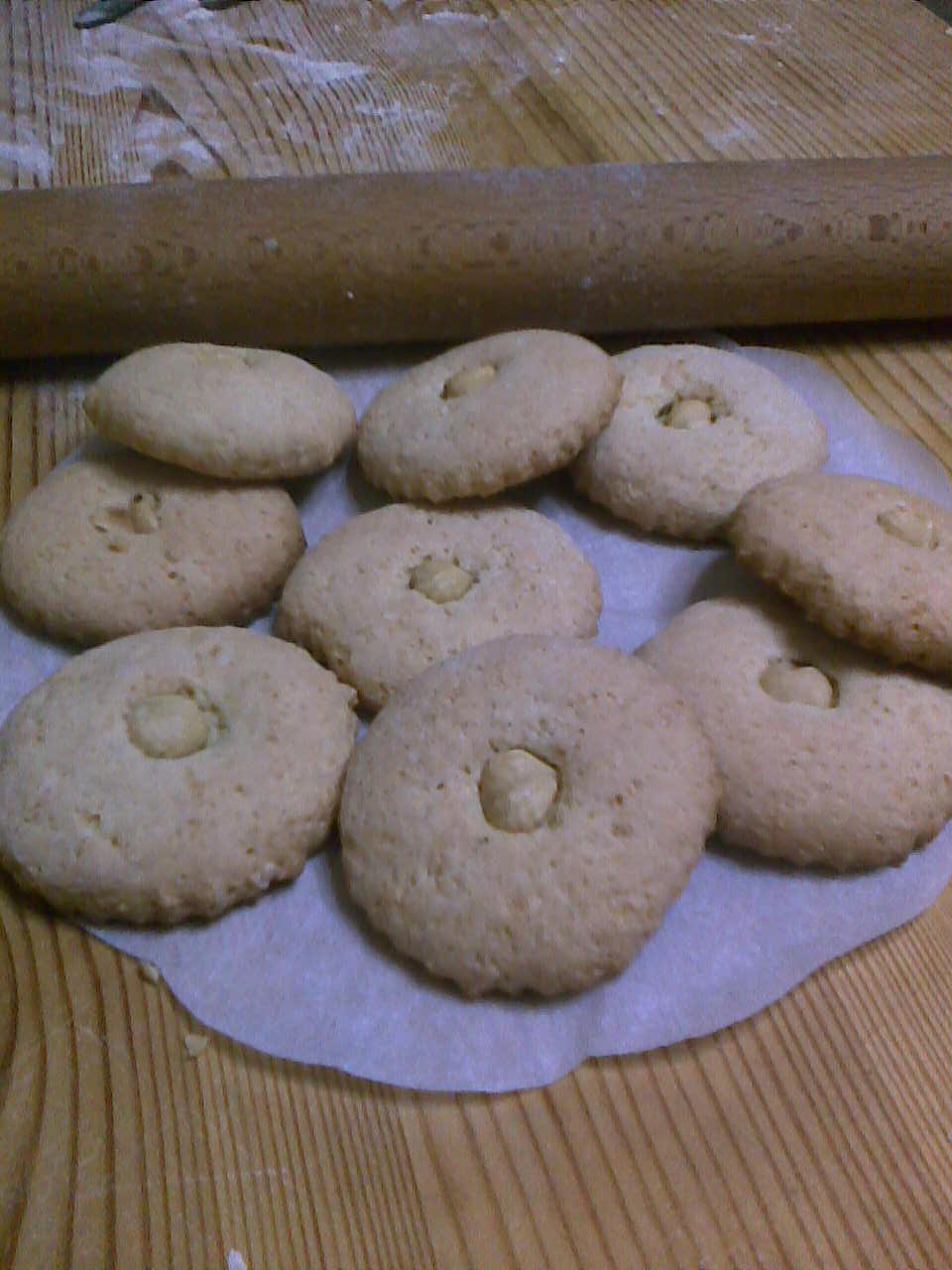
Here is the recipe for some really good cookies. The flavor reminds me of the cookies that I ate as a child, in the small town in Avellino where I grew up, during the Easter season. 

I was in the supermarket (in the baking goods aisle, where always go out of curiosity!!!), and I saw little bags of Bicarbonato di Ammoniaca [in English "baker's ammonia"], which according to the package was to be used as a leavening agent for making tea cookies. 

[Translator's note: Unlike American baking soda, which is sodium bicarbonate, this is ammonium bicarbonate.  The old-timers used baker's ammonia, which made cookies and crackers extra crispy. According to the King Arthur Flour website, "Baker’s ammonia (ammonium carbonate) is a classic leavener, called for in your grandmother’s or great-grandmother's recipes. Use in old-fashioned recipes calling for it (or for hartshorn)."]  

On back of the package there was even a recipe to make old-fashioned cookies without shortening.  I bought the package and tried the recipe.

Usually, for almost all cookies, I made the logs of dough, then slice them.  This time, however, I rolled out the dough and cut out the cookies, which I garnished with a toasted hazelnut.  

The flavor gets better after a day or two.  Try and see if you can resist them that long!


Ingredients: for c. 25 cookies

250 g flour
2 large eggs
150 g sugar
¼ teaspoon
ammoniaca (baker's ammonia)
milk if necessary

25 toasted hazelnuts

Preparation

On a cutting board, knead all ingredients except the hazelnuts. Roll out the dough to the thickness of 4 or 5 millimeters (between 1/4 and 1/8 of an inch).  Cut out the cookies with a cutter, and garnish each with a toasted hazelnut. Place the cookies on the baking sheet lined with parchment paper and bake at 350º for about 15 minutes.


Take out of the oven, let cool, and store in a cookie jar.  They will still be tasty even after a week.


***

Heartfelt thanks to all the contributors. And, suffice it to say, Buon Appetito!